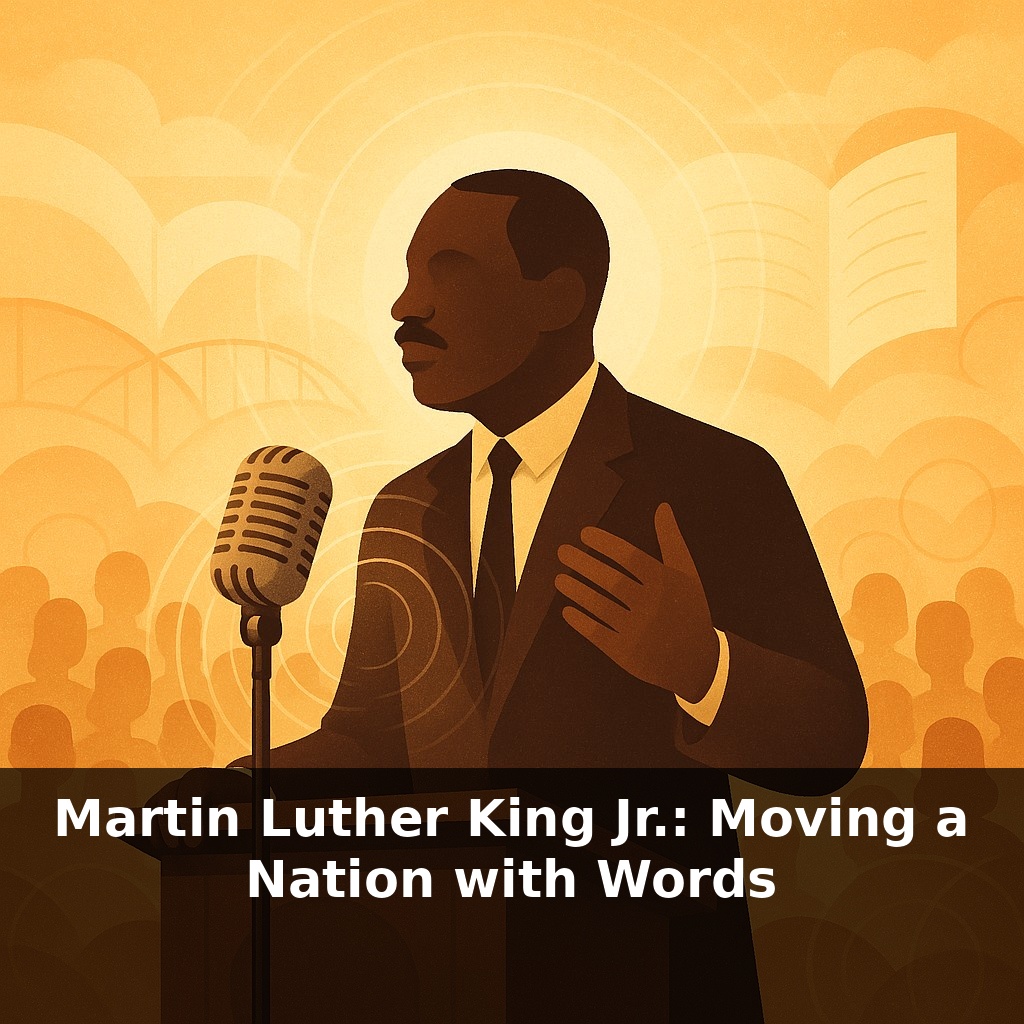
A single speech on a summer day helped push a nation toward new laws. But here’s the twist: most people never heard the full thing. They caught brief clips on TV—and still felt moved. How does a voice, filtered through a few seconds of broadcast, reshape history?
Most people know a few famous lines. What they usually don’t see is the grind behind them. King wasn’t just “inspired” on a podium; he was a working craftsman who shaped words the way an engineer shapes a bridge—testing strength, checking structure, refining until it could carry the weight of a nation’s hopes.
Between 1955 and 1968, he delivered thousands of speeches and sermons, often on little sleep, constantly adjusting language for church basements, union halls, and televised audiences. The moral urgency felt in those clipped TV moments came from this relentless rehearsal and revision.
In this episode, we’ll zoom in on how King: - Structured ideas so they were impossible to ignore - Used biblical cadence to make arguments unforgettable - Matched message, moment, and medium with strategic precision
King’s power wasn’t just in how he spoke, but in *when* and *where* he chose to speak. He stepped onto stages at moments of maximum tension—after brutal attacks in Birmingham, during the build-up to the March on Washington, as the nation watched Southern defiance on the evening news. His words didn’t float above events; they pressed directly on fresh wounds in the public conscience, turning private discomfort into public pressure that lawmakers could no longer ignore. Think of it as a kind of moral timing—hitting the national nerve precisely when it was already exposed.
King’s genius wasn’t only in *what* he said, but in how he made people *feel* the stakes in their bones.
He did this first through **concrete scenes**, not abstract slogans. Instead of saying “racial injustice persists,” he would say: “the Negro lives on a lonely island of poverty in the midst of a vast ocean of material prosperity.” That’s not a concept; it’s a picture. Listeners could locate themselves in it—either on the island or on the shore. Over and over, he pulled distant issues down to street level: a bus seat, a jail cell, a lunch counter.
Then he layered in **moral contrast**. King often paired two sharply different images in a single breath—“the dark and desolate valley of segregation” versus “the sunlit path of racial justice.” These juxtapositions did quiet psychological work: they made neutrality uncomfortable. You either walked toward the light or stayed in the valley; standing still suddenly felt like a choice.
He also leaned hard on **repetition as escalation**, not filler. Lines such as “Now is the time…” or “We can never be satisfied…” weren’t just catchy; each repetition slightly raised the demand, widened the circle of responsibility, or shortened the acceptable timeline. By the time he finished a sequence, audiences often found themselves nodding along to sentences they might have resisted if he’d opened with them.
Crucially, King tied individual stories to **systemic stakes**. A single child barred from a school became evidence of a national promise broken. He’d start with one community’s pain, then zoom out to the Constitution, the Bible, or America’s founding creed. That move—from local wound to national identity—turned sympathy into a question of *who we are*.
And all of this rested on a disciplined, confrontational non-violence. Marches, sit-ins, and boycotts were designed to force unjust systems to reveal themselves on camera. His words didn’t float above those confrontations; they interpreted them in real time, giving millions a vocabulary to name what they were seeing and a direction for what they should demand next—from leaders, from neighbors, and from themselves.
Across different audiences, King adjusted his language like a software engineer adjusting settings for different devices: same core program, different interface. In Southern Black churches, he drew on shared spiritual codes and local stories; with Northern liberals, he leaned more on constitutional promises and televised brutality they could no longer deny. At the March on Washington, he blended both, knowing cameras would carry his words far beyond the Lincoln Memorial.
He also shifted *scale* deliberately. In one breath he might speak to weary activists who’d been jailed, beaten, and ignored; in the next, to moderates watching from living rooms who feared “moving too fast.” His phrases often contained two invitations at once—courage for the committed, conscience for the cautious.
And underneath the poetry was a legal and strategic spine. “I Have a Dream” didn’t list bill numbers, but it prepared hearts to accept the Civil Rights Act and Voting Rights Act when the political window opened. The dream softened resistance before the details arrived.
King’s approach hints at a future where citizens need “x-ray vision” for inspiring language. As AI tools learn to mimic passion and conviction, the real test becomes alignment between words, risk, and sacrifice. In classrooms, students can dissect speeches the way coders review source code—tracing claims back to actions, coalitions, and tradeoffs. Activists worldwide already remix King’s patterns into local struggles, proving that borrowed rhythms still demand original courage on the ground.
King’s record isn’t just “I Have a Dream”; it’s years of late‑night edits, risky marches, and sermons shaped under threat. For anyone leading today, his life is a reminder that language matures like a long‑running conversation: tested in setbacks, revised after criticism, and strengthened every time real people answer back—or walk away.
Try this experiment: Pick a short message you care about (like fair treatment at work or safer streets) and rewrite it three times using MLK’s tools—first with vivid imagery (“I have a dream…” style pictures), second with a strong moral frame (“this is right/wrong because…”), and third with a clear, rhythmic refrain you repeat every 2–3 sentences. Record yourself giving each version out loud to your phone, just like a mini speech. Then play them back and ask two people to listen and tell you which version moved them most and why—that’s your personal data on which of King’s techniques land strongest for you.