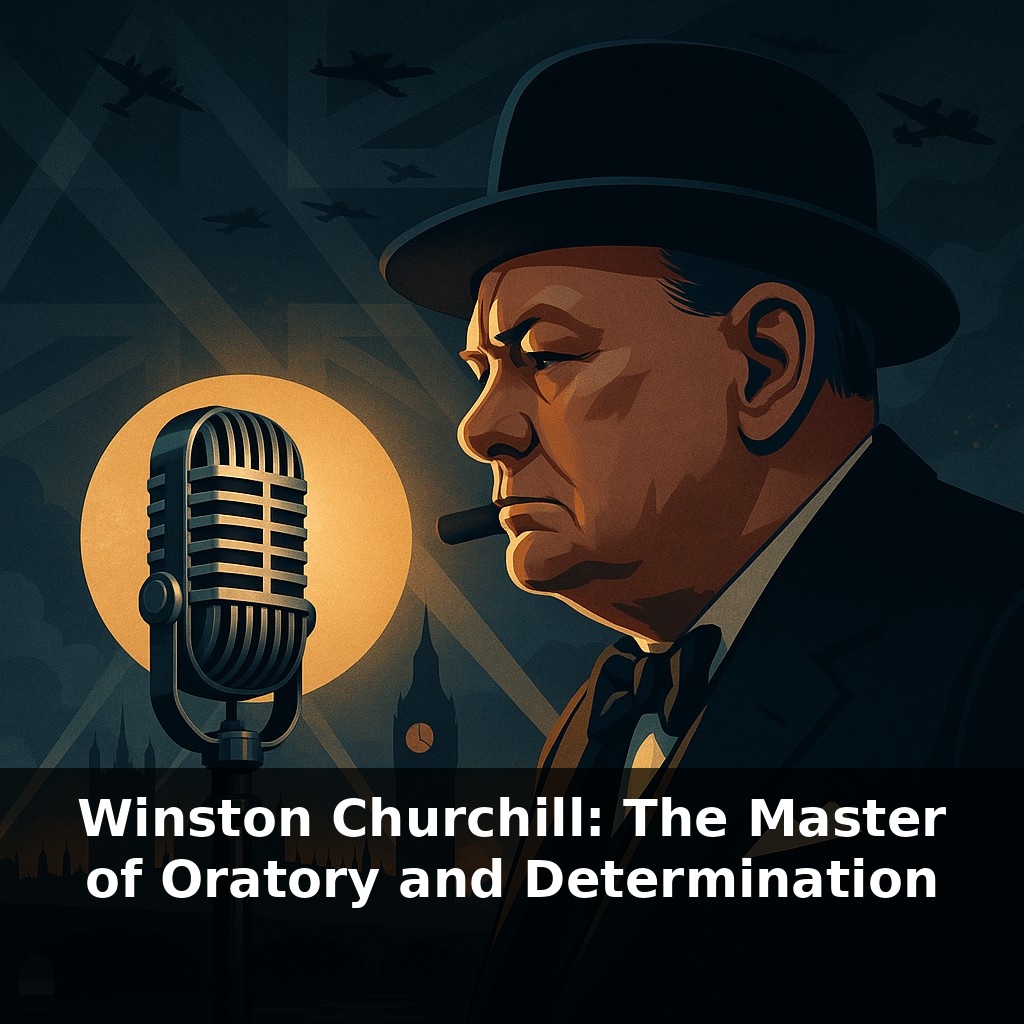
Winston Churchill: The Master of Oratory and Determination
📝 Transcript
Bombs fall over London, yet radios glow in living rooms across Britain. A single voice cuts through the blackout, turning fear into stubborn resolve. How does a politician, mocked for decades, suddenly become the sound that holds a nation together?
The curious thing is: Churchill wasn’t a natural, effortless speaker. Early recordings reveal a slightly lisping, almost theatrical delivery. Colleagues mocked his self-conscious phrasing. Yet by 1940, that same carefully constructed voice could steady millions of people who went to bed not knowing if their home would still be standing by morning. The transformation didn’t come from some mystical “gift,” but from years of deliberate craft—rewriting drafts by hand, testing rhythms out loud, trimming and tightening until each sentence hit like a hammer, then left just enough silence for the blow to register. His wartime addresses weren’t improvised pep talks; they were engineered experiences, built so that a factory worker on a night shift and a cabinet minister in Whitehall could both hear their own private doubts named—and then answered. To see how, we need to slow one of these speeches down.
So let’s zoom in on the moment when all that preparation collided with real danger: the summer of 1940. France had fallen with shocking speed, the British army had barely escaped at Dunkirk, and invasion seemed like a weather forecast—less a question of “if” than “when.” Newspapers carried maps of German advances like creeping storm fronts edging toward the Channel. In Whitehall, some senior figures quietly explored whether negotiated terms might be the least disastrous option. Churchill faced a double task: stop Hitler at Britain’s coastline—and stop defeatism at Britain’s doorstep.
Here’s where Churchill’s method becomes visible in the details. Take “We shall fight on the beaches,” delivered just after Dunkirk. The opening is sober, almost clinical: he lists lost guns, vehicles, men. No soaring phrases, just a controlled inventory of damage. Then, instead of pretending things are fine, he tightens the tension: the odds are harsh, the dangers real, invasion likely. Only after walking listeners to the edge does he pivot to the line everyone remembers.
That famous passage works because of structure and repetition. Each “we shall fight” stacks on the last, like waves hitting the same shore. The language is plain—no elaborate metaphors, no decorative flourishes. Short, concrete nouns: beaches, landing grounds, fields, streets, hills. A factory worker could picture each place; a general could picture how to defend it. This wasn’t theatre for its own sake. It was a way of quietly answering the question no one wanted to ask out loud: “What happens if the Germans actually get here?”
The same pattern shows up weeks later, as the air war intensifies. Behind the scenes, Churchill knows the numbers are brutal: a few hundred fighters against thousands of German aircraft, pilots flying multiple sorties a day. Publicly announcing that imbalance might have panicked people; hiding it would have insulted them. Instead, he narrows the spotlight. In “Their Finest Hour” and “The Few,” he turns an abstract air campaign into a human story about young pilots holding the line. By praising them so lavishly, he smuggles in the truth about how close-run the struggle really is—if “so many” owe so much to “so few,” then Britain is clearly fighting on a knife-edge.
Something similar happens in his private decisions. Even as he talks about “victory, however long and hard the road may be,” he is signing off on measures that accept that long, hard road: diverting scarce resources to Fighter Command, rejecting any approach that smells like a step toward terms with Berlin, writing long, insistent messages to Roosevelt to pry open American aid. The external message and the internal strategy are aligned: Britain will stand, but not by wishing; by grinding through.
He applied that same discipline to timing and audience. A lesser leader might have hoarded good news and buried setbacks. Churchill often reversed that instinct. When shipping losses spiked under U-boat attack, he didn’t pretend the Atlantic was safe; he admitted the danger, then connected it to specific actions—convoys, escorts, radar—that people could visualize. In factories, posters echoed phrases from his broadcasts, so that what workers heard at home turned into text they saw on the shop floor. It wasn’t just uplift; it was a feedback loop between words and work.
You can see the pattern in his handling of American opinion. He knew U.S. voters feared “another European war,” so he framed Britain not as a distant imperial power, but as the current line of defense for values many Americans claimed as their own. He seasoned private letters to Roosevelt with personal anecdotes, jokes, and historical allusions, like variations in a piece of music, returning always to a simple theme: help now, or pay more later.
Churchill hints at a template modern leaders still struggle to follow: fuse language, policy, and emotion so they move in step, like sections of an orchestra. Climate briefings, cyber warnings, pandemic updates often fail not for lack of data, but lack of narrative spine linking sacrifice to outcome. As speech patterns are mapped like brainwaves, we may learn why certain cadences steady crowds—turning “public morale” from guesswork into a measurable strategic asset.
Churchill shows that resolve isn’t just stubbornness; it’s choosing hard clarity over comforting fog, then returning to it, day after day. Modern leaders facing pandemics, blackouts, or market crashes need similar verbal storm shelters—places where people can stand, see the damage plainly, and still hear a horizon described as worth walking toward.
Here’s your challenge this week: Choose one of Churchill’s famous speeches (like “We shall fight on the beaches” or “Their finest hour”), read it out loud twice, then rewrite a 2-minute version in your own words aimed at a modern audience facing a tough situation in your life or work. Record yourself delivering your new speech standing up, at full voice, using Churchill-style cadence (short, punchy phrases, deliberate pauses, and repeated key lines). Then play it back, pick one sentence to sharpen into a powerful rallying cry, and use that exact sentence once each day this week to encourage your team, family, or yourself when things get hard.
Unlock all episodes
Full access to 5 episodes and everything on OwlUp.
Subscribe — $1.99/monthLess than a coffee ☕ · Cancel anytime