A man with no military training personally overrules his generals—and wins lightning victories across Europe. For a brief moment, it looks like pure genius. Then his own rigid beliefs start dictating every move, turning early triumphs into the seeds of catastrophe.
Hitler’s power didn’t rest only on speeches or terror; it rested on a story he told about the world—a story where history was a brutal struggle between “races,” and Germans were destined either to dominate or be destroyed. That myth shaped everything from school textbooks to factory quotas. Ordinary choices—what to teach a child, which factory to fund, which border to cross—were pulled into its orbit like iron filings to a magnet.
As his control tightened, the gap between reality and his worldview widened. Economic limits, resource shortages, even battlefield reports were filtered through what he wanted to be true. Those who tried to introduce unwelcome facts faced dismissal or worse, so many simply stopped trying. Step by step, policy became less about what Germany could realistically do, and more about proving his story right, no matter the cost.
Inside that closed information bubble, Hitler’s regime began to rewire Germany’s priorities. Budgets, factories, and research labs were quietly redirected like river channels cut into new beds. Consumer goods disappeared from shelves as rearmament soaked up resources; by 1939 more than a fifth of Germany’s economic output fed the war machine. Propaganda framed these sacrifices as necessary steps toward a looming showdown. At the same time, foreign policy turned sharper—testing borders, treaties, and rivals—probing for weaknesses the way a climber tests holds on a cliff before committing to a dangerous ascent.
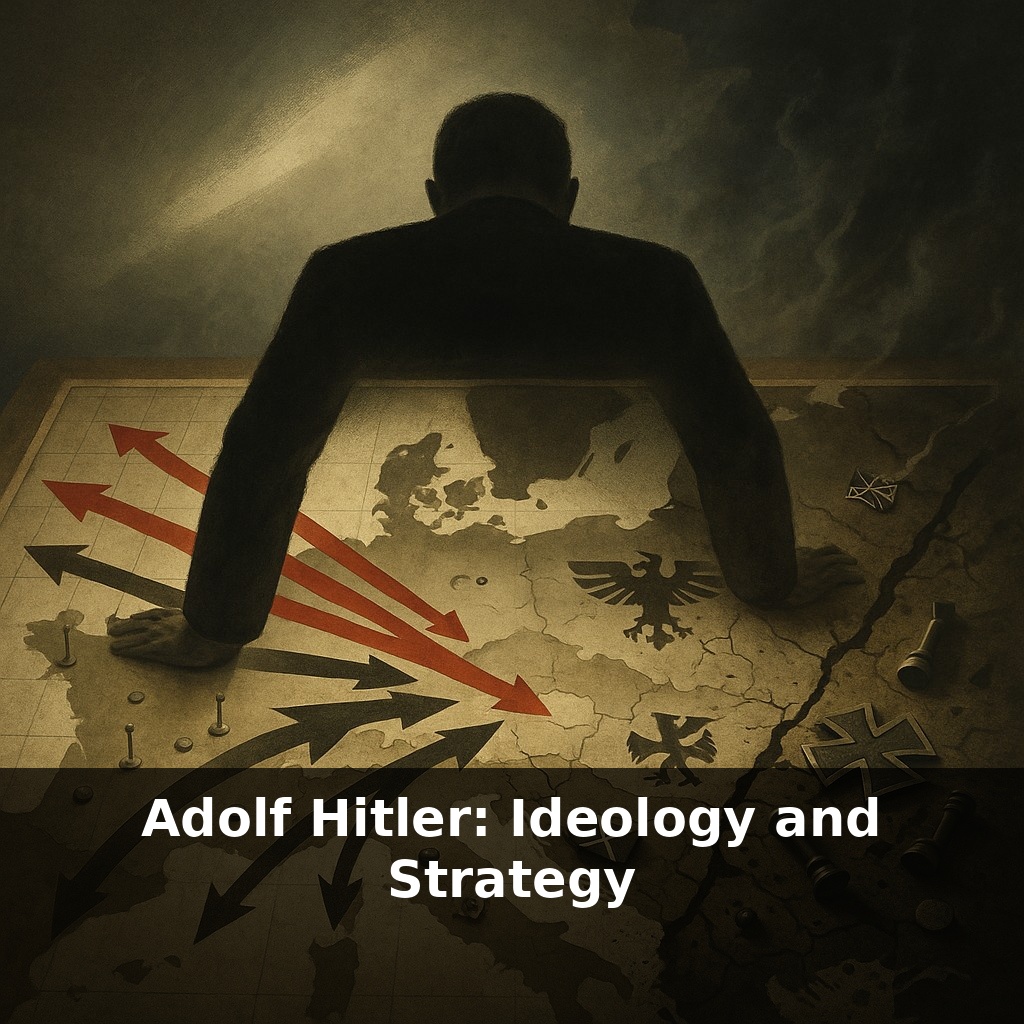
The story that guided Hitler didn’t stay abstract; it translated into a tight set of priorities that decided who mattered, who didn’t, and what risks were acceptable. At the top sat territorial expansion. Not just any expansion, but conquest aimed at creating “living space” in the east. Maps in planning rooms weren’t just military diagrams; they were blueprints for who would farm which field, who would be pushed off it, and who would never be allowed to return.
This meant that diplomacy was never truly about compromise. Agreements with neighbors or great powers were treated as temporary tools, held only as long as they served the larger racial and territorial agenda. The pattern is visible: reassurance, demand, escalation, and then, when resistance seemed weak enough, a sudden leap forward across a border. Each successful leap encouraged the next, larger one.
Inside the regime, power structures evolved to serve this drive. Institutions overlapped, not by accident but as a method of control. Party officials, state bureaucrats, SS leaders, and military officers found their jurisdictions colliding. Instead of a clean hierarchy, there was constant competition for access to Hitler and for the chance to turn his broad slogans into concrete programs. Initiative tended to flow upward: ambitious subordinates anticipated what ideological direction he favored, then raced to implement it more thoroughly than their rivals.
The result was an odd mix of chaos and focus. On paper, multiple agencies might claim the same task; in practice, the ones that aligned most aggressively with core goals—expansion, racial engineering, war readiness—gained resources and license to push further. Projects that didn’t fit those priorities struggled, no matter how practical they seemed. The state behaved less like a single, coordinated machine and more like a series of currents, all tugging toward the same destination but often colliding on the way. For a time, that collision produced energy and momentum. It would later magnify every miscalculation.
In practice, that meant decisions often followed ideological “shortcuts” instead of careful planning. When synthetic fuel projects promised independence from foreign oil, they were fast-tracked not mainly for technical merit, but because they seemed to prove that willpower could beat material limits. Colonization offices drafted detailed schemes for German settlements in places they did not yet control, allocating future farms, schools, and rail links as if the map were already theirs. Security forces, competing to appear most reliable, escalated persecutions without waiting for direct orders, assuming that harsher measures would be welcomed.
This dynamic also shaped alliances. Italy, Japan, and smaller partners were judged less by realistic military value than by how well their cooperation appeared to confirm the regime’s worldview. When their interests diverged—over strategy, resources, or timing—Berlin’s leadership struggled to adjust. Concessions looked like weakness; compromise sounded too close to doubt. Over time, the gap widened between what the system expected the world to do and how other states and societies actually behaved.
Hitler’s system shows how organizations can drift when no one is rewarded for saying “stop.” When careers depend on confirming the boss’s story, errors don’t vanish—they sink like silt to the bottom of a river, quietly shifting its course until the water suddenly floods the banks. In modern states and AI systems, this risk grows when feedback is one-way. The more tightly one mind grips the wheel, the less anyone dares to tap the brakes when the road bends.
So the question lingers: what happens when a whole system orbits one mind? In Hitler’s case, loyalty mattered more than results, and doubts were treated like disloyalty. It’s a pattern that can recur anywhere power concentrates—boardrooms, parties, even online communities—when correcting course feels riskier than staying wrong.
Here’s your challenge this week: Choose one specific element of Hitler’s ideology from the episode—such as his use of antisemitic conspiracy myths, the “Führerprinzip” (leader principle), or the Volksgemeinschaft (racial people’s community)—and spend 20 minutes tracing where you see that *exact* pattern echoed in two modern sources (a news article, a politician’s speech, or a social media post). For each source, underline the phrases that mirror the episode’s examples of dehumanization, absolute obedience, or scapegoating and jot a one-sentence note on how the framing is similar. Then, tell one other person about one of these parallels in a 5-minute conversation, explaining why recognizing this pattern early matters for resisting extremist politics today.