Bombs are falling on London. Tanks grind across Eastern Europe. And in a quiet room in Washington, one man is sketching a plan for a world that doesn’t exist yet. Here’s the twist: he’s choreographing battles he’ll never see—while designing the peace that must follow.
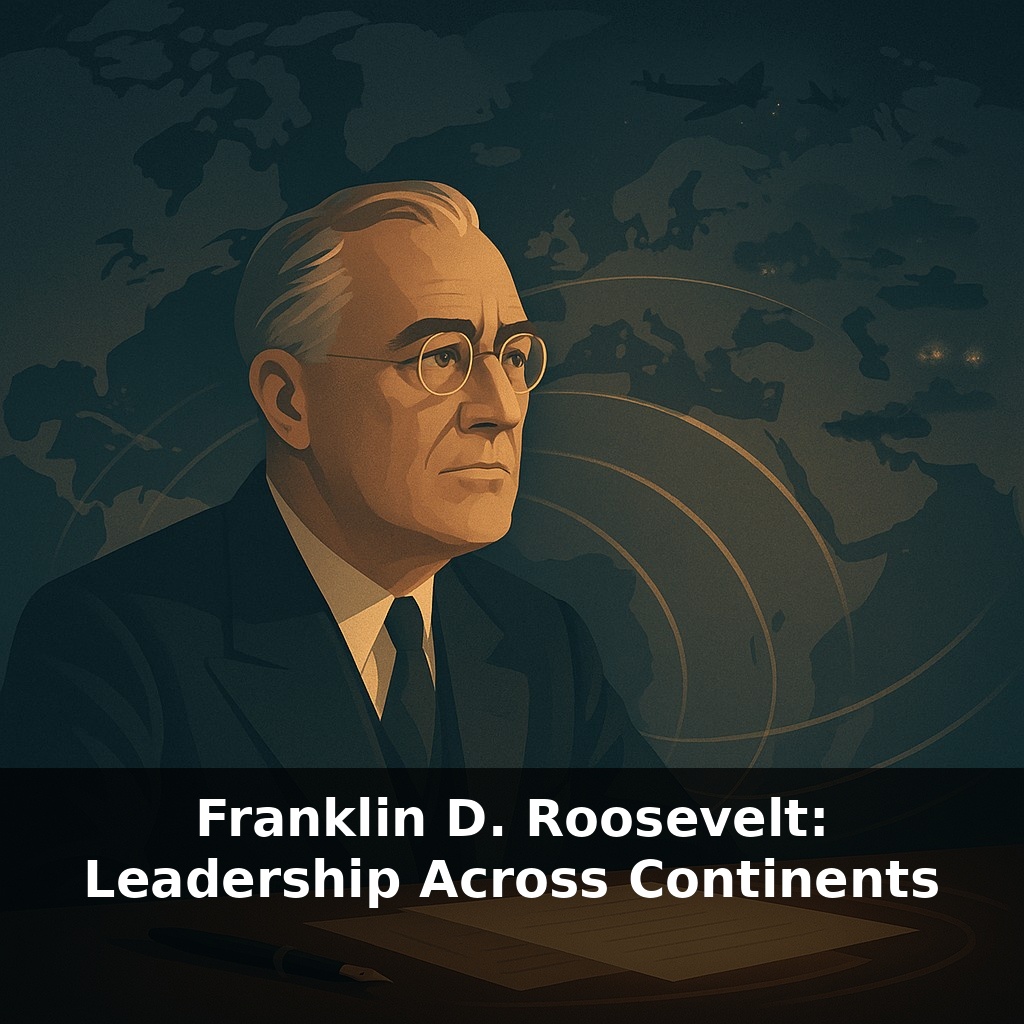
Franklin D. Roosevelt is easy to picture behind a desk, signing papers. But to understand his real impact, you have to think wider: this was a president who treated geography almost like wet clay. He bent distances, blurred borders, and tried to make continents talk to each other in new ways. While most leaders focused on winning their own front, FDR kept asking a larger question: How do you turn separate wars in Europe, Asia, and the oceans into one coordinated effort—and then turn that effort into a stable peace?
That’s why he wasn’t just moving armies; he was rearranging relationships. Old empires, new superpowers, and fragile governments-in-exile all had to be balanced so none collapsed at the wrong moment. His challenge was less like drawing a battle line and more like aligning moving tectonic plates: shift one alliance too far, and the whole landscape could crack.
Roosevelt’s solution was to fuse domestic power with overseas leverage. He first had to turn a wounded, semi-isolationist America into what one adviser called “the arsenal of democracy,” then plug that arsenal into four very different partners: Britain, the Soviet Union, China, and a patchwork of smaller governments. That meant more than signing Lend-Lease bills. It meant creating new habits: weekly Anglo‑American strategy meetings in Washington, constant back‑channel messages to Moscow, and quiet reassurances to anxious allies that U.S. factories—and voters—would stay in the fight until the job was done.
Roosevelt’s first move was not to send troops, but to move money, machines, and trust. He turned factories into quiet diplomats. A Detroit assembly line that once stamped car parts now turned out aircraft and jeeps whose destination decided more than any speech: a shipment to Britain signaled endurance, to the Soviet Union signaled grudging partnership, to China signaled that Asia wasn’t an afterthought. Each crate crossing the Atlantic or the Pacific was a promise with a serial number.
To keep those promises aligned, FDR experimented with structures that had barely existed before. The Combined Chiefs of Staff in Washington were not just a meeting; they were an early prototype of integrated command. British and American planners argued over priorities, resources, even personalities—but they did it in the same room, over the same maps. That constant friction created something unusual for great powers: shared habits. Once generals accept a joint timetable, it becomes harder for politicians to drift apart.
With Moscow, the tools had to be different. There were no conferences in plush hotels at first, just cables crossing an abyss of suspicion. Roosevelt understood that timing mattered as much as content. He sent reassurances when Soviet losses were highest, pressed for information when offensives were forming, and held back on confrontations he knew he couldn’t enforce yet. The messages themselves were short; the real work was in deciding when to push, when to flatter, and when to simply acknowledge pain without promising miracles.
China added another layer of complexity. Its battlefield performance was uneven, its politics fractured, yet its symbolism as a major Asian partner mattered for the postwar map. Roosevelt elevated it deliberately—inviting Chinese leaders into big‑power discussions, supporting them enough to keep them in the game, but not so much that they could veto broader plans.
Underneath all this ran a simple constraint: American voters. Every foreign commitment had to be sold at home without triggering a backlash. Roosevelt’s speeches stitched together unemployment figures, production targets, and battlefield updates into a single story: that jobs in Ohio and ships in California were directly linked to villages in France or islands in the Pacific. That narrative discipline was its own kind of logistics, moving consent as carefully as cargo.
Roosevelt’s real experiments show up in the small, unglamorous decisions. Think of how he handled priority disputes: when Britain wanted more landing craft for the Mediterranean and U.S. generals pushed for the Pacific, FDR sometimes delayed a verdict by a week—not out of indecision, but to let tempers cool and new intelligence arrive. He treated time as a resource, not just troops or steel.
He also tested ideas in miniature before scaling them. The first integrated planning cells in Washington were tiny: a handful of colonels swapping draft plans. Only after those pilots proved they could survive bruising arguments did Roosevelt expand them into full Combined Chiefs structures. Today you see echoes of that method when NATO runs joint exercises in Eastern Europe or when G‑20 finance ministers coordinate stimulus in a downturn—small, repeatable routines that, over time, make separate governments behave a bit more like branches of a sprawling, uneasy team.
FDR’s playbook hints that future leaders will need to treat institutions less like monuments and more like evolving software—patched, updated, sometimes rolled back. In a pandemic or cyber crisis, that means standing up ad‑hoc teams that can cut across borders faster than treaties. His mix of charisma and structure suggests a test for modern politicians: can they win elections at home while quietly wiring their country into systems built to outlast them?
Roosevelt’s real legacy may be less the institutions he named than the habits he normalized: crisis calls made across time zones, trade-offs argued over shared maps, futures drafted before the shooting stopped. Like gardeners swapping seeds across fences, today’s leaders inherit his unfinished rows—and decide what still deserves to grow.
Try this experiment: For the next seven days, run your team or household like FDR’s “fireside chats” by holding a 10‑minute end‑of‑day huddle where you calmly explain one decision you made, why you made it, and what it means for everyone tomorrow—no speeches, just plain language. Before the huddle, borrow FDR’s habit of gathering diverse input by asking two very different people (e.g., an optimist and a skeptic) for quick opinions on the same issue, then test how combining their views changes your decision. Track what happens: Do people ask fewer anxious questions? Do they volunteer more ideas? At the end of the week, ask the group one focused question—“Should we keep doing this, and if so, what should we change?”—and decide on a simple version 2.0 of your “fireside chat” leadership.