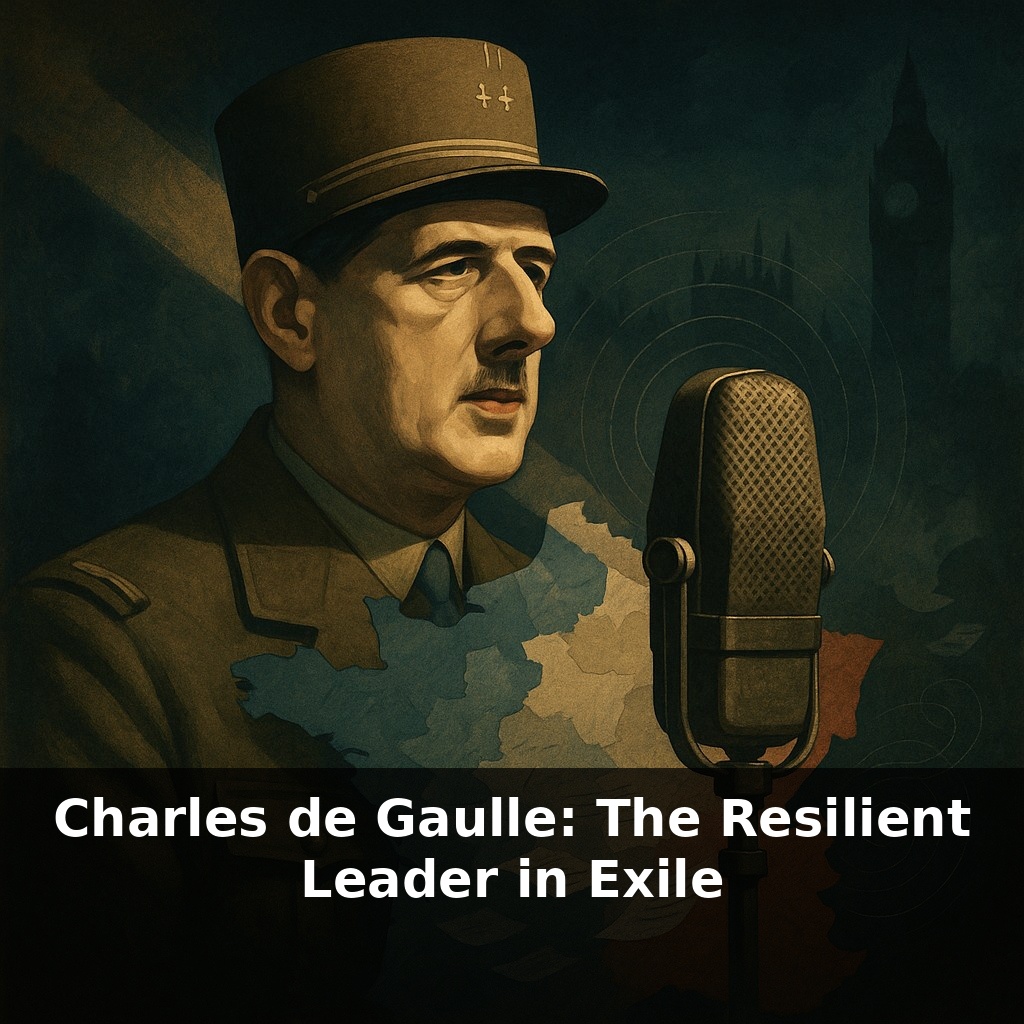
A defeated general, alone in London, speaks into a BBC microphone—and only a fraction of France hears him live. Yet within days, his forbidden words are copied by hand, passed in cafes, hidden in loaves of bread. How does a voice in exile become the backbone of a broken nation?
By late 1940, de Gaulle was not just a distant voice; he was trying to assemble a state without territory, a government made of fragments. Officers trickling in from defeated units, sailors who’d slipped away from Vichy-controlled ports, colonial leaders weighing their options—all of them had to decide whether this exile in London truly represented France. His task looked less like commanding an army and more like grafting a damaged branch onto a new rootstock: preserving the living core while changing everything around it.
He had no parliament, no elections, no obvious legitimacy—only the claim that France could not surrender because the French people had never voted to stop existing. From that claim flowed a strategy: weld scattered resistance groups and overseas territories into something that could stand beside Britain and, eventually, the United States as a partner rather than a charity case.
His problem wasn’t only military—it was psychological and symbolic. Vichy claimed the trappings of legality, Nazi banners covered French prefectures, and many citizens tried to survive by keeping their heads down. De Gaulle had to contest not just who ruled France, but what “France” meant. Was it the signatures on the armistice, or the millions who’d never had a say? To shift that answer, he leaned on radio, stubborn protocol, and the slow conversion of colonies and commanders, each defection like a new light switching on across a darkened map.
De Gaulle’s first problem was numbers. In mid‑1940, barely a few thousand men had followed him; Vichy still commanded fleets, armies, and almost all colonies. Most French officers viewed him as a reckless brigadier who had abandoned discipline. His answer was not to soften his stance, but to raise the political stakes. Every officer he courted in Africa or the Levant was pushed to decide: are you loyal to a government that signed an armistice, or to a nation that hasn’t been asked? That moral framing turned defections into declarations of principle, not just moves on a chessboard.
Colonial leaders felt the pressure most sharply. Rallying to de Gaulle meant risking German or Vichy retaliation and betting that this marginal general would somehow end up on the winning side. When territories like Chad, Cameroon, and later parts of French Equatorial Africa chose him, they didn’t just swell his troop lists; they gave him taxes, ports, and airfields. Free France began to look less like a club of dissidents and more like an alternate state with its own resources and flag.
As his forces grew—from a few thousand to hundreds of thousands by 1945—he also had to solve a different problem: coherence. Resistance movements inside France were local, ideological, often suspicious of one another. Many resented any “London” authority. By backing envoys like Jean Moulin to unify these groups under a single national council, de Gaulle aimed to ensure that when liberation came, there would be one French voice claiming to speak for the maquis, not a cacophony that invited Allied trusteeship or civil war.
All this made him an awkward ally. Churchill saw his value but bristled at his demands; Roosevelt distrusted him and flirted with rival French leaders. De Gaulle responded by behaving publicly as though France were already a co‑equal power: insisting on protocol, arguing over flags, refusing to be treated as a junior partner. It looked petty to some contemporaries, yet that stubborn choreography paid dividends. When Allied armies crossed into Germany, France had a recognized committee, recognizable forces in the field, and a clear claim to sit at the victors’ table—claims the Allies ultimately ratified with an occupation zone and a permanent UN Security Council seat.
De Gaulle’s leadership in exile is easiest to grasp through what he refused to do. He would not create a party machine around himself, even though it might have simplified control. That choice matters: it prefigured the later Fifth Republic, where the presidency stands above parties rather than merely riding them. Nor would he accept Allied plans that treated France as a liberated territory to be administered, rather than a state returning from eclipse. In 1943–44 he fought, memo by memo, for French civil authorities to land in Normandy right behind the troops, so that liberated towns met French mayors, not Allied military governors.
Think of his method as closer to composing a piece of music than commanding a drill parade: he set the key and tempo—national sovereignty, republican legality—and then forced wildly different “instruments” (Gaullists, socialists, conservatives, communists, colonial elites) to play within that framework. The harmonies were tense and often dissonant, but they added up to something the Allies could not easily ignore: a recognizable French state ready to resume power.
De Gaulle’s legacy now works like a pressure system shaping today’s political weather. Movements from Warsaw to Taipei study how he stitched legitimacy together before regaining a capital. His blend of stubborn independence and selective cooperation haunts debates on EU defense, data sovereignty, even space policy: how far can a state plug into shared structures yet still steer its own course when crisis hits, without a de Gaulle figure at the helm?
De Gaulle’s years on foreign soil also rehearsed his later domestic role: testing how far a leader can pull a country toward unity without erasing argument. His stubborn line gave postwar France not just prestige but a template. Like a river cutting through rock over time, his example invites us to ask: which principles do we keep carving toward, even under pressure?
Try this experiment: Pick one project where you feel like a “government in exile” at work—no authority, no backing—and, for one week, act like de Gaulle broadcasting from London. Each morning, record a 60-second voice memo (on your phone) as if you were giving a “Free [Your Team/Project]” address: clearly state the goal, what you’re refusing to compromise on, and one concrete step you’ll take that day without waiting for permission. Then share one focused “appeal” with a specific ally each day (a short DM or email asking for a precise support action, like a test, intro, or resource), just as de Gaulle courted the British and the Resistance. At the end of the week, compare: how many new allies, resources, or opportunities emerged versus weeks when you stayed quiet and compliant?