A wall less than 200 kilometers long once helped divide nearly an entire continent. In one part of a single city, crossing the wrong street could turn you from citizen into criminal. How did a metaphorical “curtain” harden into concrete, barbed wire, and armed guards?
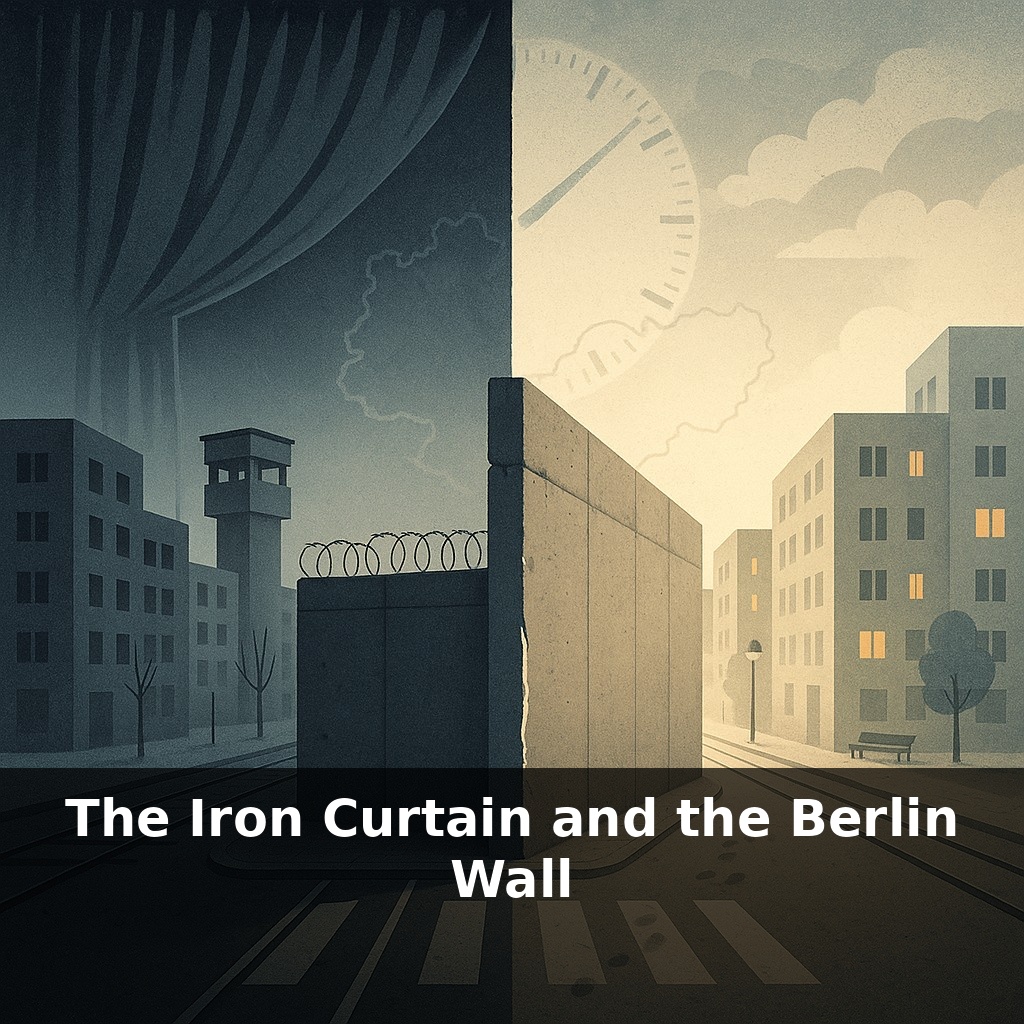
For people living on either side, this new barrier wasn’t introduced with a grand announcement—it arrived like an overnight change in the weather. One day, Berlin was a city where families, jobs, and tram lines crossed the urban map without a second thought; the next, routes that had felt as ordinary as a morning commute were abruptly severed. The Iron Curtain’s most visible segment in Berlin did more than redirect traffic: it rearranged life paths. College choices, careers, even whom you could marry were suddenly tied to where you happened to wake up that August morning in 1961. Western news, music, and consumer goods still seeped through cracks in this system, but every such crossing now carried risk. To understand the Cold War, we have to zoom in on those daily negotiations—how border guards, factory workers, and students adapted to a city split by concrete and ideology.
The split didn’t begin with concrete; it began with decisions in distant conference rooms. After 1945, victorious Allies carved Germany into occupation zones, like musicians dividing a score into separate parts. Berlin, deep inside the Soviet zone, was also split four ways, turning the city into a tiny island of shared control. As cooperation soured, two German states emerged in 1949: the capitalist Federal Republic of Germany in the West, and the socialist German Democratic Republic in the East. Berlin, technically shared, became the fault line where both systems tried to prove they were the future.
In the early 1950s, the line between East and West inside Germany looked porous on a map but felt increasingly edged with warning signs. Barriers went up in stages: watchtowers here, a minefield there, new border troops with orders that grew more severe each year. Step by step, moving westward from much of Eastern Europe turned from bureaucratic hassle into near impossibility. By the late 1950s, almost the entire inner-German frontier had become a multi-layered security zone—fences, patrol tracks, signal wires, floodlights—stretching for more than a thousand kilometers. Yet Berlin remained a glaring exception: its city streets formed one of the last open doors.
People noticed. Between 1949 and 1961, millions left through that urban gap, often by simply taking a commuter train to West Berlin and then a flight to Frankfurt or Hamburg. The ones leaving weren’t random. Doctors, engineers, teachers, skilled factory workers—exactly the people an ambitious socialist project needed—were overrepresented among the departures. Each defection carried two kinds of loss: a missing professional at home and a living billboard abroad saying, “I trusted my future more on the other side.”
By 1960–61, the numbers turned into a crisis. Entire hospital departments in the East found themselves short-staffed. University classrooms lost lecturers just weeks before term. Housing statistics showed apartments emptying faster than the state could reassign them. Leaders in East Berlin framed the situation as “republic flight,” a betrayal that weakened collective progress. Inside increasingly tense meetings with Moscow, they pushed for permission to slam the remaining door.
The decision to seal Berlin came together not as a single dramatic command, but as a series of calculations about risk, prestige, and timing. Soviet and East German officials weighed international outrage against the fear that, left unchecked, the outflow would hollow out the system from within. They worried less about spies slipping in than about their own population silently voting with their feet.
When orders finally crystallized in August 1961, the first night’s work looked crude: barbed wire, armed guards, improvised roadblocks. Yet even this rough line sent an unmistakable signal. What had long been a political border was now a personal one, drawn through friendships, careers, and family trees. Within a few years, that provisional line hardened into a dense complex of walls, ditches, dog runs, and bunkers, turning a city’s edges into one of the most heavily monitored frontiers on earth.
At street level, the new border felt less like a line on a map and more like a constantly shifting weather front. One apartment block might have its front door in the East and its back courtyard facing the West. A bakery whose regulars once came from every direction suddenly lost half its customers overnight, while a nearby kiosk saw business surge because its windows happened to open toward the remaining tram stop. Some Berliners quietly adjusted their routines—taking longer routes, timing walks to avoid patrol shifts—like city-dwellers learning to read a complicated train timetable.
Culture followed these improvised pathways. A song played on Western radio could drift across balconies and courtyards, picked up by listeners who turned dials carefully to avoid attention. Western TV antennae pointed toward stronger signals, creating rooftop forests of metal that doubled as subtle acts of resistance. Each escape attempt—tunnels, forged papers, improvised hot-air balloons—became a kind of whispered urban legend, retold at kitchen tables as both warning and inspiration, proof that the new order was powerful but not absolute.
Borders today increasingly live in code, cables, and curated feeds. Instead of barbed wire, think algorithmic filters deciding which news crosses your screen and which never appears. That shift matters: future tensions may hinge less on tanks at checkpoints than on who controls platforms, standards, and data routes. Your challenge this week: map the invisible “walls” in your own media diet—note which sources you never see, then ask whether that absence is by design or by choice.
The lesson of these vanished borders isn’t just that walls fall, but that they’re constantly drafted, edited, and redrawn by ordinary choices. Like a river quietly shifting its course, small decisions—what to broadcast, whom to trust, where to stand—gradually reshape the banks. Power lines may change, yet the human urge to look over the next horizon persists.
Before next week, ask yourself: 1) If I had lived in East Berlin in 1961, what everyday freedom I take for granted now—travel, media, friendships across borders—would I most fear losing, and how would that change the way I move through my day today? 2) Looking at my own life, where do I see “invisible walls”—social, ideological, or digital echo chambers—that quietly separate me from people on the other “side,” and what’s one concrete conversation or source (a book, article, or person) I could seek out this week to peek over that wall? 3) When I hear leaders justify restrictions “for security” the way Soviet and East German officials did, how do I decide whether that’s legitimate protection or a creeping Iron Curtain, and what specific question will I ask—or piece of evidence I’ll look for—next time I encounter a policy like that in the news?