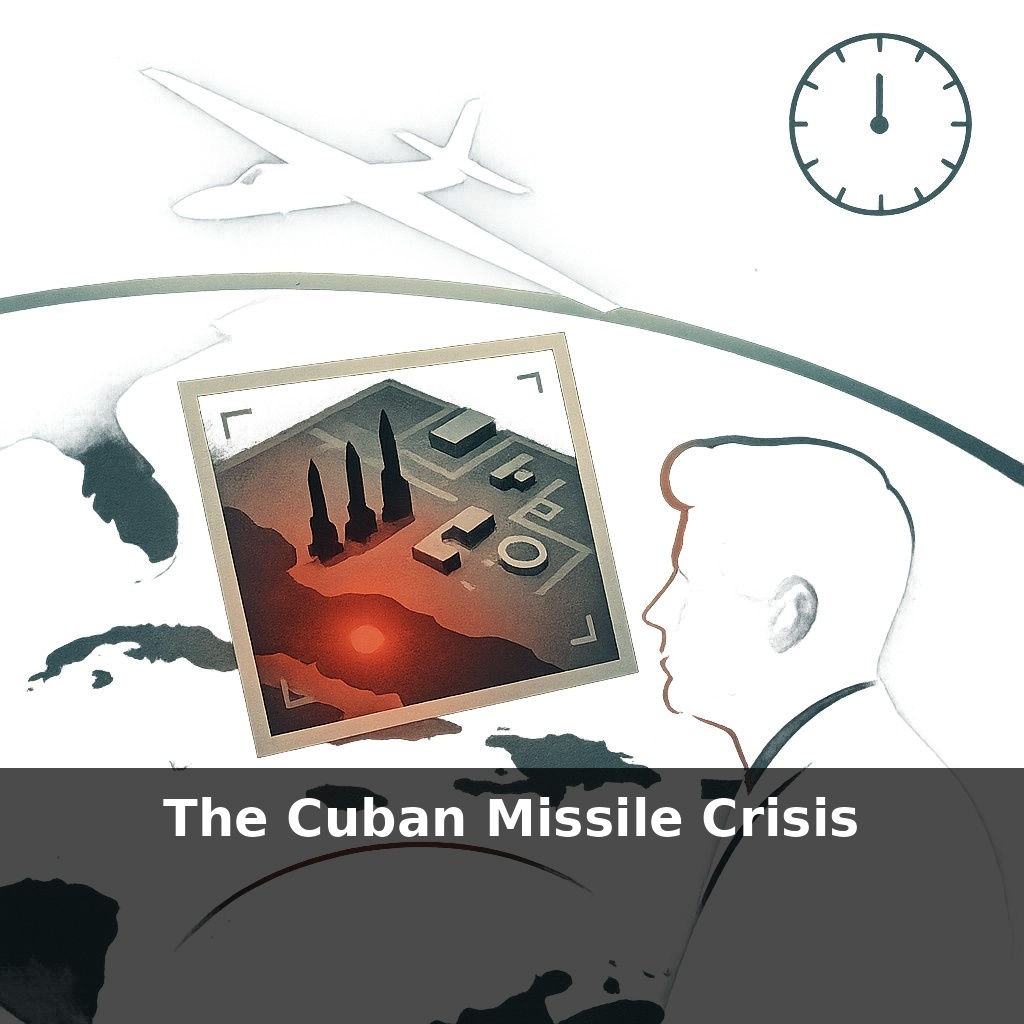
A single U‑2 spy plane photo, taken on an ordinary October morning, suddenly revealed nuclear missiles just a short flight from Miami. In that moment, routine reconnaissance turned into a countdown. How do two rival superpowers step back when the world is already at the edge?
Kennedy’s advisors crowded into the Executive Committee—ExComm—room, faced with options that all looked terrible: do nothing and appear weak; strike the sites and risk war; or attempt something in between. The photos were only the starting gun; now every word, every pause, every memo could tilt the balance. While the public heard almost nothing, inside Washington and Moscow, messages crossed like storm fronts: official cables, private letters, confusing hints, and hard threats. Some generals pressed for an air strike, convinced time was running out. Others argued that the more you rush a crisis, the less control you really have. Meanwhile, Castro watched from Havana, furious at being treated as a pawn, wondering whether his island would become a battlefield—or a bargaining chip no one would admit to using.
Kennedy quietly chose a public “quarantine” of Soviet ships—technically not a blockade, which would have been an act of war in legal terms. As U.S. vessels moved into position, the real battle shifted to timing and perception. Moscow claimed the missiles were defensive; Washington published photos to rally allies and pressure Khrushchev. NATO partners worried they might be dragged into a conflict they hadn’t scripted. In Havana, anti-aircraft crews stayed on alert, while ordinary Cubans queued for food and rumors, sensing that distant decisions might land on them like an unexpected storm.
The real drama of those October days unfolded in overlapping layers, some public, many hidden. While television showed Kennedy’s calm announcement and maps of circles reaching across the U.S., ExComm was split: “hawks” argued the missiles had to be destroyed before they could fire; “doves” warned that bombing Cuba might kill Soviet personnel and trigger the very war everyone feared.
Khrushchev, under pressure from his own military, pushed ahead with deployments already underway. Soviet commanders in Cuba had tens of thousands of troops and a range of weapons, including tactical nuclear arms intended for use on the island or nearby forces. Crucially, some of that nuclear authority sat closer to the front lines than leaders in Washington realized. The danger wasn’t just a deliberate decision in Moscow or D.C., but a misjudgment by a local officer who thought war had already begun.
Then the signals from Moscow turned contradictory. On 26 October, a long, emotional, almost pleading private letter from Khrushchev suggested a deal: remove the missiles if Washington promised not to invade Cuba. The next day, a harsher public message demanded something more concrete: get U.S. missiles out of Turkey. Kennedy’s team now had two incompatible offers on the table and no clear way to know which one truly reflected Soviet intentions.
At the same time, military routines kept grinding forward. U.S. forces went to DEFCON 2, the highest alert short of war. A U‑2 was shot down over Cuba, killing Major Rudolf Anderson Jr., and many in the room saw it as a possible opening move in a larger attack. Another U‑2 strayed into Soviet airspace over the Arctic, nearly sparking a separate confrontation. It was like a tightly stretched orchestra, where one wrong note from any instrument could throw the entire performance into chaos.
The eventual solution hinged on reading intention through noise. Kennedy publicly answered Khrushchev’s softer first letter, accepting the non‑invasion trade, and privately signaled that the obsolete Jupiters in Turkey would quietly disappear within months. That dual track—open firmness, secret flexibility—offered Khrushchev enough to back down without openly losing face, and gave both men a way to claim they had protected their countries’ security.
Kennedy and Khrushchev weren’t just bargaining over weapons; they were trying to read each other’s limits without forcing a public humiliation. Think of two conductors sharing a single orchestra: each can cue their own section, but the music only holds if they sense what the other is about to do and quietly adjust. During the crisis, both leaders used “signals” beyond formal notes—tone of letters, speed of replies, even which officials spoke on radio—to test how far they could move. A softer message from Khrushchev late on 26 October hinted he needed an exit; the harsher public note the next day showed he also had to appease hardliners. Kennedy’s choice to answer the softer message first was like picking which melody the orchestra should follow and letting the other fade into background noise. This episode later shaped nuclear “hotlines,” arms‑control talks, and a shared understanding that, in a nuclear age, managing fear and misperception could matter as much as counting warheads.
Today’s crises unfold faster: algorithms trade in microseconds, drones cross borders in minutes, leaders react on social media in real time. The 1962 standoff hints that survival now depends on building “shock absorbers” into this system—redundant hotlines, shared protocols for incidents at sea or in space, drills that rehearse restraint, not just retaliation. Your challenge this week: notice whenever a headline rewards outrage over patience—and ask what a slower, 13‑day response might look like instead.
The lesson isn’t that leaders were brilliant, but that systems barely held. A lone submarine captain, a jittery radar operator, or a misread cable could have tipped history. Crises since—near-launches in 1979 and 1983, false alarms from satellites and computers—show how often luck has filled the gaps where design should be, like sand plugging leaks in a cracked dam.
Start with this tiny habit: When you unlock your phone in the morning, pause for five seconds and ask yourself, “What’s my ‘missile crisis’ today—what feels urgent but might not actually be worth escalating?” Then, before opening any app, take one slow breath and silently choose one “backchannel” move you’ll use that day—like asking a curious question instead of firing off a sharp reply, just like Kennedy using quiet channels instead of public threats. This tiny pause trains you to respond to pressure the way the U.S. and USSR finally did: with a cool head instead of a knee‑jerk reaction.