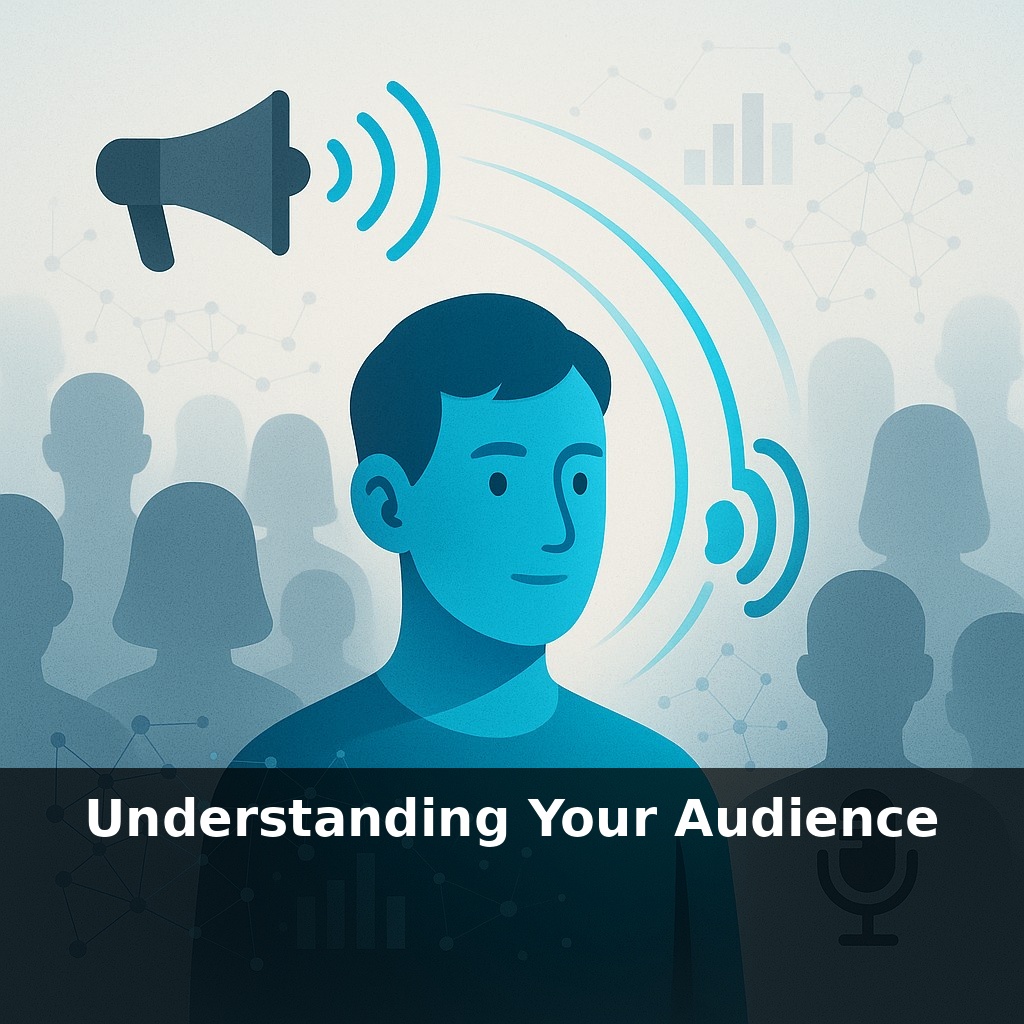
Understanding Your Audience
📝 Transcript
Right now, most brands are talking loudly to crowds—and quietly losing sales—while a few speak so specifically it feels almost eerie. One clothing brand did this with smart audience data and saw sales jump faster in one week than others manage in a whole season.
Most writers stop at “target audience” and wonder why their copy still feels generic. The real shift happens when you stop writing to a crowd and start writing to a very specific someone—built from real patterns in your data, not guesswork or wishful thinking.
This is where modern audience analysis changes the game. It’s not just age, location, and job title; it’s what people actually do, want, fear, and ignore across emails, landing pages, and social feeds. It’s how a “busy parent who loves convenience but hates waste” behaves completely differently from a “status-driven professional who treats purchases like trophies.”
Think of your research less like a spreadsheet and more like a detective board: clusters of behavior, motivations, and objections that reveal distinct groups who need very different messages—even when they’re buying the same product.
So how do you turn all that messy, scattered input into something you can actually write to? Start by tracing the paths people take toward and away from your brand: the searches that bring them in, the pages they linger on, the offers they skip, the questions they ask before they buy—or bail. Layer in context: when they browse, what device they use, which headlines stop the scroll. Patterns emerge: not just “who they are,” but “what they’re trying to get done” in that exact moment. That’s the level where your copy can stop chasing attention and start feeling uncannily relevant.
Here’s where the work stops being abstract and starts getting uncomfortably specific.
Once you’ve spotted the patterns in how people move toward or away from you, the next step is to pin those patterns down into a small set of living, breathing profiles you can actually write for. Not 20 flimsy “avatars,” but 3–4 solid personas that together capture most of your real customer base—just as Peter Fader’s research suggests is possible.
The trap is to make them cute instead of useful. “Marketing Mary” who likes coffee and lives in a city tells you almost nothing. The point is to encode decisions: what this person prioritizes, what they trade off, what finally makes them click, reply, or buy.
A practical way to do this is to start from concrete behaviors and work backward into personality and context. For example:
- A group that opens nearly every email but rarely clicks: they’re curious, but unconvinced. - A group that clicks often yet abandons carts at checkout: they’re interested, but blocked. - A group that ignores most promos but always reacts to launches or limited offers: they’re hunters, not grazers.
Now enrich each group with psychographic clues: which headlines win them over, which testimonials they linger on, which objections surface in support tickets or sales calls. That’s how you reach the deeper layer of “why,” the piece demographics routinely miss—and why psychographic variables can explain so much more of purchase intent.
Then layer in behavioral segmentation: what they’ve actually done, not just what they say they care about. Tools like email platforms and analytics dashboards already expose this—opens, clicks, time on page, paths through your site. When you combine that with even basic profiling, you can start to personalize in ways that feel startlingly accurate.
This isn’t about inventing a different brand for every persona. It’s about keeping one clear core promise while shifting which angle you lead with. One group hears relief from frustration first. Another hears speed. Another hears status. Same product, same truth—different doorway into the story.
Your challenge this week: take one existing piece of copy—a landing page, a sales email, or a homepage—and create two alternate versions, each written for a different real segment you’ve noticed in your data.
Here’s how to run the experiment:
1. Start with actual behavior. Pull even a simple report: email subscribers who click but don’t buy vs. repeat buyers who purchase quickly. If you don’t have data access, talk to someone who does (sales, support, marketing ops) and ask for two clearly different groups based on actions, not opinions.
2. For Segment A, jot down: - What they seem to want quickly (speed? reassurance? proof?) - Where they tend to stall or ghost you (specific page, step, or moment) - The last clear “yes” they gave you (clicked a certain topic, downloaded a guide, requested a demo)
3. For Segment B, do the same—focusing on what’s observably different. Maybe they respond only to discounts, or only to in-depth content. Maybe they buy small first, then upgrade. Record those contrasts.
4. Now pick your original piece of copy. Before you rewrite anything, write a one-sentence “job” for each segment, in plain language: - Segment A: “Someone who ________ but needs ________ before they’ll move.” - Segment B: “Someone who ________ and cares most about ________.”
For example: - Segment A: “Someone who is exploring solutions for the first time but needs to see social proof before they’ll book a call.” - Segment B: “Someone who already understands the problem and cares most about not wasting time on another generic tool.”
5. Rewrite the headline and first 3–4 lines of body copy separately for each segment: - For Segment A, lead with the reassurance that matches their hesitation (proof, risk-reversal, clarity). - For Segment B, lead with the payoff that matches their urgency (speed, control, competitive edge).
Don’t change your core promise or offer—only the entry point, language, and emphasis.
6. Add one micro-personalization for each segment that directly reflects their prior behavior: - Segment A: “If you’ve been comparing options for a while…” or “Still not convinced another [tool/service] will be any different?” - Segment B: “If you’ve already tried two or three fixes that didn’t stick…” or “You don’t need another overview—you need a shortcut.”
7. Optional but powerful: if you control the tech, A/B test these segment-specific versions with actual matching audiences (e.g., tagged by behavior in your email platform or analytics). If you don’t, do a lo-fi test: show each version to 3–5 people who fit each profile and ask only two questions: - “Does this feel like it’s talking to you specifically, or to anyone?” - “What question or doubt do you still have after reading this?”
8. Refine your personas using what you learn. If Segment A readers say, “I still don’t see how this is different from X,” you’ve just uncovered a core comparison you need to address. If Segment B says, “This feels slow,” you know you’re underplaying urgency for that group.
9. Finally, document the differences in a simple, usable format—no more than one page per segment: - What they’re trying to get done - Their main moment of hesitation - The angle that gets their attention fastest - Words or phrases they use (from real emails, calls, or chats) - One promise that matters most to them
Treat this as a working draft, not a final “persona sheet.” The goal isn’t to finish a research artifact; it’s to feel, in your hands, how adjusting the same message for different segments can radically change how it lands.
Run this challenge with just one asset and two segments, and you’ll start to see where your current copy is unconsciously optimized for a blurry “average” reader—while leaving your most valuable groups half-served.
A simple way to feel this in practice is to look at how different brands talk about the same offer. Take a fitness app. To one segment, the headline is basically: “12-week shred, before-and-after photos, leaderboards.” Same product, but for another segment the story shifts toward: “Gentle programs, injury-safe progress, stress relief after long days.” Or consider a bookkeeping service. Founders who hate numbers might see copy that says, “We’ll untangle your finances so you can finally sleep,” while experienced operators get, “Audit-ready reports in half the time, without adding headcount.”
You can spot this kind of tuning in your own inbox. Notice how some retailers lean on “last-size-left” urgency while others highlight “ethically sourced, long-lasting” benefits for what is essentially the same item. Over time, you start to see that strong copy isn’t louder—it’s more precisely angled, almost like adjusting a lens until one person’s world comes into crisp focus while the rest of the scene gently blurs.
Soon, your “audience” won’t be a static file; it will behave more like a live dashboard that reshapes itself as people click, scroll, speak, or look at things. AI will stitch together subtle signals—tone in support chats, voice queries, even AR interactions—to infer mood, knowledge level, and intent in real time. The craft shift for copywriters: instead of writing one path, you’ll design flexible narrative systems that can fork, loop, or zoom in depending on how someone moves through the experience.
As you practice, notice how your own attention shifts online. Which headlines stop you, which offers feel “off,” which brands feel like they’re eavesdropping on your thoughts? Treat those moments like a stock ticker of intent—tiny market signals about what stories people are hungry to buy into, and which scripts they’ve quietly sold off.
Here's your challenge this week: Have 3 real conversations with people who match your ideal audience and ask them the exact three questions from the episode: “What are you currently struggling with around [your topic]?”, “What have you already tried that didn’t work?”, and “What would a ‘win’ look like for you in the next 30 days?”. Capture their actual words (no summarizing), then highlight the recurring phrases they use to describe their problems and desired outcomes. By the end of the week, rewrite one piece of your existing content (a sales page, about page, or email) using at least 5 of those exact phrases so your messaging speaks in their language, not yours.
From this course
Copywriting for Impact
6 episodesUnlock all episodes
Full access to 6 episodes and everything on OwlUp.
Subscribe — $1.99/monthLess than a coffee ☕ · Cancel anytime