“About half the arguments people find ‘convincing’ fall apart the moment you ask a simple follow‑up question. You’re in a meeting, a friend is ranting, a leader is making promises—everyone sounds confident. But how can you tell who’s actually credible, and who’s just loud?”
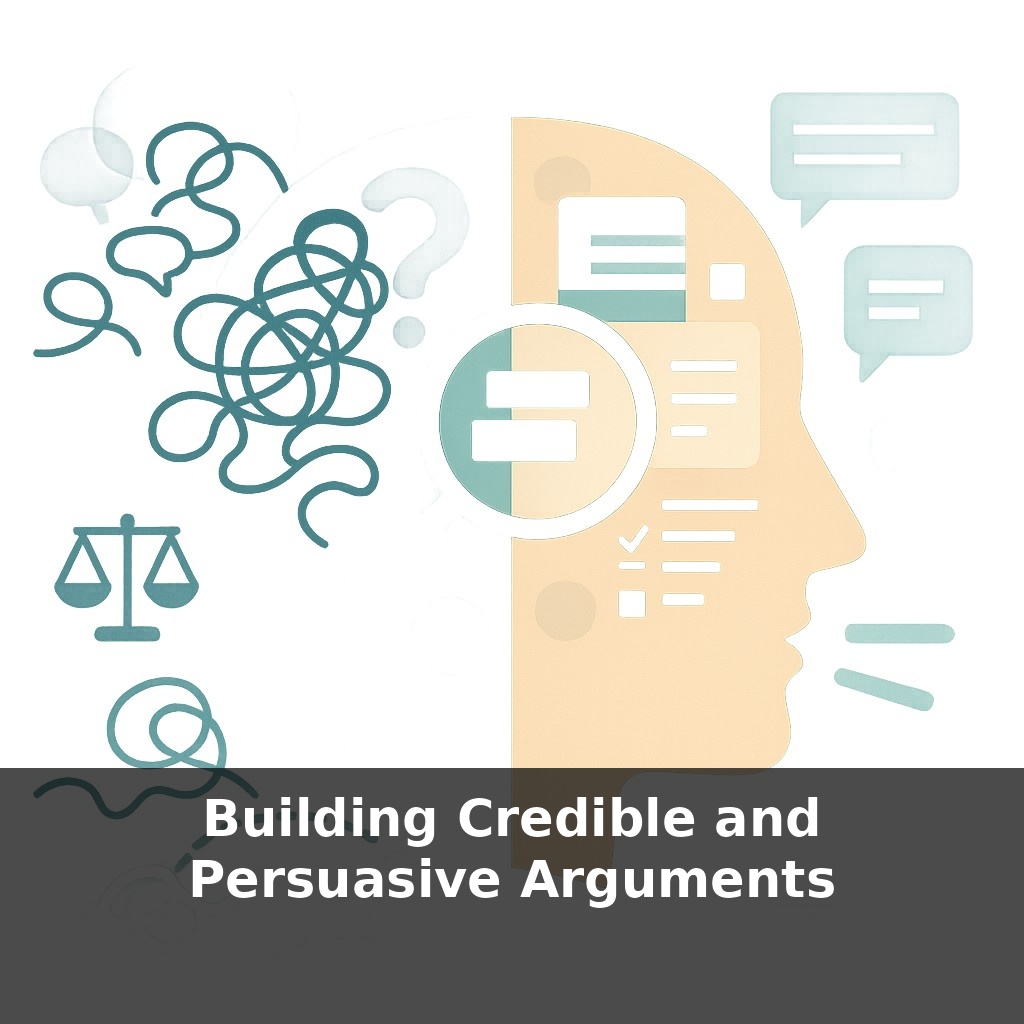
Here’s the uncomfortable truth: most weak arguments don’t fail because they’re wrong—they fail because they’re sloppy. They blur claims with opinions, toss in a story or two, and hope confidence will do the rest. But in environments where decisions move millions of dollars or affect thousands of people, that isn’t enough. Leaders, clients, and readers are quietly asking three questions: “What exactly are you claiming? Why should I believe that? And what are you not telling me?” Strong communicators answer all three—explicitly. They separate claims from evidence, show how the evidence connects, and surface the trade‑offs instead of hiding them. In practice, that means being precise: one clear claim per paragraph; at least one concrete number per key point; and one explicit nod to what a smart skeptic might say—and why you still stand by your position.
Here’s why this matters now: you’re competing not just with other experts, but with feeds, notifications, and hot takes. In that noise, structure becomes a shortcut for trust. Research shows a single verifiable statistic can lift persuasion by up to 40%, yet most emails, pitches, and posts contain none. Transparent thinkers also win longer-term: papers that share data earn 25% more citations, and articles with outbound links keep readers 2.6× longer. The lesson for your daily writing—Slack updates, client decks, LinkedIn posts—is simple: show your receipts, or risk being ignored.
Let’s make this practical. When you sit down to write a recommendation, pitch, or thread, you can stress‑test it with a simple three‑layer check: logos, ethos, pathos. Think of them as dials you can tune—not vague “be logical / be emotional” advice, but concrete levers.
Start with logos. After you draft, scan each main section and ask: “What is the one sentence a tough stakeholder could repeat back?” If you can’t find a crisp line, you don’t have a point, you have a topic. Next, force at least one checkable detail into each key section: a number, a date, a source, or a comparison. “This will improve engagement” becomes “In our last test, comments per post rose from 3.1 to 5.4 (74%) in 14 days.” One number turns vibes into something reviewable.
Then dial up ethos. Instead of sprinkling citations, decide whose trust you actually need. A CFO cares about cost and risk; a head of product cares about speed and user impact. Choose 2–3 sources those people respect—an internal dashboard, a customer cohort, a well‑known study—and name them precisely. “Our finance team’s Q4 report shows churn fell from 7.2% to 5.9% after we…”. You’re not just saying “research says”; you’re tying your reasoning to institutions and data your reader already deems serious.
Now layer in pathos—carefully. You don’t need melodrama; you need relevance. Quantify stakes in human or business terms: “If we delay 3 months, that’s roughly 2,400 support tickets we’ll handle manually,” or “For every week we wait, we leave about $18,000 in upsell revenue untouched at current conversion rates.” Notice that emotion here comes from consequence, not volume. You’re helping the reader feel the cost of inaction or the upside of change.
Finally, pre‑empt the illusory truth effect by making your key points easy to verify. Link your source, attach the spreadsheet, show the query. Repetition will still shape memory, but now what sticks is anchored to something the reader (or their team) can re‑check. Over time, that habit shifts you from “good talker” to “default trusted source”—the person whose numbers, and narratives, withstand a second look.
Watch how this plays out in real work. A PM wants engineering resources. Version A: “We should prioritize Feature X because users are asking for it and it’ll help retention.” Version B: “In the last 30 days, 312 support tickets (18% of all tickets) mentioned the missing export option. Among those users, 41% downgraded or churned within 2 weeks. If we ship Feature X, reducing those tickets by even 30% could protect roughly $48k MRR per quarter.” Same request, but Version B gives a skeptical VP something to grab: volume (312 tickets), proportion (18%), behavior (41% churn), and upside ($48k).
Now add a brief objection and response: “Yes, this pulls 2 sprints from the dashboard revamp, but the dashboard hasn’t appeared in a single churn interview this quarter.” In 4 sentences, you’ve made the upside concrete, the downside visible, and your thinking checkable—without a single slide.
Soon, readers will test you as they read. Browser extensions already flag shaky numbers; in a few years, your deck might be auto‑scanned against live benchmarks in under 200 ms. Treat every slide and landing page as if a silent auditor is present. Start small: add source notes to your next 3 recommendations, log how often stakeholders click or ask follow‑ups, then raise your own bar until “show your data” becomes your default reflex.
Treat this as a skill you can measure, not a talent you’re born with. Over your next 10 messages, decks, or posts, log 3 numbers: how many concrete stats you use, how many links you provide, and how many explicit objections you address. Track responses. If replies grow even 15–20%, you’re not “wordy”—you’re now measurably useful.
To go deeper, here are 3 next steps: (1) Pull up a recent email or proposal you’ve written and run it through the free Hemingway Editor and ChatGPT (with the prompt: “Rewrite this using a clear claim–evidence–reasoning structure and flag any weak or unsupported assertions”) to tighten your logic and clarity. (2) Watch Harvard’s free “Introduction to Logic and Critical Thinking” lectures on YouTube and, while you watch, pause and map one of your own arguments into premises and conclusion, checking it against the common fallacies they cover (like straw man or ad hominem). (3) Grab a copy of *Thank You for Arguing* by Jay Heinrichs and, for one real upcoming conversation (e.g., a pitch to your manager), use his ethos/pathos/logos checklist to deliberately add one credibility move (ethos), one emotional frame (pathos), and one data point or example (logos) into your outline before you speak.