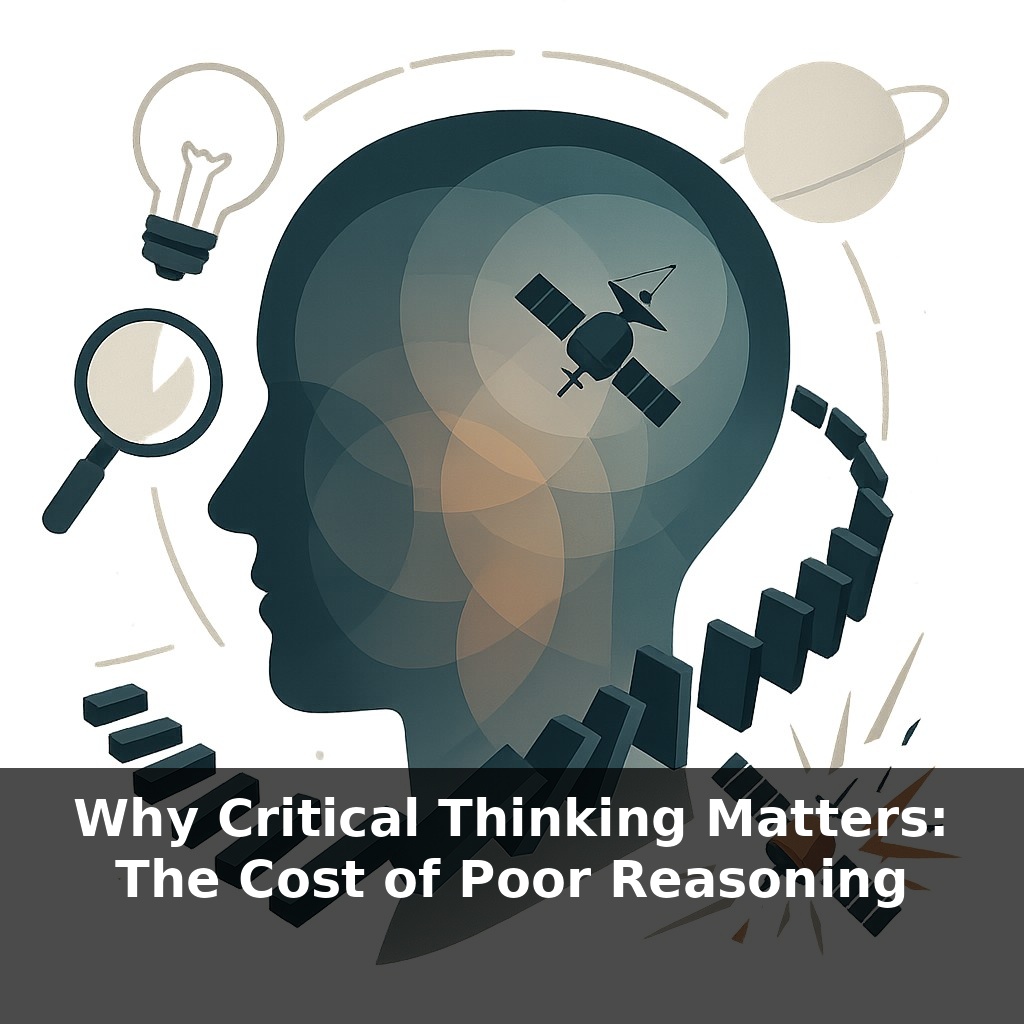
Why Critical Thinking Matters: The Cost of Poor Reasoning
📝 Transcript
A single unchecked assumption once destroyed a Mars spacecraft worth over three hundred million dollars. In this episode, we’re diving into a simple question: how many quiet, everyday assumptions are steering your own choices—and what are they secretly costing you?
Some costs are obvious—a bad investment, a project that flops, a relationship that ends after one big argument. Others are almost invisible: the promotion you never get because you misread a situation, the product your team never builds because someone’s “gut feeling” went unquestioned, the warning sign you scroll past because it doesn’t fit your expectations. These aren’t dramatic failures; they’re slow leaks in the way we think. Critical thinking is what lets you pause before trusting the loudest voice, the prettiest slide deck, or the most convenient explanation. It turns “sounds right” into “let’s test that.” Across medicine, engineering, and public policy, the difference between those two mindsets has meant safer bridges, more accurate diagnoses, and fewer crises amplified by wishful thinking and overconfidence.
In this episode, we’ll zoom in on a quieter villain: poor reasoning that *feels* smart. Biases rarely announce themselves; they show up as confidence, clarity, and “obvious” answers. Confirmation bias makes us treat supporting evidence like VIP guests and conflicting data like spam. Groupthink replaces real scrutiny with a smooth meeting where everyone nods. And overconfidence turns rough guesses into “facts” we plan around. These patterns helped sink Theranos, worsen Flint’s water crisis, and misdirect countless everyday choices. Our goal isn’t to think more—it’s to *notice* how we’re thinking before the stakes get high.
When you look closely at famous failures, what jumps out isn’t a lack of intelligence—it’s a pattern of *unasked* questions.
NASA’s Mars Climate Orbiter didn’t fail because rocket scientists forgot basic physics; it failed because no one insisted on the boring, clarifying question: “Are we using the same units?” That’s the kind of question strong reasoning produces: simple, slightly annoying, and quietly decisive.
The research backs this up. Across hundreds of studies, people who train their critical-thinking skills don’t just score better on tests; they make fewer real-world errors. A moderate boost in problem-solving might sound abstract, until you realize that in a hospital, a “small” reduction in diagnostic mistakes can mean thousands of patients correctly treated instead of harmed. In a company, it can mean the difference between a cautious pilot program and a billion-dollar misstep.
Notice how different this is from mere intelligence or expertise. Investors in Theranos weren’t short on IQ points or financial experience. What they lacked was disciplined doubt: insistence on independent lab data, clarity on how the technology scaled, and genuine engagement with skeptics instead of sidelining them. Smart people, untrained in examining their own reasoning, simply become better at rationalizing what they already want to believe.
The Flint Water Crisis shows the public side of this. Officials had access to contradictory measurements and outside analyses, but weak reasoning habits made it easy to dismiss “inconvenient” information as noise. The price wasn’t just financial; it was neurological damage in children and a long-term collapse of trust.
Critical-thinking training targets exactly these failure points. It teaches you to separate a claim from the person making it, to distinguish raw data from the story someone tells about that data, and to map out alternative explanations *before* you lock onto your favorite. Like methodical debugging in software engineering, it slows you down at key junctures so errors are found when they’re cheap—not after launch, when they’re catastrophic.
And crucially, this is learnable. Simple habits—asking “What would change my mind?”, actively seeking disconfirming cases, checking whether the conclusion really follows from the evidence—compound over time. The payoff isn’t just fewer disasters; it’s more dependable judgment when it actually counts.
Think about smaller, quieter decisions: hiring someone because they “seem like a great fit,” approving a design because “the client will love it,” or dismissing a safety concern as “unlikely.” None of these feel reckless in the moment. But if you traced them over a year, you’d see patterns of avoidable rework, stalled projects, and preventable fires you’re stuck putting out at 11 p.m.
Research on critical-reasoning training shows its benefits aren’t limited to classrooms or labs. In business simulations, teams that practiced structured evaluation—explicitly listing alternatives, rating evidence strength, and naming their own uncertainties—made fewer costly strategic errors and adjusted faster when conditions changed. In healthcare, checklists that force brief, focused questioning cut surgical mistakes and infections.
Think of this as upgrading from “hope this works” to “let’s make failure work for us.” Each time you catch a weak inference or missing data *before* acting, you’re reclaiming a bit of control over outcomes that usually feel like “bad luck” in hindsight.
In the next decade, the gap between people who sharpen their reasoning and those who don’t will look like the gap between people who can and can’t read. As AI floods feeds with fluent nonsense and plausible fakes, institutions will need habits of scrutiny the way cities need clean-water systems. Job ads already ask for “structured thinking” and “evidence-based decisions”; soon, being hired or promoted may depend less on what you know and more on how you show your work.
Treat this as ongoing practice, not a personality trait you either have or lack. Like strength training, small, repeated “reps” of examining claims change what feels normal. Over time, pausing to probe evidence becomes as routine as fastening a seatbelt: unremarkable in the moment, but quietly decisive in how your future turns out.
This week, delve into a prevalent news story or viral social media claim with fresh eyes, applying the 'critical thinking checklist' introduced earlier. First, trace its origin: determine the initial source and any significant omissions or biases. Conduct an emotional assessment—is the claim steering emotions unduly? Seek out a counter-narrative from a diverse perspective. As you evaluate, rate your confidence in the claim using a 1-10 scale—but make this about the evidence, not gut reactions. By the end of the week, select a claim that transformed your viewpoint, and discuss this shift with a friend, illustrating how your newfound perspective was raw and evidence-driven.
From this course
Critical Thinking: Evaluate Claims Like a Pro
7 episodesUnlock all episodes
Full access to 7 episodes and everything on OwlUp.
Subscribe — $1.99/monthLess than a coffee ☕ · Cancel anytime