A judge once said, “Most bad arguments don’t sound stupid. That’s the problem.” You’re scrolling headlines: a celebrity “destroys” a critic, a politician claims “there are only two options,” a friend says “everyone knows this is true.” All three feel convincing—and all three might be broken.
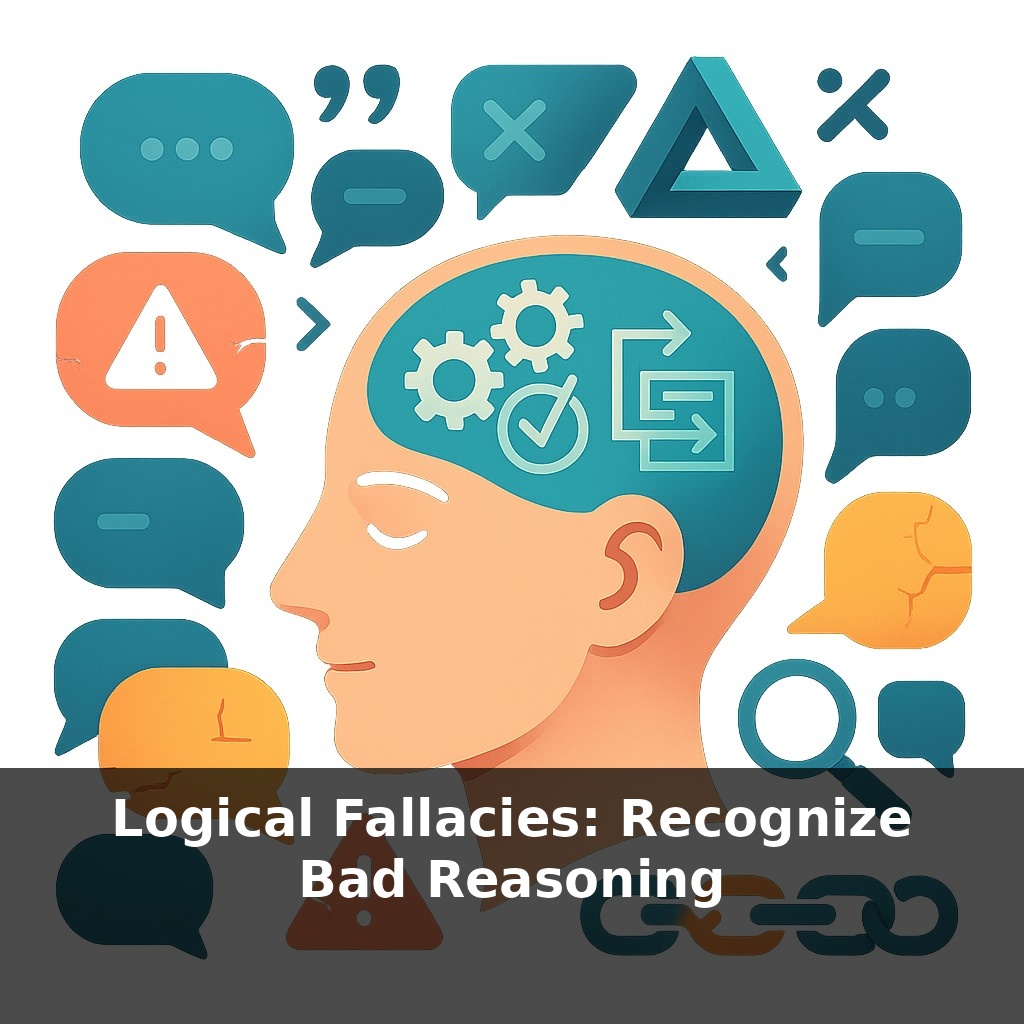
By lunchtime, you've likely encountered dozens of claims—headlines, group chats, office Slack threads, podcasts, and that one relative in the family text. Most of them don’t come labeled with a “warning: bad reasoning ahead.”side.” They show up dressed as confidence, outrage, or “common sense.” That’s where logical fallacies sneak in—not as cartoonishly dumb mistakes, but as shortcuts that feel right because they fit our expectations, our tribe, or our mood in the moment. Researchers have cataloged hundreds of these patterns. The tricky part isn’t memorizing names; it’s noticing the subtle moves: shifting the topic to a person’s character, quietly rewriting someone’s view into an easier target, or treating “after” as “therefore because.” Spotting those moves turns you from a passive recipient of arguments into an active editor of them.
Some of these patterns are surprisingly old—and surprisingly stubborn. Philosophers in medieval universities were already naming and debating them, long before social media turned them into viral habits. Modern research backs up why they matter: in one Stanford study, students who practiced spotting fallacies for just six weeks improved at judging arguments by roughly a third. That’s a huge jump for a small change in attention. And fallacies don’t just appear in debates or politics; they sneak into product reviews, wellness advice, office decisions, even how we explain our own choices to ourselves.
Let’s get concrete and walk through a few of the most common patterns you’ll actually meet in the wild, and how they quietly warp your sense of what’s reasonable.
Start with **ad hominem**. You’ll know it by a subtle pivot: instead of asking “Is this claim supported?”, the focus slides to “What’s wrong with this person?” Examples: - “Don’t listen to her climate data, she flies a lot.” - “He’s a college kid; what does he know about taxes?” The move isn’t just rude; it swaps out evidence-checking for character-judging. Sometimes character matters (say, in judging trustworthiness), but it’s not a shortcut to truth about the claim itself.
Next, **straw man**. Watch for someone taking a nuanced view and boiling it down until it’s unrecognizable. - Original: “We should review police budgets and training.” - Straw man: “So you want to abolish all law enforcement?” - Original: “I’m not sure this medicine is right for everyone.” - Straw man: “You’re against modern medicine.” You’re no longer debating what the person actually said; you’re shadowboxing a weaker version.
Then there’s the **false dilemma**. Instead of mapping the real range of options, the speaker frames the situation as an ultimatum: - “You’re either with us or against us.” - “Either you work 70-hour weeks or you don’t care about your career.” This matters because the missing middle is often where the best solutions live—compromises, mixed strategies, or “third ways” that get ignored.
**Circular reasoning** is sneakier. The conclusion is quietly smuggled into the premise: - “This policy is the best choice because it’s clearly superior to all others.” - “He’s trustworthy because he always tells the truth.” If you strip away the repetition, there’s no independent support—just the claim restated.
Finally, **post hoc** patterns show up wherever we see sequences: - “I wore my lucky socks and then got the promotion; they worked.” - “We changed the website and sales dropped, so the redesign ruined everything.” Order alone isn’t proof of cause; sometimes it’s coincidence, sometimes a third factor.
Spotting these isn’t about being a pedantic “logic cop.” It’s about slowing down the slide from “sounds right” to “is right,” especially when the claim flatters your side.
Think about where you actually *feel* these patterns in daily life. You’re in a team meeting: someone says, “This feature failed last time, so it’s doomed again.” That’s not just pessimism; it’s a quiet slide from “happened once” to “therefore always.” Or you’re reading reviews: one one-star rant about a delivery delay somehow outweighs fifty calm, positive comments. Your brain loves vivid stories more than sober averages.
Detecting a logical fallacy is like debugging a piece of code: the app may run, the interface looks fine, but one small error in the logic sends the whole program down the wrong path. The conversation can still be lively, the speaker confident, the examples emotional—yet the core step that should connect reasons to conclusion is missing or mislabeled.
Over time, you’ll notice patterns in *who* triggers your guard to drop. Charismatic leader? Friendly influencer? Someone on “your side”? That’s exactly when to zoom in and check the logic, not just the vibes.
As AI starts drafting emails, policies, even news summaries, you’ll be reading more arguments built by algorithms you never see. Fallacy-checking will feel less like a niche skill and more like checking food labels. You might skim comments with a browser plug‑in that quietly flags patterns, the way spellcheck underlines typos. Over time, that nudge could shift norms: “clean” reasoning becomes expected, and sloppy rhetoric stands out like a pop‑up ad.
Treat each claim you meet like a recipe someone hands you: scan the ingredients, not just the pretty photo. Who benefits if you accept this as true? What evidence would change your mind? When two smart people disagree, ask what assumptions each side is protecting. Your brain is wired for speed; fallacy-spotting is how you occasionally hit the brakes.
Try this experiment: For the next 24 hours, every time you scroll social media or watch the news, deliberately hunt for *one* example each of three fallacies mentioned in the episode: a straw man, an ad hominem, and a slippery slope. Screenshot or save the post/headline, then say out loud what the person is *actually* arguing and how the fallacy twists it (e.g., “They’re attacking the person, not the claim”). If you feel persuaded by any of them, pause and ask, “Would this still convince me if the fallacious part were removed?” By tonight, quickly rank which fallacy type you found most persuasive on you, and decide one concrete way you’ll watch for that specific pattern tomorrow.