About a third of Americans say they’ve accidentally shared false information online. Now, hear this: you’re scrolling, you see a bold claim, a confident voice, a familiar logo. In seconds, you’ll trust one of them. But which one—and why that one, not the others?
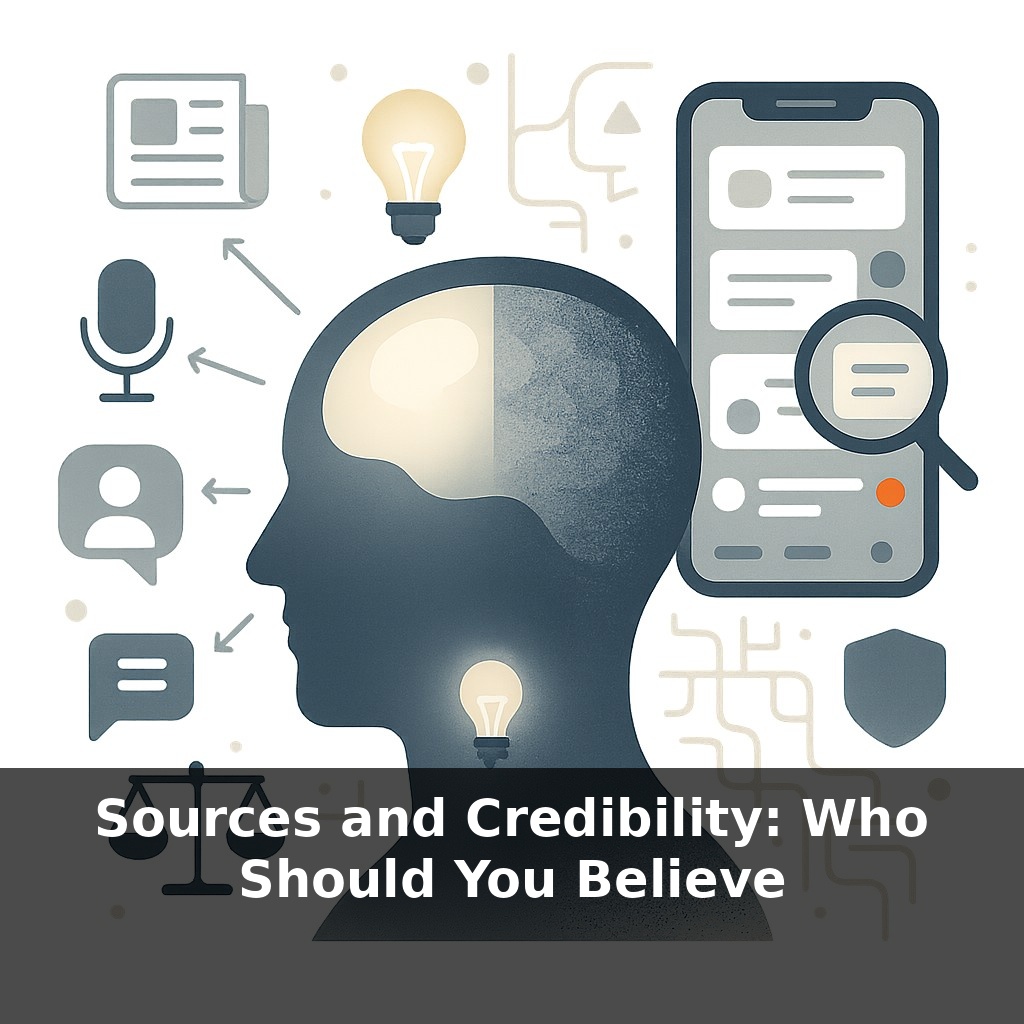
You probably already have “go‑to” sources you lean on without thinking—like that one friend whose movie takes you always trust, or the teacher whose assignment instructions you never double‑check. We do the same thing with news feeds, podcasts, and search results: some we treat like a trusted mentor, others like background noise. The problem is, in a world where anyone can publish almost anything, the usual shortcuts—professional layout, confident tone, big follower counts—have become unreliable. Some unreliable sources borrow the style of trustworthy ones, the way a knockoff product imitates the packaging of a real brand. The real skill now isn’t just spotting what sounds convincing; it’s learning to investigate *who* is speaking, *how* they know, and *what* they stand to gain when you believe them.
Online, credibility works less like a single “trusted guru” and more like a voting system. Each claim collects signals—for and against—every time it’s published, challenged, corrected, or quietly ignored. A science paper might gain weight because it’s peer‑reviewed, then lose some if later studies fail to replicate it. A viral thread might seem strong until you realize every “source” traces back to the same unsupervised blog. As digital platforms speed this up, you’re not just a spectator; each click, like, and share helps decide which voices rise and which quietly disappear.
Thirty‑five percent of Americans say they’ve shared something false without realizing it. That number isn’t just about “careless people”; it’s about how easy it is for *anyone* to confuse “sounds right” with “is well‑supported.” So instead of asking, “Is this source good or bad?” a better question is, “What *signals* is this source giving me—and what do they really mean?”
Start with *transparency*. Can you see who created the information? An article with a named author, clear bio, and links to original data is showing its work. Anonymous posts, vague group names, or “research shows” with no specifics force you to take things on faith. That doesn’t automatically make them wrong, but it should make you cautious.
Next, look for *independent anchors*. Does anyone outside the author’s circle back the claim up? If a health claim only ever appears on sites that sell a matching supplement, that’s one kind of signal. If you can find it discussed—critically—by people with different interests or ideologies, that’s another. Agreement across rival groups is especially telling, because they have fewer reasons to protect each other’s mistakes.
Authority is more than a fancy title; it’s *fit* plus *track record*. A Nobel‑winning physicist is an authority on quantum theory, not necessarily on nutrition or geopolitics. Check whether the person has formal training, professional experience, or a history of accurate work in *this* area. When someone comments far outside their lane, treat it as an informed opinion at best, not a trump card.
Digital platforms add another twist: algorithms silently promote sources based on engagement, not rigor. A dramatic, oversimplified thread can outrun a careful, nuanced article because it’s easier to react to. So “I’m seeing this everywhere” often means “The system thinks I’ll click this,” not “Experts are lining up behind it.”
One useful habit is to separate *claims* from *evidence types* the way a programmer separates code from data: personal stories, expert quotes, statistics, leaked documents, direct observations. Each has different failure modes, and strong sources usually combine several rather than leaning on a single dramatic anecdote.
Finally, remember that credible systems correct themselves. Look for sources that issue clarifications, show updates, and link to critiques—signs they care more about getting it right than looking infallible.
Think about following a money tip you see on your feed. One post says, “This coin will 10× next month—trust me, I called the last bull run.” No name, no track record, no receipts. Another is from a known analyst who clearly states their firm, methods, and past predictions—wins and losses. Same topic, different *habits*: one hides the risk, the other shows it.
Or take two videos about a new study on sleep. The first shouts, “Scientists prove 4 hours is enough!” and never links anything. The second walks through limitations, sample size, and who funded the work, then adds, “Here’s why this might not apply to shift workers.” That extra friction—uncertainty, nuance, conditions—is a quiet signal of care.
Evaluating sources is less a one‑time verdict and more a running scoreboard. Which outlets update headlines when details change? Which guests get invited back because their calls were consistently reasonable, not just dramatic? Over time, your trust should shift toward the ones that keep earning it.
Deepfakes and AI‑written posts mean “looks real” is about to matter less than “can be traced.” Cryptographic watermarks and content credentials might function like tamper‑evident seals on a banknote: not perfect, but harder to fake at scale. Schools may soon treat source‑checking like long division—basic, testable, expected. And as platforms face pressure to reveal how feeds are ranked, you may judge not just *what* you read, but *why* it was placed in front of you.
Treat your attention like a limited budget: every click is an investment in whose voice grows louder. Over time, your pattern of “follows” and “mutes” reshapes the info‑ecosystem around you. The small move is to pause before boosting a post; the larger move is to ask, “If everyone used my standards today, what would tomorrow’s feeds look like?”
Here’s your challenge this week: Pick one current issue you care about (e.g., nutrition advice, a political claim, or a health headline) and choose two *conflicting* sources about it—one from social media or a blog and one from a more established outlet (like a peer-reviewed article, major newspaper, or government site). For each source, check: Who is the author, what are their credentials, what evidence do they cite (studies, data, expert consensus), and what might their incentives or biases be (selling a product, pushing a worldview, chasing clicks)? Then, before the end of the day, decide which source you’d tentatively trust more *and why*, using the podcast’s criteria like expertise, transparency about evidence, track record of accuracy, and openness to uncertainty.