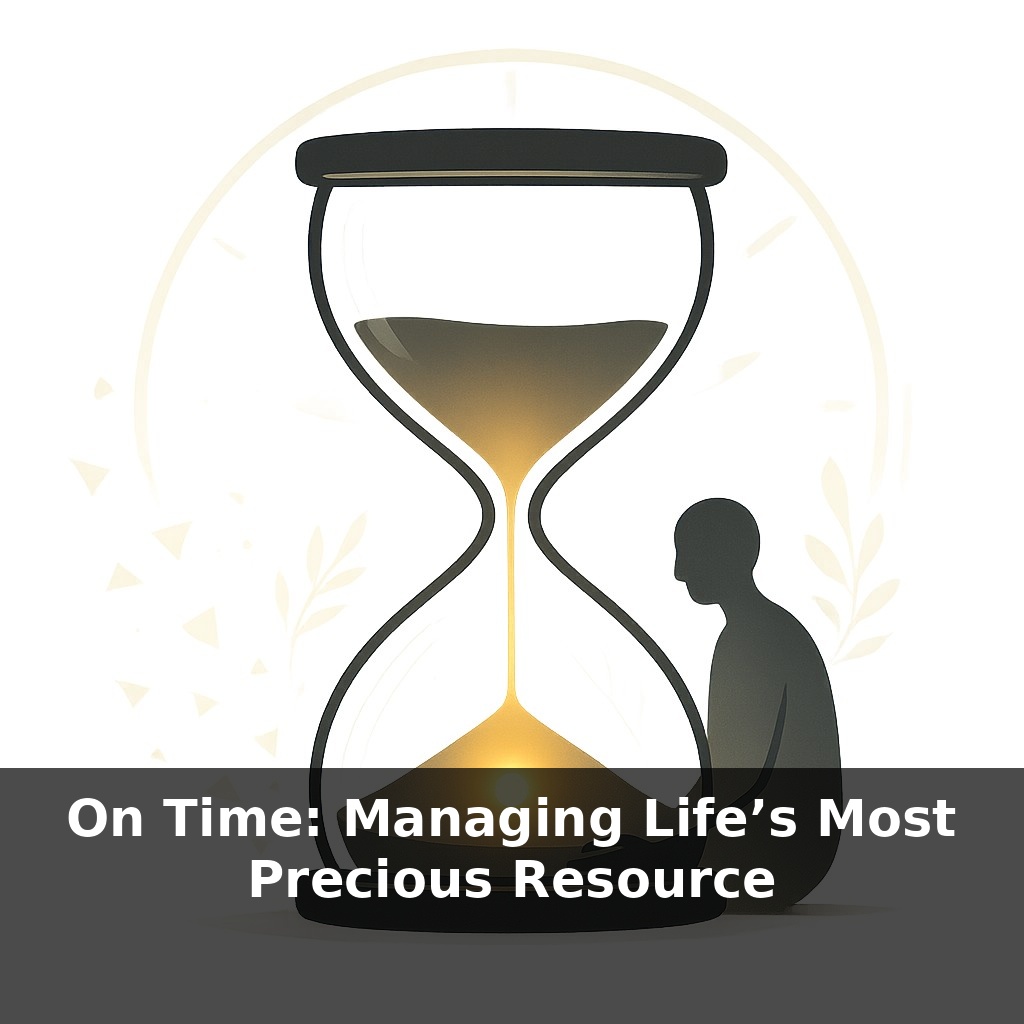
Seneca wrote that “life is long, if you know how to use it.” Yet most of us lose hours each day to distraction we don’t even remember. You sit down to check one message, and suddenly the afternoon is gone. Where did it go—and who, exactly, spent it for you?
Seneca would say our problem isn’t that life is short, but that we treat it like a casual free sample instead of a finite allocation. We act as if the day will quietly refill itself, no matter how we slice it up. Yet every yes you give—to a meeting, a favor, a scroll through your feed—is also a hidden no to something else: sleep, depth, a conversation that actually matters. Modern research calls this opportunity cost, but Seneca grasped it centuries ago when he warned that people guard their property yet “allow others to trespass on their time.” The hard part is that these trades are almost always invisible in the moment. You don’t watch a clock drain; you just surface, hours later, slightly dazed. This series is about dragging those trades into the light—so that your minutes stop leaking away and start aligning with the life you actually want to live.
Seneca learned this the hard way. Exiled to Corsica, stripped of status and busyness, he suddenly faced huge stretches of unstructured hours. Instead of treating them as dead space, he treated them as raw material, turning enforced solitude into some of his most enduring work. Today, no one ships us to an island, but our days still contain pockets like that—commutes, queues, those 10 minutes before a call starts. Research on attention shows these “in-between” moments quietly shape our mood and identity. Used carelessly, they train us for fragmentation; used deliberately, they become small but steady investments in who we’re becoming.
Seneca’s twist is uncomfortable: he says we rarely *lose* time; we mostly *give it away*. Not in dramatic, heroic chunks, but in tiny, automatic decisions that feel too small to matter. Open one more tab. Say yes to a “quick” call. Let a notification decide what you’ll think about next. No villain steals your day—your routines do.
Modern research backs this up. Studies on “choice architecture” show that default options quietly direct behavior. The same applies to your hours: your defaults—phone on the table, email always open, meetings accepted by habit—form an invisible schedule that often bears no resemblance to your actual priorities. Seneca would say we’ve outsourced governance of our life to impulse and expectation.
He suggests a kind of internal audit: not “How busy was I?” but “Who did I willingly become today?” Behavioral scientists echo this with the idea of *implementation intentions*—pre-deciding how you’ll act in specific situations. “If I’m waiting in line, then I’ll…” “If it’s after 9 p.m., then I won’t…” This is where ancient counsel meets practical design. You stop negotiating with every moment and start running a few clear rules.
Here is where many people stumble: they aim for total control, then burn out. Seneca isn’t asking you to schedule every minute. He’s asking you to decide which *kinds* of minutes are non‑negotiable. Time to think without inputs. Time to practice a craft. Time to sit with someone you love and not check a screen. These are not luxuries; they’re the scaffolding of a coherent life.
Think of your day like a financial budget: before the world opens for business, you quietly “pay yourself first” by reserving blocks for what matters most, then let the remaining hours absorb obligations, noise, and chance. Without that upfront allocation, the urgent will always evict the important.
Seneca’s question, translated into today’s terms, becomes: if a hidden camera followed your attention for one ordinary day, would you be willing to live that same pattern for the next ten years? If not, the task isn’t to feel guilty—it’s to start rewriting the pattern on purpose, one small, deliberate allocation at a time.
A practical way to see this is to zoom in on one ordinary slice of your day. Say you have 30 unscheduled minutes between meetings. One version of you auto-opens email, answers low‑stakes messages, skims three links, and arrives at the next call slightly drained. Another version writes a rough outline for a problem you’ve been postponing, or calls a friend you’ve been “too busy” to reach. Same 30 minutes, completely different downstream effects: one scatters your attention, the other compounds into clarity or connection.
You can also watch this play out inside companies. Some teams accept every recurring meeting invite; their calendar becomes a museum of past priorities. Others run quarterly “calendar resets,” where every standing meeting expires unless someone makes a case for it. Over a year, that simple rule returns hundreds of hours for deep work and recovery.
The subtle shift here isn’t heroic self‑control; it’s curiosity. Instead of asking, “How do I squeeze more in?” you start asking, “What happens if I quietly remove this one thing and see what grows in the space that’s left?”
If this is true, whole systems need redesigning, not just personal habits. Schools might treat “attention labs” like science class—students running weekly experiments on how different environments affect their ability to think. Workplaces could publish “time manifests” the way they publish values, stating when employees are expected to be offline. Even cities might track “quiet zones” as carefully as traffic patterns, protecting pockets of undisturbed hours like urban parks for the mind.
Seneca might say the test isn’t “Was my day efficient?” but “Did anything in it feel worthy of memory?” The minutes you’ll recall rarely come from autopilot. They’re the ones where you were fully there: cooking with someone, wrestling with an idea, walking without headphones. Those moments don’t just fill time; they quietly shape who you are becoming.
Before next week, ask yourself: “If I treated my calendar like a values statement instead of a to‑do list, which 2–3 time blocks this week would I immediately protect—no rescheduling, no multitasking allowed—and what exactly would I do in them?” “Looking at how I actually spent the last 24 hours, which 30–60 minute chunk felt the most ‘wasted,’ and how could I redesign just that same slice tomorrow so it better reflects what (or who) I say matters most?” “The next time I reach for my phone out of habit, can I pause and ask, ‘Is this worth trading five minutes of my one and only life for?’—and if the answer is no, what higher‑value use of those five minutes is available to me right now?”