Each year, anxiety quietly drains the world’s economy of about a trillion dollars in lost focus and wasted effort. Yet in the middle of a crowded commute or a tense meeting, some people stay remarkably calm. How do they do that without escaping their responsibilities?
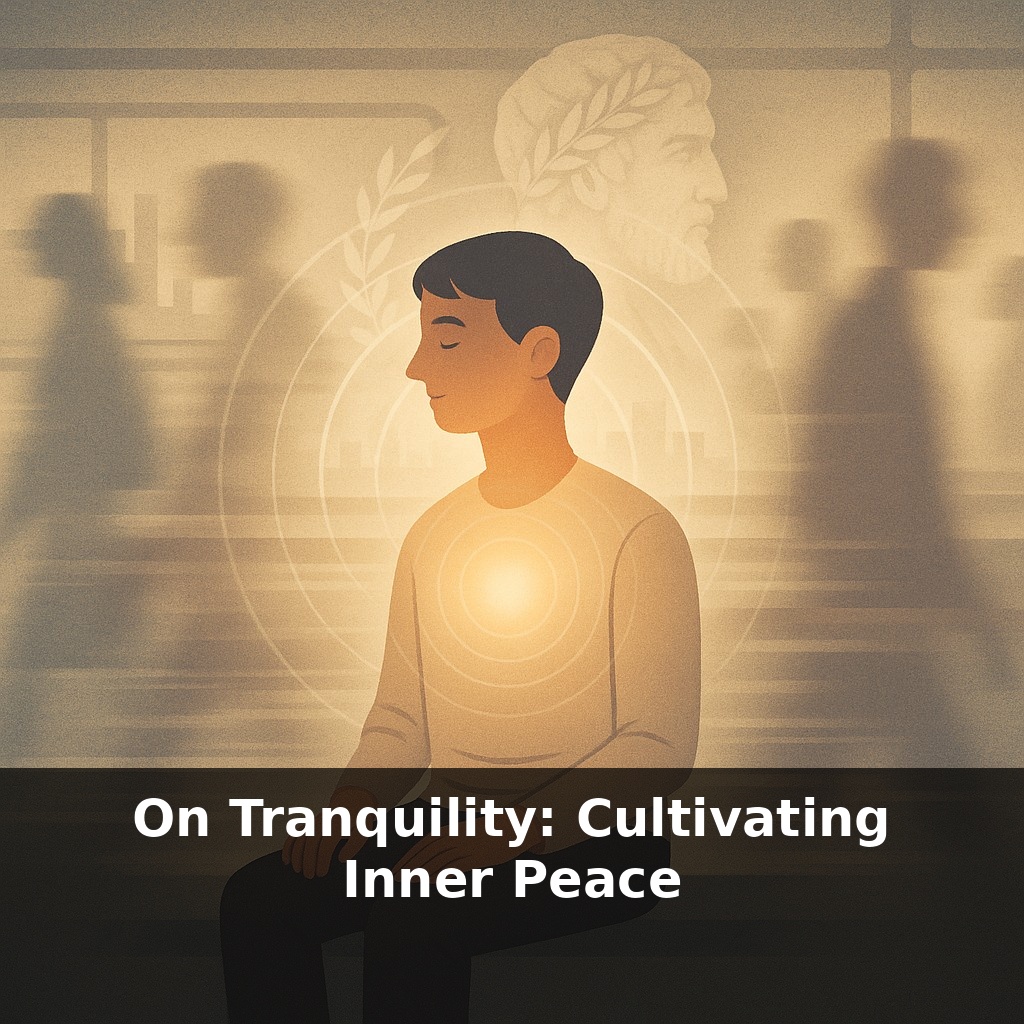
Seneca would say those unshaken people aren’t “naturally calm” – they’re trained. Their minds have habits the rest of us don’t practice often enough. Modern scanners can’t see virtue, but they can see what those habits do to the brain: when we deliberately rethink a stressful event, the alarm centers quiet down, and the regions for reasoning and self-control light up. Tranquility, then, isn’t mystical; it’s a skill with visible fingerprints in your nervous system.
But here’s the twist: Stoic tranquility is not numbness or detachment from life. It’s having clear internal “settings” for what truly matters, so external noise doesn’t constantly reset you. Seneca pairs this with a life ordered around a few stable commitments—like a well-designed workday that protects deep-focus blocks instead of chasing every notification. Inner peace is less a mood and more a disciplined way of choosing what gets to move you.
Seneca thinks our unease often comes less from events themselves than from a life arranged on accident. We say yes by default, work from urgency instead of priority, and let other people’s crises set our pace. The result is a baseline tension that no amount of “relaxing” can fix. His remedy is architectural, not decorative: design your days around a few chosen aims, practiced consistently, so your judgments don’t have to start from zero each time something happens. Modern research on value-based living echoes this—people who align schedules with core values report more steadiness, even when their calendars stay full.
Seneca’s starting move is brutally practical: sort your life into “mine” and “not mine.” Not in the sense of possessions, but of responsibility. Your efforts, choices, and responses belong to you; other people’s opinions, the market, the weather, your past mistakes live outside that boundary. Turmoil begins when we manage the second list more fiercely than the first.
He doesn’t ask you to become indifferent to outcomes, only to treat them as feedback, not identity. A project fails; a friend misunderstands you; a plan collapses. Stoically, these are tests of how well you can choose the next action, not verdicts on your worth. Modern cognitive science quietly agrees: the more you tie your self-concept to controllable processes rather than volatile results, the more stable your mood and performance.
To make this workable, Seneca recommends pre-deciding certain judgments. For instance: “Anything that doesn’t touch my character is a disturbance, not a disaster.” When trouble hits, you don’t improvise from panic; you apply a script you’ve rehearsed. Far from rigid, these scripts are like if–then rules in a piece of software: “If criticized unjustly, then examine for truth, correct if needed, ignore the rest.” The assessment is flexible, but the posture is constant.
He also warns against scattering attention across too many half-commitments. Each unresolved “maybe” consumes mental bandwidth and keeps your nervous system idling high. Deliberately choosing a smaller number of meaningful roles—parent, craftsperson, teammate, citizen—and giving them clear priority quiets the background hum of “I should be doing everything.”
Crucially, tranquility grows in motion, not in retreat. Seneca praises people who go to the law courts, the senate, the sickbed, and still carry a composed mind. The measure is not how empty your calendar is, but how rarely you feel internally overruled by it. And every time you catch yourself shifting from “Why is this happening to me?” to “How can I meet this well?” you’re not just surviving the moment; you’re training the reflex that makes the next storm a little less loud.
A developer under deadline gets a harsh email: “This feature is a mess.” One response is instant defensiveness, then an evening lost to rumination. Another is a brief pause and a question: “What exactly is broken?” She skims the message, pulls out three concrete issues, and schedules ninety minutes to fix them. Same sting, different script. Neuroscientists call this a form of reappraisal; Seneca would call it governing your judgments instead of letting them riot.
Or consider a doctor in a busy clinic. Patients are late, labs glitch, admin demands pile up. He keeps a small card in his pocket with two lines: “Care, not speed” and “Steady tone under stress.” Each micro-crisis is filtered through those commitments. He still feels pressure, but decisions take fewer detours through panic.
Your own version might be far less dramatic: a colleague who talks over you, a family member who brings chaos, a delayed train. Tranquility shows up in those tiny junctions where you choose either rehearsal of outrage or rehearsal of clarity—one more repetition of the life you say you want.
As wearables, VR, and neurofeedback mature, they may become less like fitness trackers and more like “judgment trainers,” flagging not just heart rate but when your reactions drift from what you’ve chosen to stand for. A prompt might nudge you to revisit a commitment before a difficult meeting, the way a calendar reminds you of a flight. The ethical frontier won’t be the tech itself, but who sets the defaults—your deliberate choices, or an employer’s idea of a “productive” mind.
Let this be an experiment, not a crusade: one week of treating disruptions like pop‑up windows—glance, decide, then close or act. Notice which ones you keep re‑opening. Those loops often point to neglected needs, conversations, or limits. Following that trail, patiently, is how composure stops being a technique and starts becoming your default stance.
Before next week, ask yourself: (1) “In the last 24 hours, when did I feel even a flicker of inner quiet—maybe during a slow walk, a pause between emails, or a deep breath—and what, exactly, was different about that moment compared to my usual pace?” (2) “Which recurring source of agitation—like checking my phone before bed, replaying a conversation, or saying yes to every request—am I willing to gently experiment with for just three days, and what boundary or tiny ritual could I put in its place to protect my calm?” (3) “If my living space had to visually reflect tranquility for just one corner—a cleared nightstand, a calmer desk, or a peaceful chair—what would I remove, what would I keep, and how would I use that spot for a daily 3-minute ‘quiet check-in’ with myself?”