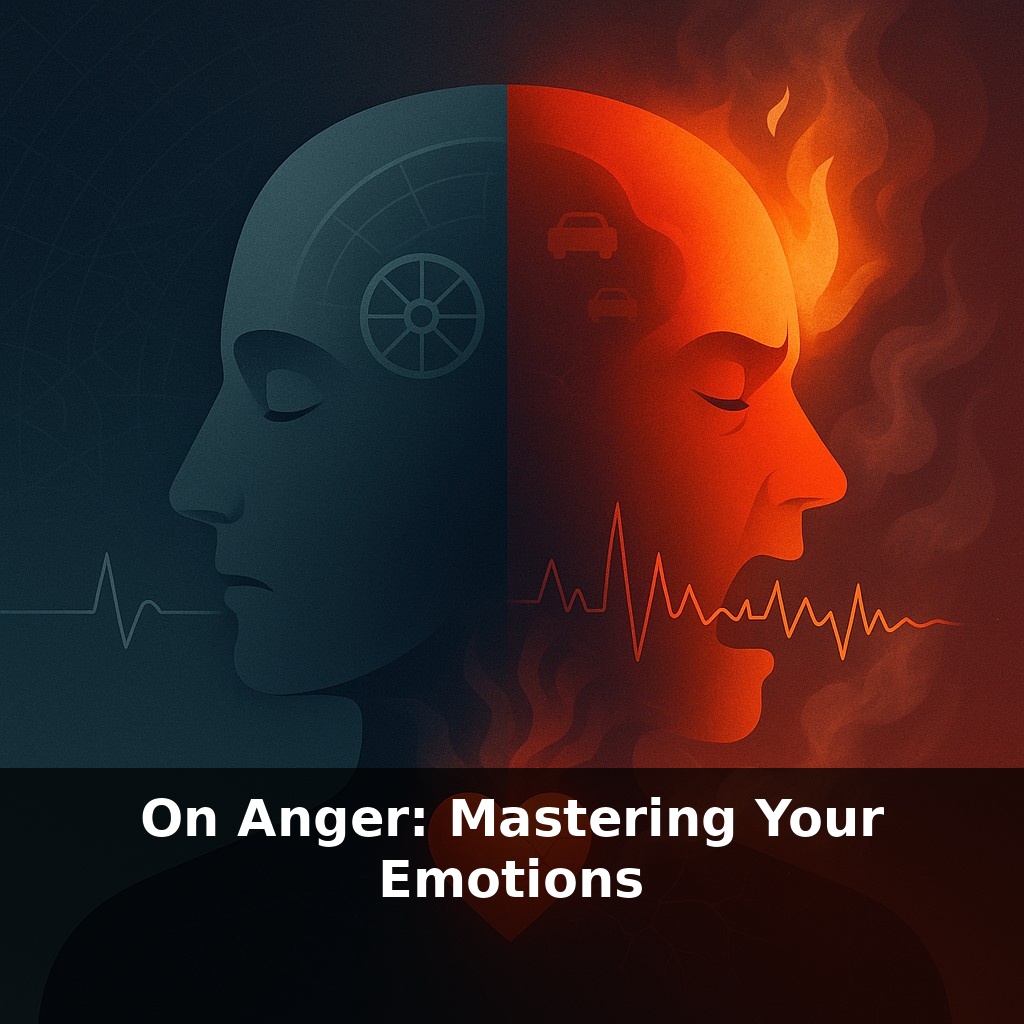
A single angry outburst can quietly triple your risk of a heart attack, yet most of us still treat anger as strength, not danger. You’re in traffic, a stranger cuts you off, and your pulse spikes. Is that really you choosing… or is your biology driving the car?
Think about the last time you snapped at someone you care about—a sharp comment, a slammed door, that instant “I didn’t mean that” regret afterward. The moment passes, but its echo hangs in the air like smoke after something’s burned. Seneca would say that’s not just a bad mood; that’s a brief surrender of your mind. Modern research quietly agrees: those flashes of fury don’t just strain relationships, they leave measurable fingerprints on your long‑term wellbeing and decision-making. Anger shrinks your world down to a single point: the slight, the insult, the delay. You stop seeing the full picture—context, intentions, options—and fixate on punishment or defense. It’s as if your mental “zoom lens” gets stuck on maximum close‑up, cutting out everything else that matters. Stoic practice, and today’s best psychology, both ask a daring question: what if you could widen that lens in real time?
Seneca called anger “temporary madness,” but he didn’t mean only the obvious explosions—the shouting match or the slammed door. He meant the quieter distortions too: the grudge you replay for days, the sarcastic reply you craft in your head, the cold silence that feels righteous in the moment. Modern research maps this “madness” in detail: judgment narrows, consequences fade from view, and we become strangely confident in the story our anger tells. That’s the danger—anger feels like clarity while it quietly edits out half the evidence. Before we can master it, we have to learn to spot that edit in real time.
Seneca’s first move wasn’t “stop being angry.” It was: slow down the sequence. He saw anger not as a single flash, but as a chain: first, an impression (“I’ve been wronged”), then an inner verdict (“this is unbearable”), then a decision (“I will strike back”). You can’t always stop the first link—that jolt of irritation—but you can interrupt the verdict and the decision.
Modern psychology breaks it down in a similar way: trigger → thought → feeling → impulse → action. The danger isn’t the trigger itself; it’s how quickly we slide from thought to action without inspection. When that slide is automatic, we confuse speed with certainty. “I reacted instantly, therefore I must be right.” Seneca would say: no—there’s just no one at the wheel.
His remedy was surprisingly practical. First, name what’s happening: not “I am fury,” but “an angry impulse is rising.” That tiny shift—from identity to observation—creates a gap. In that gap, he advised deliberate delay: stand up, walk, be silent, postpone the reply, sleep on the decision. Not to avoid the issue, but to make space for a second, cooler judgment.
Cognitive research backs this up: even a few seconds of labeling a feeling (“I’m feeling disrespected”) dampens the intensity in the brain’s threat circuitry. You haven’t suppressed anything; you’ve moved from being inside the emotion to looking at it from the outside.
Next comes reframing. Instead of accepting the first story anger hands you—“They’re insulting me on purpose”—you test alternatives: “Is there any other way to read this? What might I be missing?” Seneca trained himself to anticipate human flaws in advance: people will be clumsy, forgetful, selfish at times. If you’ve already admitted that the world contains these imperfections, each offense arrives with less shock and less fuel.
Over time, this shifts your goal. Rather than “winning” the moment, you start asking: “What response leaves the smallest trail of damage? What would I be proud of later?” That question moves you from payback to stewardship: of your health, your relationships, your future self.
Consider a tense email from a colleague that hits your inbox at 11:47 p.m.: “We need to talk about your performance.” The familiar surge comes, but instead of firing back, you treat it as a drill. You stand up, breathe, and write your angriest reply in a separate, unsent draft. That’s your “first judgment” on display—useful data, not a final verdict. After ten minutes, you read it as if a stranger wrote it. What is this person afraid of? What are they trying to protect? Often you’ll spot insecurity where you first saw hostility.
Or take a leader like Satya Nadella, known for pausing in heated meetings and asking, “What are we trying to learn here?” That question doesn’t erase the tension; it repurposes it. Think of anger like a pot of water on the stove: you don’t throw away the pot—you adjust the flame so you can actually cook with it. Used this way, the same energy that once burned bridges can power clear boundaries, firm negotiations, and honest conversations that would never happen if you stayed silent and stewing.
Unseen, these skills reshape systems, not just moods. A teacher who can spot their own rising edge is less likely to humiliate a student in front of the class; a manager who can delay a sharp email keeps a project team from splintering. As AI begins flagging “hot” moments in meetings or classrooms, the question won’t be, “Who is angry?” but “What do we train people to do with this signal when it appears?” The risk isn’t detection; it’s using it to punish instead of to coach.
Treat this work like learning a new language: at first you only catch a few “words” of your rising irritation; with practice, you understand whole “sentences” before they spill out. The payoff isn’t sainthood, but options. When your old script starts playing, you can choose a rewrite—protecting your health the way you’d protect your savings.
To go deeper, here are 3 next steps: (1) Watch Dr. Jud Brewer’s 10‑minute TED Talk “A Simple Way to Break a Bad Habit” and use his curiosity loop (“What am I feeling? Where is it in my body? What happens next?”) the very next time you feel your anger spike. (2) Grab the book *Anger: Wisdom for Cooling the Flames* by Thich Nhat Hanh and practice his specific “conscious breathing while walking” exercise for 5–10 minutes today, using each step to silently say “breathing in, I know anger is here; breathing out, I calm my anger.” (3) Install the free Insight Timer app and try a guided “R.A.I.N. for Anger” meditation (search “RAIN anger”) to walk yourself through Recognize, Allow, Investigate, and Nurture the next time you’re replaying an upsetting conversation in your head.