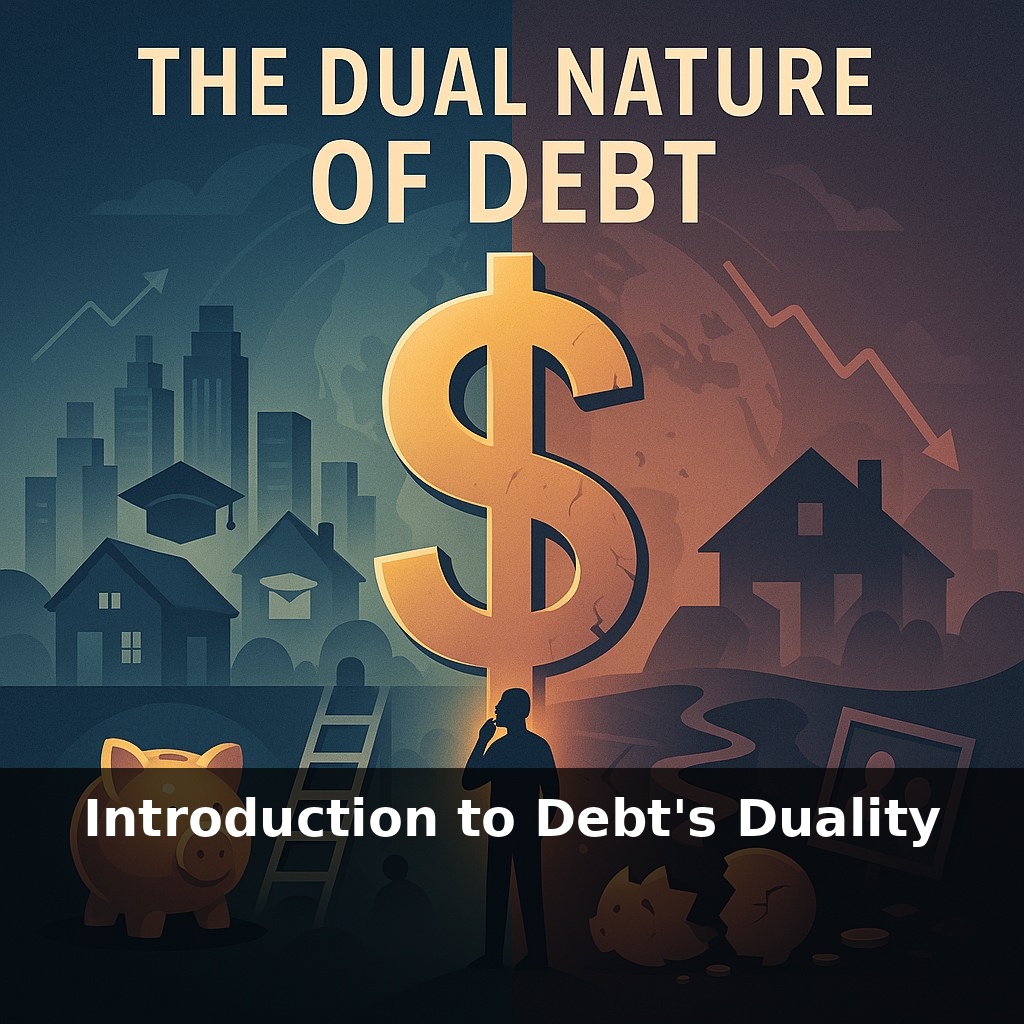
Introduction to Debt's Duality
📝 Transcript
Global debt now towers above the world’s yearly income, yet most of us rely on it just to own a home or get an education. A tool that powers nations and also breaks families—how can the same borrowed dollar build a fortune in one case and spark disaster in another?
A strange pattern shows up whenever debt gets cheap: people, companies, and even governments start treating tomorrow’s income as if it’s already in their pockets today. Ultra-low interest rates in the 2010s fueled everything from soaring housing markets to tech startups burning cash in pursuit of growth. When money felt “free,” caution felt old‑fashioned. Then rates surged: U.S. mortgages jumped from around 3 % to over 7 %, cutting buyers’ budgets overnight and exposing who had quietly been depending on permanently easy money. At the national level, countries like Greece learned how quickly confidence evaporates when lenders doubt you can roll over what you owe. In markets, heavily indebted firms lagged as borrowing costs climbed, while stronger balance sheets suddenly looked wise, not boring. Debt didn’t change—conditions around it did, revealing how fragile some “success” really was.
Zoom in from the global picture to a single decision: signing your name on a loan. That signature quietly links your future paychecks, or a company’s future cash flows, to promises made today. Whether that link becomes a springboard or a trap depends on one hard number: does what you earn on that borrowed money reliably exceed what it costs you? Households feel this when a promotion makes a fixed mortgage easier, or a layoff suddenly makes the same payment unbearable. Firms feel it when an expansion pays off—or when higher rates turn yesterday’s “cheap” loan into today’s profit drain.
At every level—household, company, government—the same quiet calculation sits in the background: what does this borrowing *let me do* that I couldn’t do otherwise, and how reliably will it pay for itself?
For a person, that might be buying years of education, relocating for a better job, or starting a small business. The payoff isn’t guaranteed, but it is at least *measurable*: higher expected income, lower long‑run rent, or a new revenue stream. That’s fundamentally different from running up a card for lifestyle upgrades that fade while the bill remains. Both transactions increase what you owe; only one increases what you can earn.
Firms make a similar trade‑off. Taking on obligations to build a factory, acquire a competitor, or develop a product line can raise future cash flows far more than the added interest. That’s when leverage works like a force multiplier: shareholders keep the upside after lenders are paid. But the same structure turns ruthless when revenue slows or conditions tighten. With obligations fixed and income variable, a mild downturn can wipe out equity long before obligations stop coming due.
Public borrowing adds another layer. Governments don’t just chase profit; they finance infrastructure, health, and security. Borrowing to build a port that boosts trade, or a power grid that cuts outages, can enlarge the tax base later. Borrowing simply to roll old obligations, or to cover persistent gaps between spending and tax revenue without reforms, gradually narrows room to maneuver. As more of each tax dollar goes to bondholders, less is left for everything else.
Across all three, timing and flexibility matter as much as size. When payments are far in the future, linked to stable income, and denominated in a currency you control, the same obligation is far less dangerous than one due soon, in cash, to a nervous lender. And when you keep some buffer—savings, unused credit lines, assets that can be sold without destroying the core operation—you gain the option to adapt before others decide for you.
In practice, “good” use tends to share three traits: it builds or protects productive capacity, it’s sized for pessimistic scenarios rather than optimistic ones, and it leaves the borrower with meaningful choices if the world turns.
Think of three friends facing the same crossroads: stay put or stretch with a loan.
The first uses a small business line of credit to buy inventory only after confirming preorders. Revenue arrives within weeks, interest is trivial, and the limit can be cut back if demand cools. Here, borrowing is tied to a short, visible path from cash going out to cash coming back.
The second friend layers personal loans on top of a car note to fund “networking trips” that might lead to opportunities someday. There’s no clear metric for payoff, only a hope that future income rises fast enough to outrun the mounting obligations.
The third is a founder who raises debt instead of equity to avoid dilution. While sales grow, it feels clever. But when a key customer defects, mandatory payments suddenly dictate every decision—from hiring freezes to shelving promising projects—because missing one due date risks losing control entirely.
Your own choices sit somewhere along this spectrum: how tightly do you connect each dollar you borrow to a realistic, testable source of repayment?
A world with pricier credit reshuffles who gets to take risks. Projects that once cleared the bar now stall, while cash‑rich players can scoop up distressed assets like athletes signing undervalued free agents. Households may delay big life moves, slowing mobility but also curbing excess. As fintech and DeFi widen access, the real frontier becomes *judgment*: who can translate a future that’s foggier and more volatile into obligations they can still carry when the weather turns.
Seen this way, the real question isn’t “Is borrowing good or bad?” but “What future am I quietly betting on?” Treat each new obligation like committing to a long training season: you’re locking in early‑morning runs before knowing how the championship ends. The more uncertain your league, the more conservative your schedule needs to be.
To go deeper, here are 3 next steps: 1) Open a free account with a payoff simulator like Undebt.it or the “Debt Payoff Planner” app and plug in every debt you have (balances, minimums, and interest rates) so you can visually model how “good” vs “bad” debt behaves over the next 12–24 months. 2) Grab a copy of *The Psychology of Money* by Morgan Housel and read the chapters on leverage and risk this week, then contrast that with your own student loans, credit cards, or mortgage to decide which are truly productive (wealth-building) and which are extractive (wealth-draining). 3) Visit your bank or brokerage’s website today and compare the interest rate on your highest-interest debt to the expected return of a simple low-cost index fund (like VTI or VOO); if your debt rate is higher, set up or increase an automatic extra payment, and if it’s lower, open (or fund) a Roth IRA and schedule a recurring contribution, treating that as “good” intentional leverage for your future.
From this course
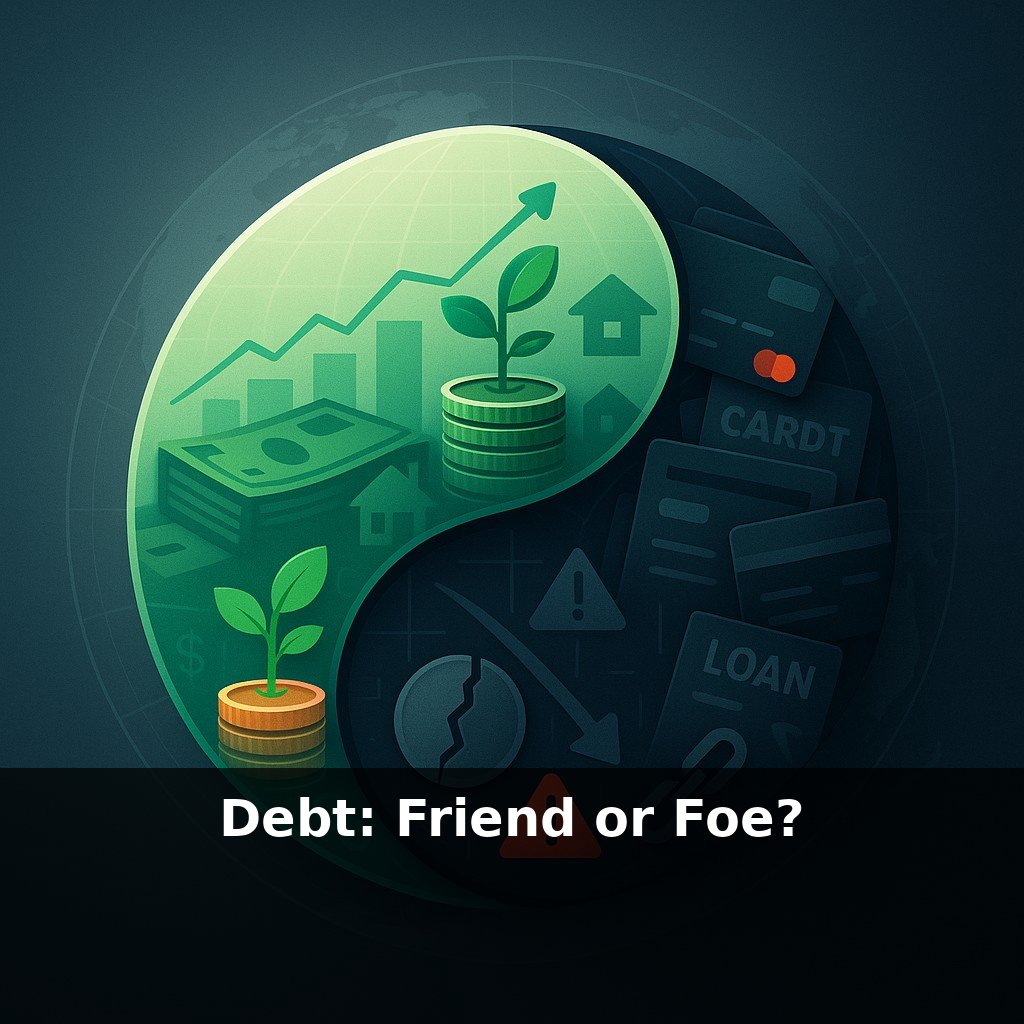
Debt: Friend or Foe?
6 episodesUnlock all episodes
Full access to 6 episodes and everything on OwlUp.
Subscribe — $1.99/monthLess than a coffee ☕ · Cancel anytime