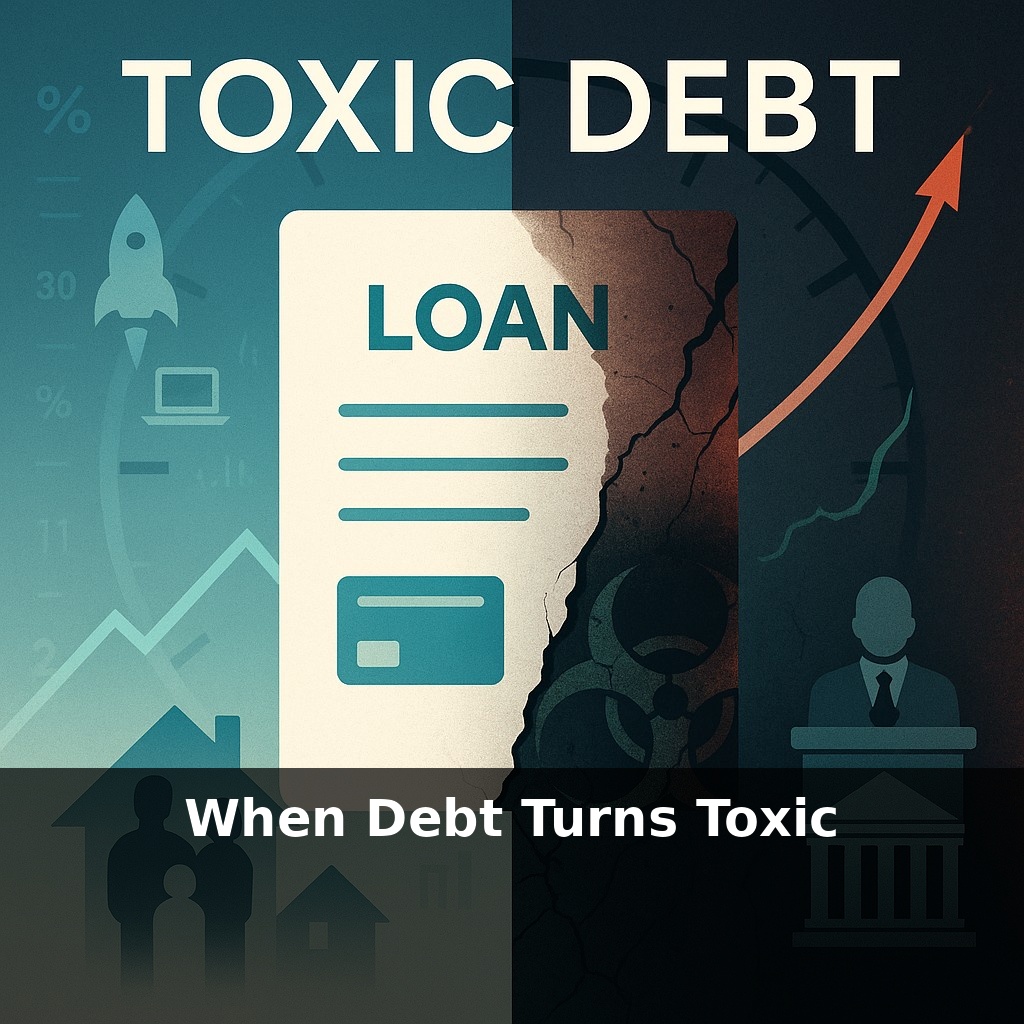
Debt levels are now more than three times the world’s yearly income, yet a surprising number of people believe their own debt is no cause for concern. A young family, a start-up founder, and a government minister enter into seemingly ordinary loans—unknowingly, one of them is teetering on the brink of toxicity.
A quiet shift is often what turns a normal loan toxic. The family doesn’t suddenly lose their house; first, their mortgage resets a bit higher, their credit‑card balance creeps up after a medical bill, and a missed payment gets “fixed” by rolling it into a new, longer loan. The founder doesn’t instantly blow up the start‑up; they accept looser covenants, then plug every cash shortfall with another convertible note. The minister doesn’t announce a crisis; they approve one more off‑budget guarantee to keep a fragile bank or builder alive. Each step feels like a small adjustment, but together they change what the debt *is*. The warning signs aren’t only numbers on a spreadsheet—they’re patterns of behavior: stretching maturities, masking risk, and depending on tomorrow being just like today. That’s when debt quietly starts working against you instead of for you.
Regulators and investors actually track when ordinary debt starts mutating into something dangerous. They watch for sudden jumps in leverage, loans stacked on shaky collateral, and complex structures no one fully understands. When U.S. credit‑card delinquencies climb to decade‑highs, or when a single sector—like Chinese real estate—swells to a quarter of national output, professionals read it as rising systemic fragility. Your own finances, your employer, and even your government sit inside that system, so “toxic” is less a niche Wall Street term and more a description of how fragile your everyday safety net has become.
When professionals talk about toxic debt, they usually mean three things have gone wrong at once: the borrower’s cash flow, the collateral, and the way the loan was built in the first place.
Start with capacity to pay. A company or household doesn’t have to be underwater yet for danger to build. The red flag is when more and more income is pre‑committed just to stay current. In data, that shows up as rising debt‑service ratios; in real life, it’s when a business can’t fund a new project without asking its bank for “just a bit more room,” or a family can’t handle any surprise expense without swiping the card again. Loss of *flexibility* is the first layer of toxicity.
Next comes collateral. Lenders comfort themselves with, “We’re covered by the assets.” That worked—until 2008, when supposedly rock‑solid, AAA‑rated CDO tranches ended up losing up to 90% of their value. You see the same risk in Chinese developers that borrowed heavily against ever‑rising land and apartment prices: once sales slow and prices stall, yesterday’s “safe” loan becomes a bet that someone else will overpay tomorrow. Toxicity shows up whenever the loan only makes sense if prices keep climbing.
The third ingredient is structure. Complexity can hide who ultimately eats the loss. Short‑term wholesale funding that constantly needs rolling over, long chains of interlinked guarantees, or securities that slice and repackage thousands of loans—all of these can turn a small pocket of bad credit into a system‑wide shock. That’s why rapid leverage build‑ups and opaque instruments worry regulators more than a single big default.
Put together, these layers create a feedback loop: missed payments erode lender capital, lenders pull back credit, weaker borrowers lose access first, spending falls, and suddenly layoffs and budget cuts make even previously healthy debts harder to service. The shift from “manageable” to “toxic” is less about one dramatic event and more about how fragile the whole network becomes when too many players are stretched at the same time.
A tech company gives a clean example of how ordinary debt can drift into the danger zone. In year one, it borrows modestly to build a new data center, locking in a fixed interest rate. Revenue grows, interest is covered, and the debt helps scale the business. In year three, growth slows but management wants to hit aggressive targets, so they layer on a second loan tied to a volatile new product. By year five, they add short‑term funding to finance share buybacks, betting the stock price will stay high. Nothing obviously “blows up,” yet now three different cash flows have to line up almost perfectly to keep every lender happy.
Sports offers a similar pattern. A football club finances a new stadium with a long‑term loan based on steady ticket sales. Then performance dips, broadcasting revenue is renegotiated, and the club borrows again to sign star players who are supposed to reverse the slump. If results don’t improve quickly, the club isn’t just dealing with one tough season; it’s juggling obligations that only made sense under best‑case assumptions.
Toxic debt today may not look like subprime did in 2008. Climate rules can quietly turn once‑profitable oil projects into loss‑making relics, leaving banks with loans to assets nobody wants. App‑based credit and “pay-in-4” offers can scatter small risks across millions of users until job losses line them up at once, like tiles in a digital domino chain. Meanwhile, aging societies and rising defense budgets can corner governments into choices between harsher taxes, service cuts, or letting inflation erode what they owe.
So the real skill isn’t avoiding debt; it’s learning to read its mood. Healthy borrowing funds tools, skills, and assets that keep earning even if your income stumbles. Watch how often repayments depend on perfect forecasts—flawless sales, nonstop growth, zero policy shocks. When every month must be a bullseye, you’re not financing progress, you’re balancing spinning plates.
Try this experiment: For the next 7 days, put every single non‑essential purchase (streaming, eating out, Amazon, in‑app buys, etc.) on *pause* and keep a sticky note on your debit/credit card that says: “Will this still matter when this debt is gone?” Each time you *almost* buy something, instead log the exact amount in a “Debt Detox” note on your phone and transfer that money the same day to one specific toxic debt (the card or loan with the highest interest). At the end of the week, compare: how much extra went to that debt, how many “almost purchases” you had, and how your stress about that particular debt feels on a 1–10 scale versus last week.