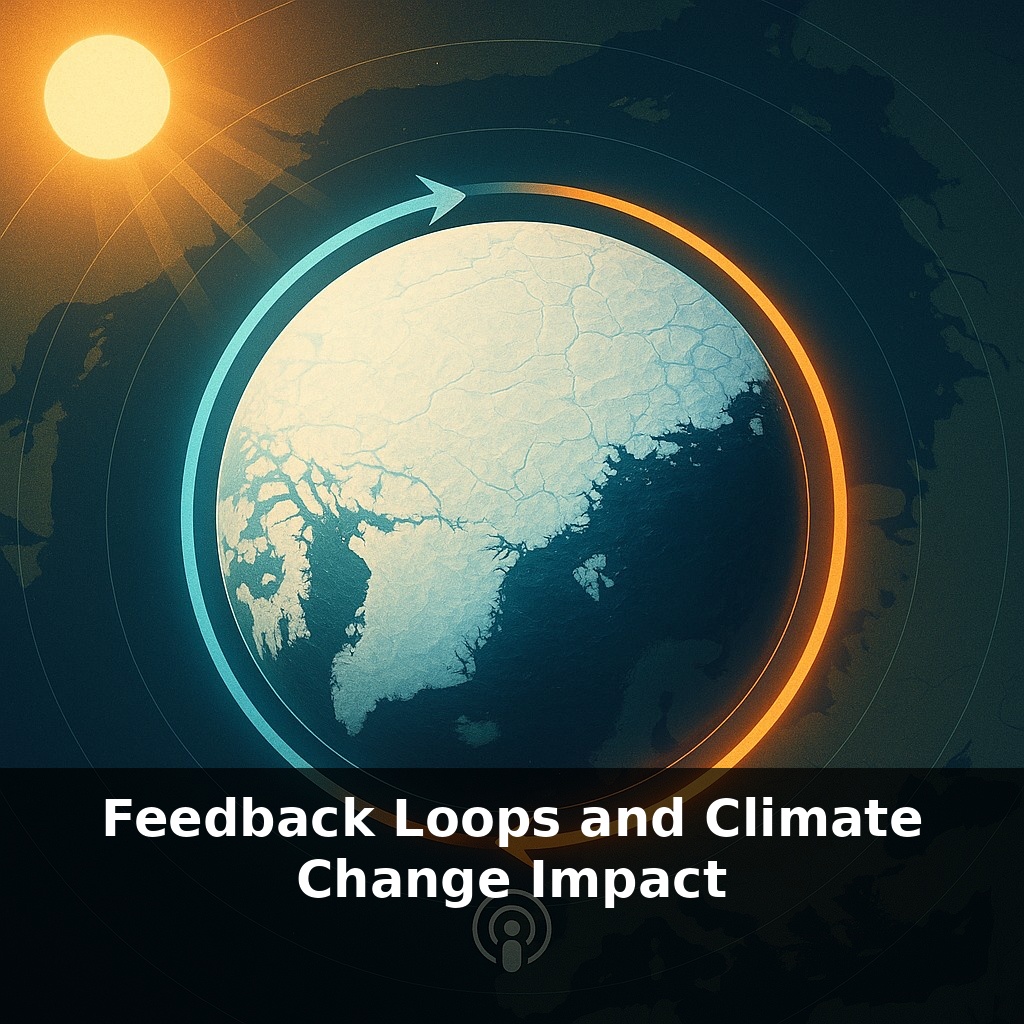
Right now, ice at the top of the world is vanishing so fast that late‑summer Arctic sea ice is down to roughly a quarter of what it used to be. Yet the real shock is this: the less ice we have, the more heat we trap. In this episode, we’ll explore how that loop quietly rewrites our future.
In the last section, we saw how one feedback in the Arctic can speed up warming. But the Arctic is only one “voice” in a much larger climate choir. As the planet warms, other parts of the Earth system start to sing louder too—some raising the temperature further, some softening the tune, and some still so uncertain that scientists argue over whether they’ll harmonize or clash.
Water vapor thickens the insulating blanket around the planet. Thawing permafrost threatens to leak ancient carbon. Certain clouds may cool or warm us, depending on their type and altitude. And over it all, a powerful stabilizing response steadily radiates excess heat to space, preventing Earth from running away into Venus‑like conditions.
In this episode, we’ll trace how these feedbacks connect, and why small policy choices today can echo for centuries.
As scientists map these feedbacks, they’re not just listing separate quirks of the climate system; they’re tracing how one change can nudge another, then another, until the overall pattern shifts. A warmer atmosphere alters rainfall belts, which can dry some forests and stress others, changing how much carbon they absorb or release in fires. Shifts in snow cover reshape regional rivers and the timing of spring melt, with knock‑on effects for agriculture and hydropower. Bit by bit, these links determine whether human emissions trigger a modest warming—or unlock a far bigger, longer‑lived transformation.
Roughly three‑quarters of late‑summer Arctic sea‑ice volume has vanished since 1979, yet that’s only one piece of why scientists worry about feedbacks. The bigger story is how multiple loops stack. Each one might add only a little extra warming to a given CO₂ increase, but together they decide whether 2 °C of human‑driven forcing feels more like 2.5 or 3 °C—or pushes us toward thresholds we can’t easily reverse.
Start with the basic “bookkeeping.” For every degree the planet warms, the Planck response quietly pushes back, increasing infrared energy sent to space by about 3.2 W/m² per °C. If that were the only feedback, Earth would warm modestly for a CO₂ doubling. But it’s not alone. Water vapor, clouds, snow, vegetation, and carbon stores all modify how much extra heat stays in the system.
When researchers bundle those together in climate models and compare them to past climate shifts—like ice age cycles—they infer an equilibrium climate sensitivity of roughly 2.5–4 °C per CO₂ doubling. Most of that spread comes from uncertainties in feedbacks, especially clouds. A 0.5 °C difference in sensitivity may sound abstract, but at global scale it’s the contrast between difficult adaptation and widespread, chronic disruption.
Some loops also carry tipping points. As permafrost thaws, gradual emissions can accelerate if soils collapse, wetlands expand, or fires become more frequent. Forests stressed by heat and shifting moisture can flip from carbon sinks to sources when drought and pests kill trees faster than they regrow. These aren’t instantaneous global “switches,” but regional thresholds that, once crossed, commit us to decades or centuries of extra emissions even if human output falls.
On the other side, certain negative feedbacks may strengthen. Warmer conditions can lengthen growing seasons in some regions, enhancing plant uptake of CO₂—until heat, nutrient limits, or water stress offset the gain. The oceans currently absorb around a quarter of our CO₂ emissions, but as surface waters warm and stratify, that service weakens.
Policy choices today influence how many of these reinforcing loops we actually trigger. Limiting peak warming doesn’t just cap temperatures; it reduces the likelihood that slow, long‑lived feedbacks—frozen soils, stressed forests, sluggish oceans—lock in additional warming that future generations can’t easily pull back from.
A small, concrete example: in parts of the western United States, hotter summers and shifting precipitation have helped turn some dense pine forests into tinderboxes. When those forests burn, they don’t just release the carbon stored in trunks and needles; dark, charred ground can absorb more sunlight until regrowth begins, subtly nudging local temperatures and drying toward more fire‑prone conditions. Far away in the tropics, repeated heatwaves and droughts have pushed some sections of the Amazon closer to acting like a seasonal source of carbon instead of a steady sink, especially when fires follow logging. Meanwhile, cities create their own mini‑feedbacks: dark roofs and asphalt boost local heat, driving up air‑conditioning use and electricity demand, which in many regions still relies on fossil fuels. Together, these regional loops don’t rival the big global players, but they can tilt the balance—much like a series of small detours slowly shifting a long journey onto a very different route.
Policies that ignore feedback risks are like travel plans that only account for the first flight, not the layovers that can cascade into missed connections. As monitoring networks sharpen, they’ll reveal which “layovers” are most delay‑prone: regions where forests, coastal wetlands, and ocean fronts may abruptly shift their role in the carbon cycle. That evidence can guide where restoring mangroves, rewetting peatlands, or cooling cities delivers outsized leverage.
So the puzzle isn’t just how much CO₂ we emit, but how many sleeping “echoes” in the Earth system we wake up. Some are already stirring; others may stay quiet if warming peaks lower and earlier. Your challenge this week: trace one local chain—heat to demand to emissions—and ask where a single “link” could be redesigned to soften the loop.