The Dawn of Political Systems
📝 Transcript
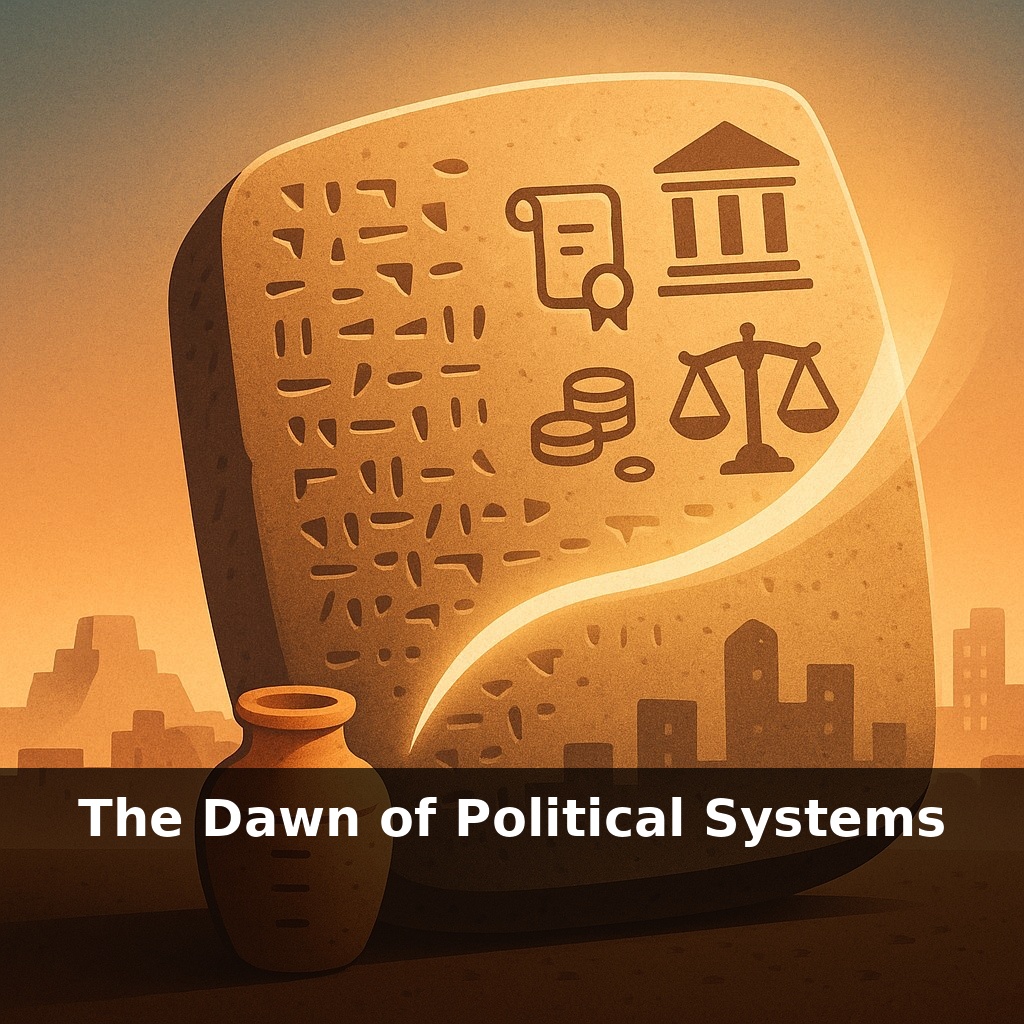
The first known city records in human history aren’t heroic tales or battle reports—they’re beer receipts. Workers in ancient Uruk were paid in liquid wages. In this episode, we’ll follow how those humble ration lists grew into laws, taxes, and full-blown governments.
Those ancient records from Uruk hint at a deeper shift: somewhere along the way, loose agreements and face‑to‑face trust stopped being enough. When a community is small, you can remember who owes whom a favor, the way a family remembers who cooked last night. But scale that up to thousands of strangers, and memory breaks. You need shared rules that live outside any one person’s head.
In this episode, we’ll move backward and forward at once: back to foraging bands where status was fluid and leaders could be ignored, and forward to the first city temples where decisions hardened into permanent offices and roles. We’ll look at why dense populations, controlled resources, and organized violence pushed humans toward hierarchy—and why some societies, like the Iroquois Confederacy, experimented with power‑sharing instead of simple top‑down rule.
As groups grew, another problem emerged: who controls *information* about the group itself? Lists of workers, records of stored grain, treaties with neighbors—these aren’t just notes, they’re levers of power. In many early cities, priests or scribes became gatekeepers, because they alone could read and write the symbols that tracked obligations and promises. That control quietly shifted who could speak “for” the community. Meanwhile, in places like Göbekli Tepe, large ritual sites hint that shared stories and ceremonies may have stitched people together long before anyone crowned a king or drafted a law code.
When archaeologists sift through the earliest city layers, one pattern jumps out: counting comes before commanding. Long before royal statues dominate the skyline, we see tokens, seals, and tallies. First someone tracks how much grain moved through a storehouse, then someone else gets to decide *whose* grain it is. Control over the numbers quietly becomes control over people.
But this wasn’t the only path. For most of human history, small foraging groups treated anyone trying to “be the boss” with mockery, desertion, or both. Anthropologists call this “reverse dominance”: the many ganging up, socially, to keep any would‑be chief in check. Leadership was a rotating role, like taking turns steering a canoe, not a permanent throne.
What changed isn’t human nature so much as human *problems*. Once fields, herds, or irrigation works could be seized, defending them required standing forces, and standing forces needed steady supplies. At a certain size and density, simply volunteering contributions stopped working reliably. That’s when we start seeing coercive collection—and with it, offices whose whole job is to say who owes what.
Still, early arrangements were surprisingly experimental. Some villages formed loose councils of elders; others followed war leaders only during crises; others fused sacred authority and practical management in temple complexes. Göbekli Tepe, with its massive stone circles built by non‑farming groups, hints that large‑scale coordination around ritual could precede permanent settlement—though what kind of authority, if any, governed those gatherings remains intensely debated.
Later, in places like Mesopotamia, rules were literally carved in stone. Codified penalties and procedures didn’t necessarily make life fair, but they did make expectations more predictable. Meanwhile, on another continent, the Haudenosaunee (Iroquois) Confederacy wove an alliance across multiple nations through a charter emphasizing consensus and constraints on leaders—an approach that would echo centuries later in colonial debates about union.
Your challenge this week: whenever you encounter a rule—at work, in traffic, online—ask: *who* benefits from this being written down, and *who* gains the power to interpret or enforce it? By the end of the week, map three concrete cases where a rule quietly redistributes authority, even if it looks neutral on the surface.
Think of a group chat that suddenly needs moderators. At first, everyone just talks. Then spam appears, tempers flare, and someone pins a post with “rules.” The moment that happens, new roles emerge: who writes the rules, who can mute, who can invite or ban. Early political systems grew from similar frictions—too many interactions, too much at stake to leave everything informal.
Göbekli Tepe adds a twist: circles of carved stone where scattered groups met, not to farm or trade, but to share rituals. No king’s throne there, but you still needed organizers: people who decided *when* to gather, *who* supplied food, *which* stories were told. Think of them less as rulers, more as event hosts whose influence accumulated over time.
Now jump to the Iroquois Great Law of Peace. Instead of one host, many “condolence chiefs” shared responsibility, with built‑in checks. The political “operating system” here spread decision‑making across multiple processors, rather than running everything through a single central unit.
As online platforms experiment with votes, tokens, and DAOs, we’re quietly replaying Stone‑Age arguments with cloud servers as our meeting grounds. The twist: decisions now ripple across continents in seconds. When a small protocol tweak changes who can speak, earn, or exit, it resembles a new village compact—only with millions of “villagers.” Expect hybrids: formal states setting boundaries while semi‑autonomous digital clans negotiate, fork, and migrate in real time.
Politics didn’t start in marble halls; it began in campfire debates about who hunts, who stays, who decides. Think of today’s group projects, open-source repos, or neighborhood chats: each time we coordinate beyond close friends, we’re quietly beta‑testing new micro‑constitutions, updating humanity’s long, improvised patch notes for living together.
Try this experiment: For the next 24 hours, run your household (or shared living space) like three different political systems from the episode—first as a tiny “band” (decisions by whoever actually does the work), then as a “tribe” (decisions by informal consensus), and finally as a “chiefdom” (one person has final say but owes everyone clear benefits). For each meal, switch the system: breakfast as band, lunch as tribe, dinner as chiefdom, and consciously decide who chooses the menu, who enforces “rules,” and how disagreement gets handled. At the end of the day, quickly rate which system felt fairest, fastest, and most stable—and notice which one people naturally resisted or slipped back into.
From this course
Decoding Political Systems: From Monarchy to Democracy
5 episodesUnlock all episodes
Full access to 5 episodes and everything on OwlUp.
Subscribe — $1.99/monthLess than a coffee ☕ · Cancel anytime