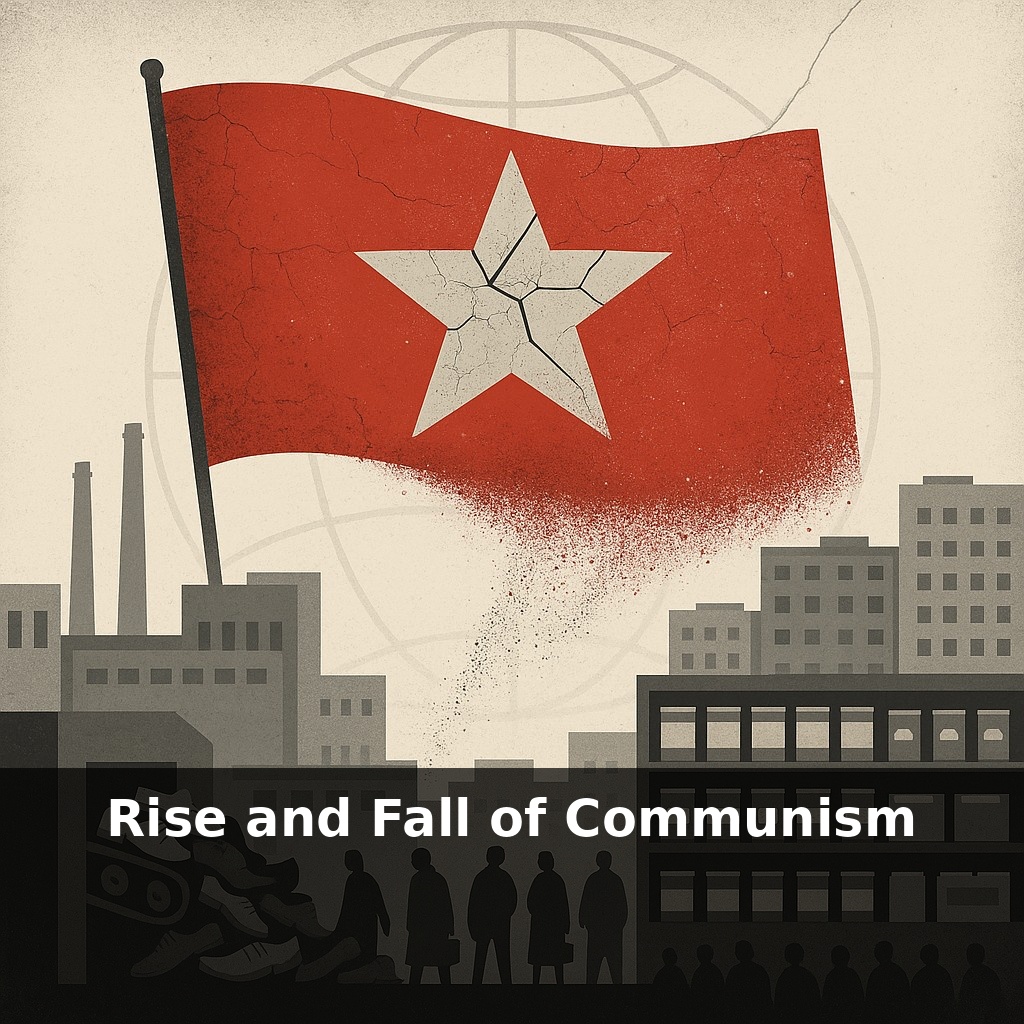
One in every three people on Earth once woke up under a government that called itself communist. Today, that world has almost vanished. In this episode, we drop straight into the moment when a system that claimed to abolish inequality began quietly collapsing from within.
Factories hit their output targets—but produced mountains of shoes no one wanted. Supermarkets stocked identical gray cans whose labels promised more than the shelves delivered. Scientists could launch satellites, yet struggle to buy decent sausages. Daily life in much of the communist world was full of these small contradictions: impressive numbers on paper, stubborn shortages in practice.
To see why, we have to move closer to the ground: to the planners with their five-year tables, the workers watching the clock, and the party officials trying to keep everything—and everyone—in line. Instead of asking only why the system eventually broke, we’ll ask how it actually functioned on an ordinary Tuesday.
Think of a giant spreadsheet that tries to list every nail, tractor, and textbook in an entire country. The cells don’t just track reality; they start to shape it. In this episode, we’ll explore what happens when life has to fit the table, instead of the table fitting life.
The numbers in that spreadsheet didn’t appear from nowhere. They flowed from a hierarchy of institutions: ministries, planning commissions, and local committees, each lobbying to look successful and avoid blame. A steel plant might exaggerate its capacity to gain prestige; a regional bureau might lowball its promises to guarantee over-fulfillment. Like a recipe handed through too many kitchens, each step subtly distorted the original idea. By the time directives reached the shop floor, plans reflected politics and fear as much as resources and demand. This is where theory met the petty struggles of careers, favors, and survival.
Walk down that hierarchy to the workshop, and the tables suddenly translate into very personal stakes. A manager knows that missing a quota risks a harsh Party meeting—or worse. Hitting it, however, can mean a bonus, a promotion, or at least peace. So he negotiates the only variables he can control: quality, honesty, and time.
If the plan demands 10,000 tons of nails, he may quietly switch to making a few massive ones that meet the weight requirement but are useless for carpenters. If the target is counted in pieces, he floods the market with tiny, flimsy nails that bend on contact. On paper, everything shines. In practice, cupboards wobble and repairs fail.
Workers learn this logic fast. Doing exactly what the plan demands—but no more—keeps them safe. Innovating without permission risks exposing flaws higher up, which can backfire. Sometimes they sabotage their own efficiency: breaking a machine near year’s end to avoid next year’s target being raised to an impossible level. “We pretend to work, and they pretend to pay us,” became a bitter joke, but also a coping strategy.
Meanwhile, whole sectors tug against each other. Heavy industry gets priority in resources and prestige; consumer goods are an afterthought. Ministries in charge of coal, steel, or machinery compete for materials, transport, and skilled people. Each hoards inputs “just in case,” creating bottlenecks somewhere else. A missing gasket in one plant can delay thousands of cars, but reporting that shortage truthfully might reveal earlier lies in the chain.
Over time, this produced a strange duality. Officially, abundance was always just around the corner. Unofficially, everyone relied on “connections” to get a better apartment, spare parts, or oranges at New Year. Barter thrived behind the statistics: a doctor trades priority access at a clinic for a mechanic’s help; a truck driver quietly diverts goods to a market stall.
The system did deliver rapid breakthroughs in specific moments—dams, rocket launches, crash industrialization—when clear goals and concentrated resources aligned. But the more complex everyday life became, the harder it was for the hierarchy to coordinate the countless small decisions that keep a modern society running smoothly.
Consider food. In many Eastern European countries, people lined up at dawn for basics not because farms vanished, but because distribution kept misfiring. A truckload of meat might arrive unannounced at a distant town, while a nearby city went days with empty counters. Local managers, scared of being blamed, often hid reserves “for later,” deepening today’s shortages to guard against tomorrow’s plan.
Housing followed similar patterns. New apartment blocks rose quickly on city edges, but interior walls were thin, pipes leaked, and elevators broke with no spare parts in sight. A family might wait years for a flat, then spend more years informally trading favors to fix what the construction brigade rushed.
Innovation, too, moved in zigzags. A research team could design a better washing machine motor, but persuading multiple ministries to adjust specifications, suppliers, and repair manuals was so exhausting that many quietly shelved improvements. Choices that looked “irrational” from the top often made perfect sense for people trying to avoid risk in a tightly watched environment.
These breakdowns echo forward. Today’s platforms quietly “plan” our feeds, rides, and warehouses, nudging millions of choices at once. Bias in a ranking formula or demand forecast can ripple out like a mis-coded recipe, leaving some overflowing, others short. As debates about climate, housing, and health push more activity into public or algorithmic hands, the lesson is less “never coordinate” than “never trust a black-box planner without feedback, exit options, and real transparency.”
In the next episode, we’ll zoom out from shop floors to streets and kitchens: how people hacked the rules, from black-market jeans to secret cassette tapes. Systems can crack, yet their habits linger—like software that’s been uninstalled but still leaves traces in your files. Your challenge this week: notice where old rules still steer new choices.