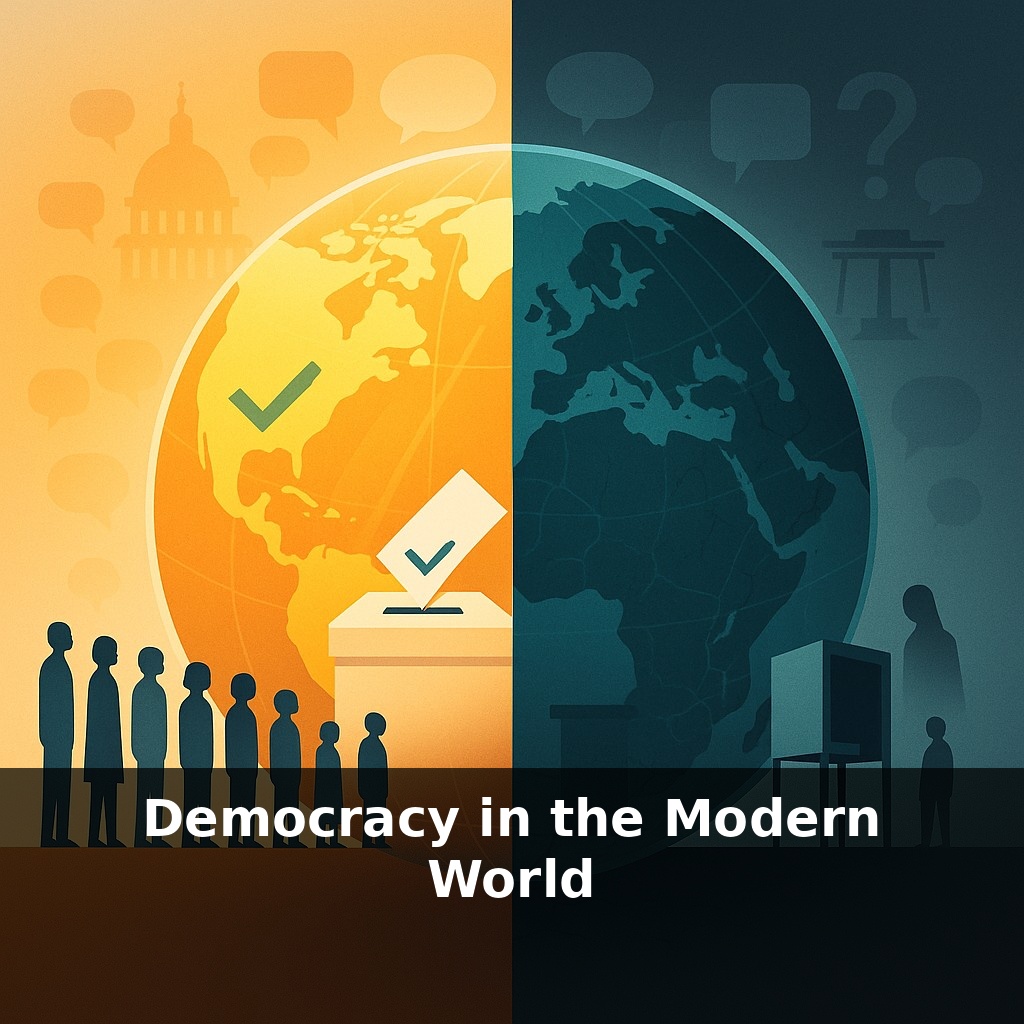
Right now, more people can vote on their leaders than at any point in human history—yet trust in democracy is quietly sinking. In one country, millions line up for hours to cast a ballot; in another, people stay home. Why does the same system inspire hope in some, and doubt in others?
In 1974, only a few dozen countries met basic democratic standards; today, that number has more than tripled. On paper, it looks like democracy is winning. But under the surface, the story is messier. Some “democracies” now keep elections while quietly weakening courts, targeting journalists, or rewriting rules to favor those already in power. Others struggle as a tiny economic elite shapes policy more than the people do. And online, false stories can spread faster than official results, blurring what citizens believe is real. At the same time, design choices matter: electoral systems that reward compromise tend to seat more women and minorities, while those favoring winner-take-all battles can deepen divisions. The puzzle is no longer just “Does a country hold elections?” but “How deep, equal, and resilient is its democracy when stress hits?”
In many countries, the formal rules on paper look solid, yet the lived experience of citizens diverges sharply. Two neighbors may share a border but not the same voice: one has strong local councils and public hearings, the other centralizes decisions in the capital. Digital platforms further scramble the picture—recommendation algorithms can amplify polarizing voices, while quieter, consensus-driven groups rarely trend. Meanwhile, design tweaks—like moving from winner-take-all races to proportional lists—can shift who enters parliament, whose concerns get budget priority, and how conflicts are bargained down.
In 2023, 115 countries qualify as electoral democracies—yet that headline masks a quieter trend: the peak was 120 back in 2008, and since then the curve has flattened and bent slightly downward. The expansion wave has slowed, and in some places is reversing. Political scientists call this “democratic backsliding”: leaders keep formal procedures but slowly hollow out constraints, tilt the playing field, or intimidate opponents until real competition shrinks.
One clue to resilience lies in a dry-sounding variable: income. Research by Adam Przeworski and colleagues suggests that rich democracies—roughly above a GDP per capita of about $12,000—almost never slide back into full autocracy. The data set still needs constant updating, but the pattern is striking. Wealth doesn’t guarantee fairness or equality, yet it seems to make outright breakdown rarer, perhaps because more citizens and firms have something to lose if politics turns unpredictable.
Another clue sits inside parliaments. Where seats are allocated proportionally rather than through winner-take-all races, women’s representation is, on average, 8–10 percent higher. That isn’t automatic progress; it usually comes from parties placing women on lists, adopting quotas, and competing for diverse constituencies. Over time, this changes budget debates—issues like childcare, healthcare, and gender-based violence move closer to the center, subtly reshaping what the state is expected to deliver.
But participation inside these systems is uneven. Across OECD countries, people over 55 turn out roughly 20 percentage points more than citizens aged 18–24. That gap skews incentives: officials have strong reasons to protect pensions, but weaker ones to tackle housing affordability, student debt, or climate policy at the pace younger generations want. The rules might be neutral, yet the chorus they hear from the polling booth is pitched in an older key.
Scale adds another layer of complexity. When India organizes its national contest, it manages logistics for around 912 million eligible participants: multi-phase scheduling, millions of poll workers, security forces, and reams of paper and electronic infrastructure stretched across megacities and remote villages. The feat illustrates how contemporary systems must be both massively centralized in coordination and deeply local in execution.
The core tension of the modern era is this: the formal architecture has never been more widespread, but its performance depends on social habits, economic structures, and digital ecosystems that evolve much faster than constitutions do.
A useful way to see modern systems is to look at specific design “tweaks” and how they play out. In New Zealand, shifting the voting formula in the 1990s pushed big parties to negotiate with smaller ones, which in turn elevated issues like indigenous rights and environmental protections that had struggled to get floor time. In Brazil, mandatory participation paired with digital result-reporting aims to broaden who shows up and shorten the window for rumor. In contrast, some Central European governments have redrawn district maps or changed media rules right before contests, quietly tilting competition without cancelling it.
Think of it like updating software: a patch that reallocates processing power can speed up some tasks while slowing others, even though the device looks the same from the outside. The real question is who gets to write those patches—and how often ordinary people can still force a reboot when the program no longer serves them.
By 2040, democratic power struggles may look less like rallies and more like code reviews. Parties could compete over data rules, AI oversight, and who controls climate-risk forecasts, the way they once fought over trade tariffs. As aging electorates meet restless, hyper-online youth, cross-border “issue alliances” might emerge: city networks sharing climate tools, or watchdog groups treating each new algorithm like a public budget that must be audited in daylight.
Democracy’s next test may be less about grand speeches and more about mundane habits: who reads privacy settings, joins a local budget meeting, or flags a deepfake before sharing. Like tuning a shared playlist, small choices by millions decide which voices dominate the mix—and whether future rules feel like background noise or a rhythm people still want to dance to.
Start with this tiny habit: When you open a news app or social media, read just *one* story all the way to the end and ask yourself, “Who decided this was important for me to see?” Then, before you scroll on, take 10 seconds to check one alternative source for the same story (for example, a public broadcaster or a non-profit news site mentioned in the episode). If the story is about elections, spend another 10 seconds looking up the official election commission page for your area. This way you’re quietly training the “democratic muscle” the episode talked about—questioning algorithms, comparing narratives, and grounding yourself in verified information.