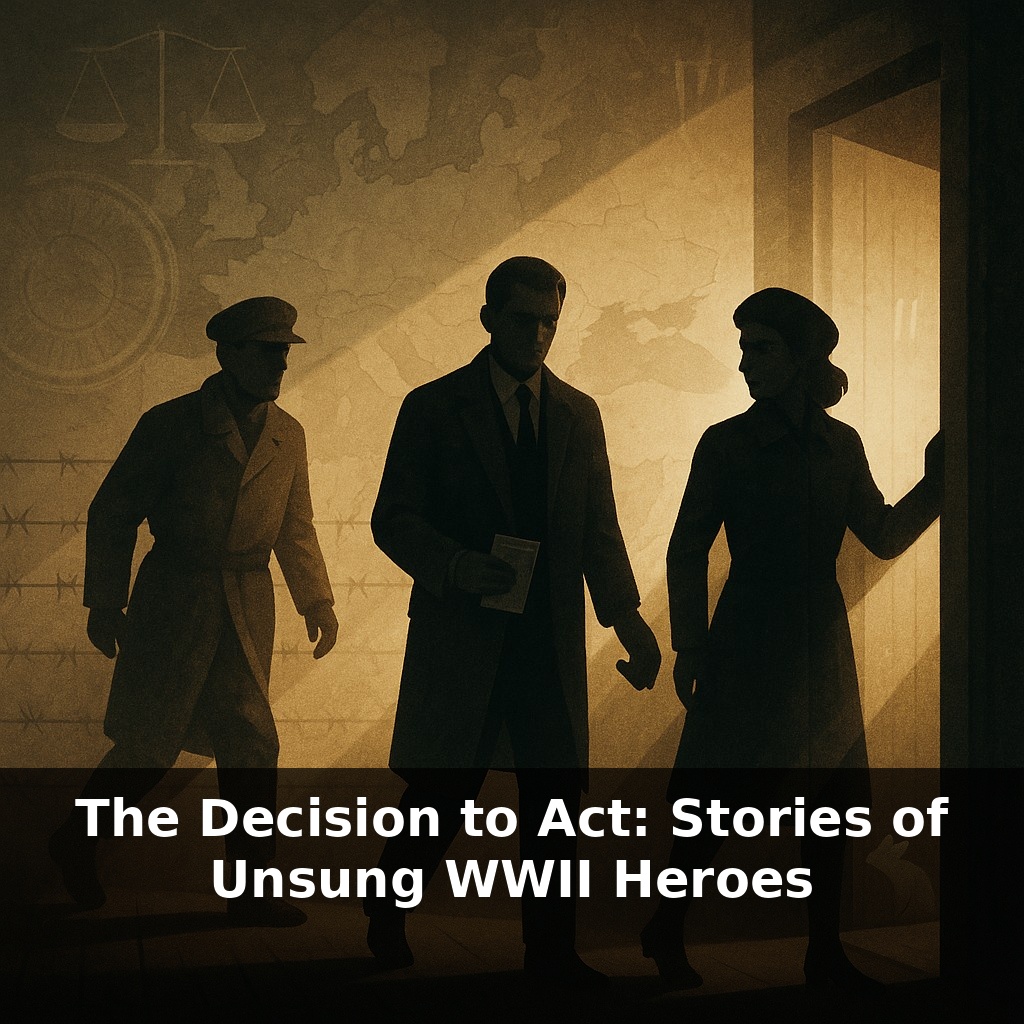
The Decision to Act: Stories of Unsung WWII Heroes
📝 Transcript
A man walks into Auschwitz not as a prisoner, but as a volunteer. A diplomat quietly ignores his government to save strangers. A young woman becomes so effective at sabotage the Gestapo calls her “the White Mouse.” This episode asks: when does one choice outweigh an entire system?
Some decisions announce themselves with sirens; others arrive like a quiet knock no one else hears. Pilecki, Sugihara, and Wake each answered that knock in a different way—one stepped into a death camp, one reached for his pen against orders, one slipped into the shadows of occupied France—yet what unites them isn’t bravery in the abstract, but a very specific pattern in how they chose. Each faced a moment where “following the rules” and “doing what felt right” split apart like a fork in a forest trail. The safe path was clearly marked; the other was overgrown, risky, and lonely. What’s striking is how ordinary the first step looked from the outside: signing a form, stamping a passport, agreeing to a mission. In this episode, we’ll trace how such seemingly routine choices became turning points for thousands of lives.
Their lives didn’t unfold as Hollywood arcs of nonstop heroism. They moved through routines—shift changes, consular paperwork, courier runs—where danger first appeared only as a faint dissonance, like a wrong note in an otherwise familiar song. What changed everything was how they responded to that dissonance. Instead of muting it, they let it get louder until it demanded action. To set the stage, we’ll zoom in on three layers around them: the bureaucracies that expected obedience, the local communities that watched in fear or silence, and the tiny, practical openings through which courage could actually be exercised.
Pilecki’s “wrong note” began in the Polish underground, poring over fragmentary reports about a new camp at Oświęcim. Others saw a black box; he saw a gap no one else was positioned to fill. The step he chose wasn’t cinematic. He let himself be swept up in a street roundup. No dramatic speech, just a quiet admission to comrades: someone has to go in, learn, organize, and report out. The pattern here is practical: he didn’t chase danger for its own sake; he matched a specific need to his specific position and skills, then accepted the cost without expecting rescue, recognition, or even success.
Sugihara’s moment looked different. In Kaunas, his desk was stacked with petitions from Polish and Lithuanian Jews. On paper, his task was clear: enforce Tokyo’s strict transit rules. Instead, he treated those rules as a starting point for problem‑solving. He negotiated with Soviet officials for rail passage, drafted telegrams to Tokyo requesting exceptions, and when refusals arrived, he recalibrated rather than stopped. He shortened application checks, interpreted guidelines as generously as possible, and wrote visas from dawn until his hands cramped. Even as he boarded the train after the consulate closed, he was still signing and throwing documents through the window. The “decision” wasn’t one dramatic outburst; it was hundreds of micro‑decisions to keep bending the line in the same direction.
Nancy Wake’s path ran through pubs, safe houses, and forest clearings in central France. Her earliest acts were small: relaying messages, smuggling people across borders, hiding downed airmen. Each time she evaded a checkpoint, she gathered more trust and more responsibility. By the time she parachuted back into France in 1944 to help coordinate Maquis units, the risks were astronomical, but the habits were familiar: verify intel, protect civilians, strike supply lines, move before the enemy can respond. Her notoriety with the Gestapo was the cumulative result of hundreds of local calculations that prioritized effect over safety.
Seen together, their choices resemble a storm front building from scattered gusts: no single breeze explains it, yet at some point the sky has unmistakably changed. None of them controlled the larger war. They did control whether the “knock” stayed abstract or turned into a concrete plan, tailored to one place, one role, one window of time—and then they kept answering it, long after the first step.
Pilecki, Sugihara, and Wake didn’t start by announcing, “I will change history.” They started closer to how people agree to mildly unreasonable favors. A friend asks, “Can you help just this once?” The “once” stretches, conditions worsen, and by the time backing out feels tempting, you’ve already become the person others rely on. Their trajectories suggest a quiet test: once you’ve seen a specific gap, how far will you allow your obligations to expand around it?
Notice what they did *before* the famous acts. Pilecki built trust in underground circles. Sugihara had a reputation for meticulous work that made his “creative” interpretations harder to dismiss. Wake cultivated contacts and fluency in local habits long before commanding fighters. The later risks rested on earlier, unglamorous competence.
Their stories also complicate how we think about cost. Each paid in a different currency: Pilecki with his life, Sugihara with his career, Wake with years of anonymity and strain. Yet none of those losses erase the fact that, for thousands of others, their names marked the boundary between disappearance and continuation.
Curricula that spotlight such “quiet pivots” can train people to scan for small hinges where their position is unusually powerful: a data analyst who spots a pattern in refugee flows, a junior diplomat who notices a loophole in sanction rules, a coder who realizes a platform feature can shield activists instead of exposing them. Your challenge this week: pick one current crisis headline and trace three concrete roles—however modest—through which an ordinary person might tilt its trajectory.
Their stories hint at a quieter question: not “Would I be a hero?” but “Where is my leverage, today?” Influence might look like moderating one heated meeting, redesigning a form so it doesn’t exclude, or mentoring one stubborn optimist. Like adding a single brick to a seawall, the act feels small—until the next storm tests where we chose to stand.
To go deeper, here are 3 next steps:
1) Watch the short documentary “The Rape of Europa” (available on Kanopy or rentable on Amazon) to see how real-life “Monuments Men” risked their lives for art, then jot down 3 operations or individuals you didn’t know about and look them up on the Monuments Men Foundation website. 2) Read the first two chapters of “A Woman of No Importance” by Sonia Purnell or “The Volunteer” by Jack Fairweather—both spotlight lesser-known WWII heroes—then pull up the WWII personnel files database at the U.S. National Archives (NARA) and search for one real person mentioned in those pages. 3) Open the “Righteous Among the Nations” database on Yad Vashem’s website, pick one rescuer whose story resembles someone from the episode, and spend 15 minutes mapping their choices on a simple timeline using a free tool like Miro or Google Drawings to see exactly how “ordinary” decisions added up to heroism.
From this course
Defying the Odds: Moral Courage and WWII Decisions
5 episodesUnlock all episodes
Full access to 5 episodes and everything on OwlUp.
Subscribe — $1.99/monthLess than a coffee ☕ · Cancel anytime