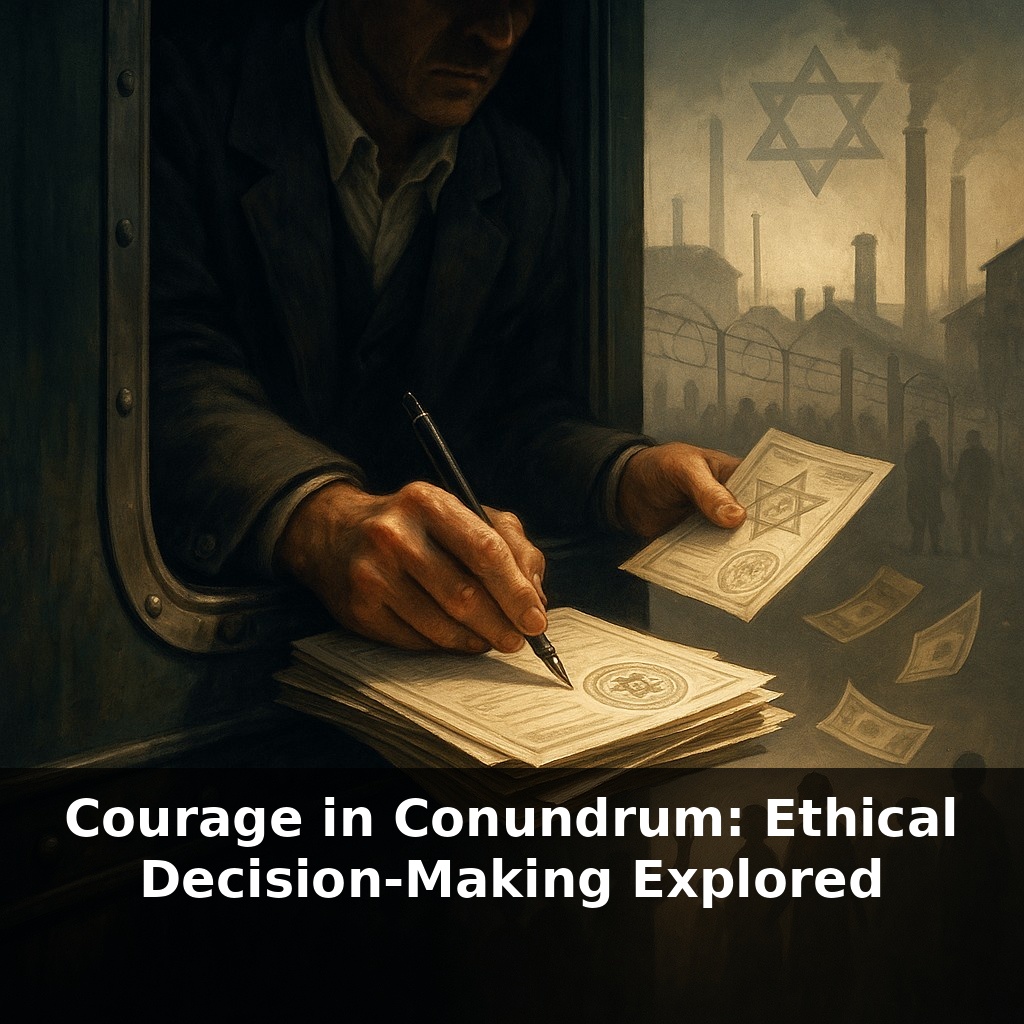
A man in a suit leans from a train window, scribbling visas until his hand cramps—while his government orders him to stop. A factory owner starts the war chasing profit, and ends it broke, having saved lives instead of banknotes. What flips that inner switch from silent witness to dissenter?
An estimated 26,000 ordinary Europeans are honored as “Righteous Among the Nations.” That number is both inspiring and unsettling: inspiring because so many acted, unsettling because it’s a tiny fraction of the millions who saw the same horrors and stayed still. The real puzzle isn’t just why a few became heroes—it’s why most didn’t, even when they felt something was wrong.
In this episode, we’ll trace how courage turned quiet discomfort into costly, concrete deeds. We’ll follow the paper trail of Chiune Sugihara’s forbidden visas, step inside resistance circles like the White Rose as they folded leaflets under threat of death, and look at what neuroscience says about the tug-of-war between empathy and obedience. Think of this as opening up the “black box” between feeling a moral jolt and actually betting your future on it.
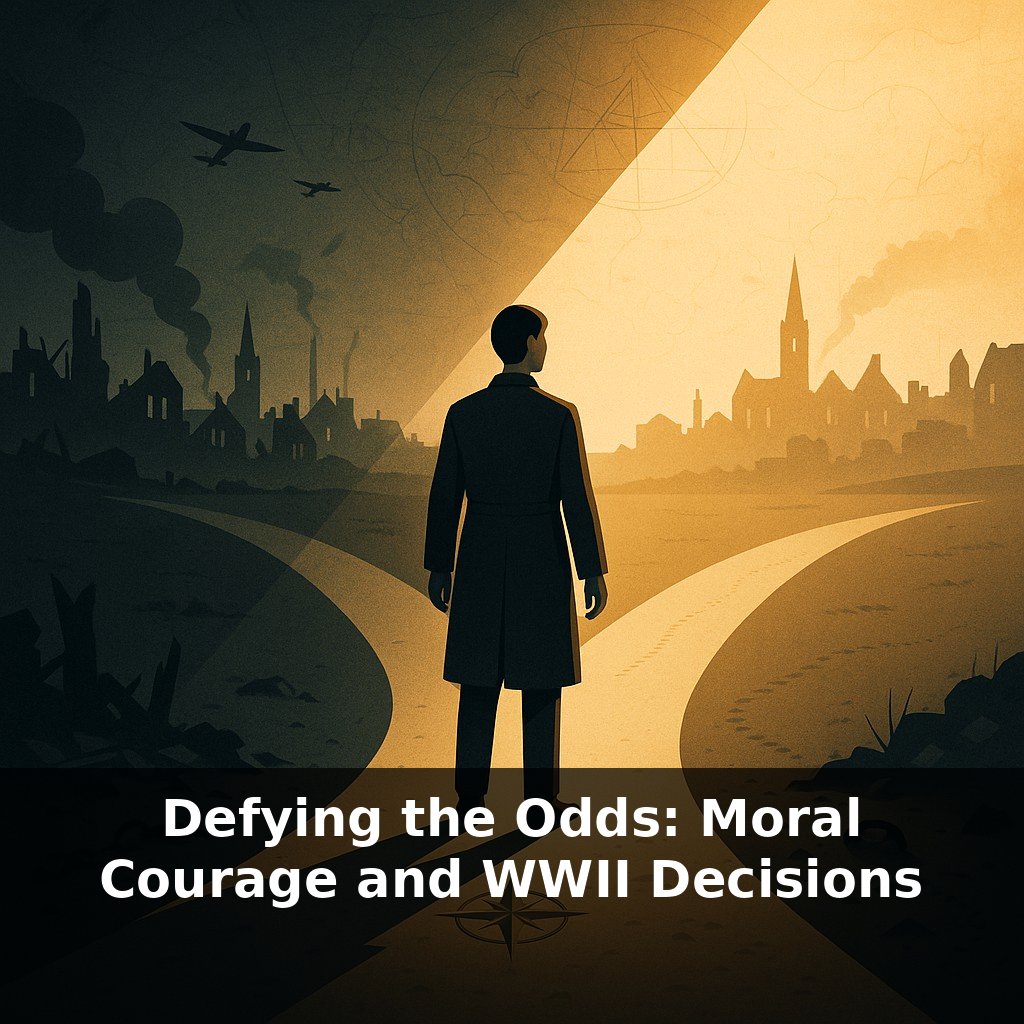
Some people in WWII moved from uneasy awareness to dangerous action; others felt the same tension and stayed put. That gap isn’t just about “good” or “bad” people—it’s about the paths their thinking and emotions took once they noticed harm. Today we’ll look at three ingredients that kept showing up when people crossed the line into risky help: a clear sense of what was wrong, a framework for judging it, and a decision to stake something personal on that judgment. Like tracing footsteps in fresh snow, we’ll follow how rescuers, diplomats, and students stitched these pieces together under extreme pressure.
Many rescuers started with something deceptively small: noticing concrete harm instead of treating it as background noise. Schindler later described a moment watching a girl in a red coat during a roundup; Sugihara saw specific faces at the consulate gate day after day. It wasn’t statistics that moved them—it was particular people, names, gestures. Recognition of harm became less like reading a headline and more like hearing a knock on your own door.
But noticing wasn’t enough. Under regimes that renamed persecution as “security” or “relocation,” people had to decide what lens to trust. Some leaned on duty: Sugihara reportedly said his obligation to help refugees outweighed his orders. Others leaned on consequences: members of rescue networks calculated how many could be hidden, how many forged papers could circulate before attracting suspicion. Still others leaned on character: the White Rose appealed to being the kind of German who would not “march in silent, cowardly complicity.” These frameworks didn’t remove uncertainty; they gave people a way to argue with the propaganda in their heads.
The third ingredient was the most disruptive: choosing what to risk. Rescuers rarely jumped straight to maximum danger. They often tested the water: one forged signature, one family in the attic, one leaflet stack left in a university corridor. Each step was a recalibration: Is this bearable? Who can I trust? How far before return is impossible? Networks amplified this. In underground circles, risk became distributed—one person secured ration cards, another handled transport, another kept watch. Shared danger made action feel less like individual madness and more like collective sanity.
Notice what’s missing from these stories: certainty of success. Most actors operated with partial information, conflicting rumors, and no guarantee that their efforts would matter. Yet they behaved more like careful engineers than reckless gamblers—testing constraints, iterating methods, learning from close calls. The line between “ordinary” bystander and “extraordinary” resistor was less a single leap and more a series of deliberate, cumulative adjustments in what harm they saw, what reasons they trusted, and what they were prepared to lose.
A modern parallel sits in hospital corridors. A junior nurse notices a senior surgeon skipping safety checks. No one is bleeding yet, but small violations stack up like dry leaves. The nurse feels that same inner tension WWII resisters described, but now the danger is career loss, not imprisonment. Her “first step” might be logging each incident, then quietly asking peers if they’ve seen the pattern too. Documentation becomes her version of a forged document: a tool that shifts unease into something actionable.
Or take a software engineer pressured to ship a feature that buries privacy settings three menus deep. No law is clearly broken, yet users lose control over their data. He starts by running impact estimates, then presents alternatives that protect both metrics and autonomy. If dismissed, he has to decide whether to escalate, delay, or, in extreme cases, walk away. In each case, the person isn’t just “being brave”; they’re designing a sequence of small, testable moves that slowly align their daily actions with the principles they refuse to abandon.
Ethical tension today often hides in routine systems—HR dashboards, audit logs, code repositories. Tiny design choices can either cushion principled pushback or choke it. A review button added to a military AI interface, for instance, can slow rash deployment the way a speed bump tempers traffic. Business schools and leadership programs are beginning to rehearse dissent the way pilots rehearse emergencies, so that resisting harmful directives becomes practiced skill, not improvised heroism.
When the next ethical squall hits, your “true north” may look less like a grand stand and more like a string of small, stubborn refusals: a report you won’t falsify, a bias you won’t ignore, a silence you won’t keep. Your challenge this week: spot one such crossroads, name the pressure tilting you, and test a bolder response than you chose last time.