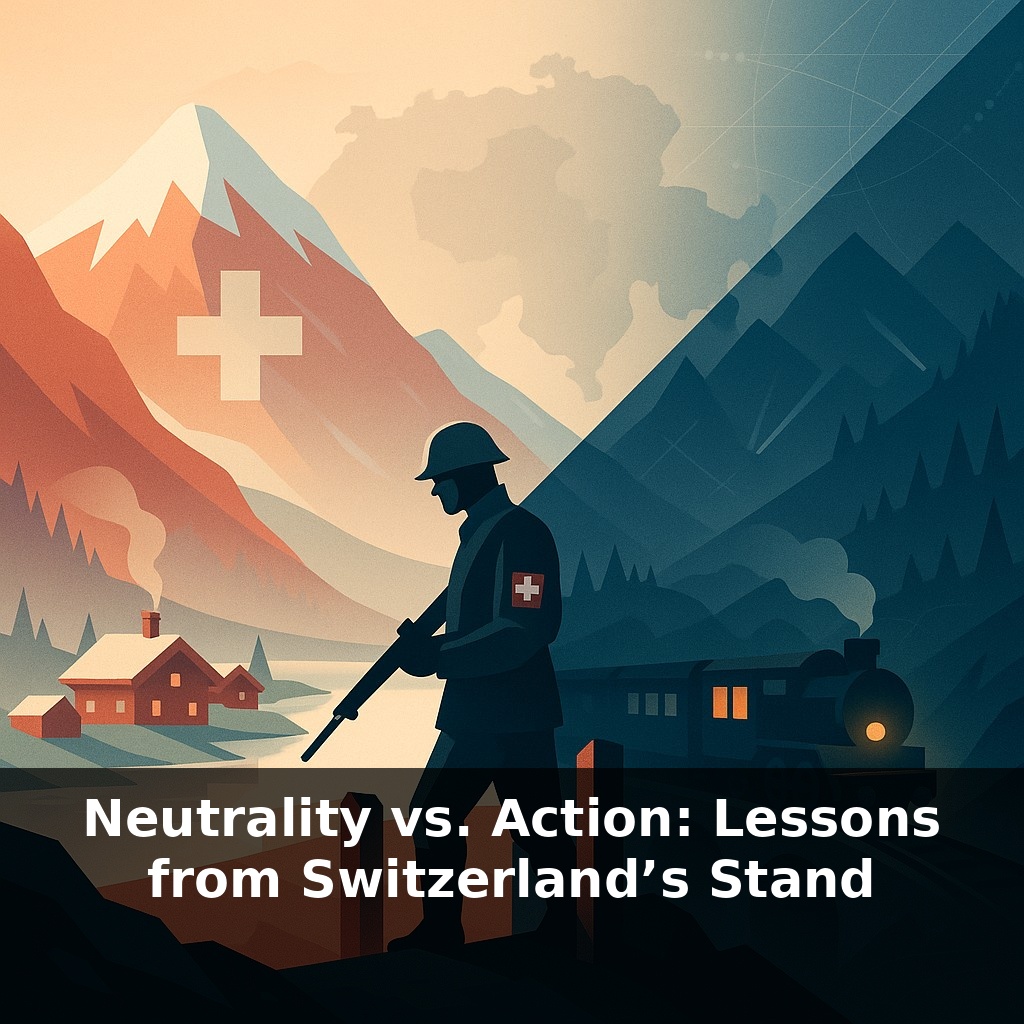
Sirens blared across Switzerland as nearly half a million citizens grabbed rifles, not passports, to face Hitler. Yet trains of gold still crossed the borders. In this episode, we’ll explore how a country can stay “neutral” while constantly choosing sides in quieter ways.
Switzerland’s leaders quickly learned that standing apart from a war didn’t mean standing still. Every train schedule, trade deal, and border decision became a quiet battlefield. Factories weren’t just making watches and chocolate; some were producing precision tools and machinery that both Axis and Allied economies depended on. Banks weren’t only safeguarding family savings; they were moving currencies and metals that could tilt financial stability one way or another. Inside the country, citizens wrestled with contradictions: civil defense drills alongside bustling cafés, blackout curtains drawn while stock markets still opened each morning. Like a mountain slope that appears solid yet hides fault lines beneath, Switzerland’s calm surface masked constant recalibration—between fear and principle, survival and responsibility, caution and courage.
Outside observers often reduced Switzerland to a simple label: safe haven or selfish bystander. But inside government rooms, each decision carried layered risks. Grant overflight rights and you anger one side; deny them and you provoke the other. Tighten refugee rules and you harden your borders; loosen them and you risk retaliation or scarcity for your own citizens. Cabinet debates stretched late into the night, generals argued with bankers, and pastors challenged police chiefs. Like a conductor managing clashing sections of an orchestra, leaders tried to prevent discord from erupting into open collapse.
Swiss planners knew that declarations alone were worthless without visible teeth. That’s why, early in the war, they quietly shifted the country’s defensive posture away from the populated lowlands and into the high mountains. Rail tunnels, bridges, and passes were wired for demolition. Key valleys could be flooded at short notice. The message to Berlin and Rome was blunt: even if you cross the frontier, you’ll pay so much in time and blood that it may not be worth it.
But deterrence on paper isn’t enough; it had to be signaled day after day. When foreign bombers strayed too close, Swiss fighters were scrambled not just to enforce a line on a map, but to demonstrate resolve. Border guards drilled, anti-aircraft crews stayed on alert, and army units rotated through harsh alpine positions, reminding potential invaders that Switzerland would not be a soft corridor through the continent.
At the same time, leaders understood that guns could not solve every threat. They had to negotiate with regimes they distrusted, sometimes despised, to keep trade routes open and encirclement at bay. Railway timetables, coal deliveries, and transit rights for freight became bargaining chips. Agreeing to one shipment might buy leverage to resist a more dangerous demand the following month.
Inside the country, arguments sharpened. Some officers pressed for harder lines against any concession, fearing a slow erosion of credibility. Others in business circles pushed for pragmatism, warning that economic strangulation would weaken the very defenses the army relied on. Churches, parties, and newspapers split over how far accommodation could go before it stained the nation’s conscience.
Occasionally, missteps forced rapid course corrections. When certain policies provoked outrage abroad, diplomats worked to repair trust, offering intelligence, mediation services, or behind-the-scenes pressure on their own banks and firms. Like a mountain guide adjusting to sudden weather shifts, the government had to revise routes without losing sight of the summit: survival with at least a core of values intact.
That balance never fully satisfied anyone. Yet it created a fragile space in which later generations could interrogate not only what was done, but what was refused—and why.
Swiss officials faced choices that feel eerily familiar today. When they decided whether to let certain trains cross their territory, they weren’t just moving cargo; they were quietly ranking which pressures mattered most: military, economic, or moral. A shipment of industrial parts might be allowed because blocking it could trigger a blockade of Swiss food imports, while another request—say, for troop transport—might be refused even at serious risk. Each “yes” or “no” created a precedent other governments would test.
Inside banks and ministries, memos show staff agonizing over details that would barely register in headlines: how strictly to check documents at a remote valley station, whether to grant an extra day on a payment deadline to a struggling foreign partner, whether to forward a sensitive message between warring capitals. A single altered timetable could shift trust, just as today a minor coding decision in a social network can tilt whose voices are amplified or buried. The tools change, but the pattern remains: seemingly technical decisions can carry heavy ethical weight.
Today’s “neutral ground” is shifting online. Data routes, cloud servers, and payment rails act like invisible mountain passes that can quietly tilt conflicts. A platform’s decision to throttle a state channel or flag a botnet may matter more than any speech at the UN. As cyberattacks probe hospitals, grids, and elections, staying aloof starts to look less like peacekeeping and more like looking away. The real fault line ahead is whether states treat digital silence as safety—or as complicity.
So the question isn’t whether to stand apart, but how to stand accountable. Servers, satellites, and supply chains now play roles rail hubs once did, quietly routing power. Your timelines, purchases, and shares add faint strokes to that map, like drizzle feeding a river. The next episodes ask: when does staying “out” start to redraw the world anyway?
Try this experiment: For the next 7 days, pick one issue at work or in your community where you’ve been “Swiss-style neutral” (e.g., staying out of a tense team decision, not weighing in on a controversial policy, avoiding a neighborhood disagreement). On day 1, deliberately stay neutral: listen, ask clarifying questions, but commit to taking no position, and note what actually happens to trust, outcomes, and your own stress. On day 3, switch: on the same issue, take a clear, values-based stand (like Switzerland finally joining sanctions) and state exactly what you support and why, plus one concrete step you’ll back. By day 7, compare: in which mode did you create more clarity, respect, and progress—and what “neutrality line” do you want to redraw in your real life going forward?