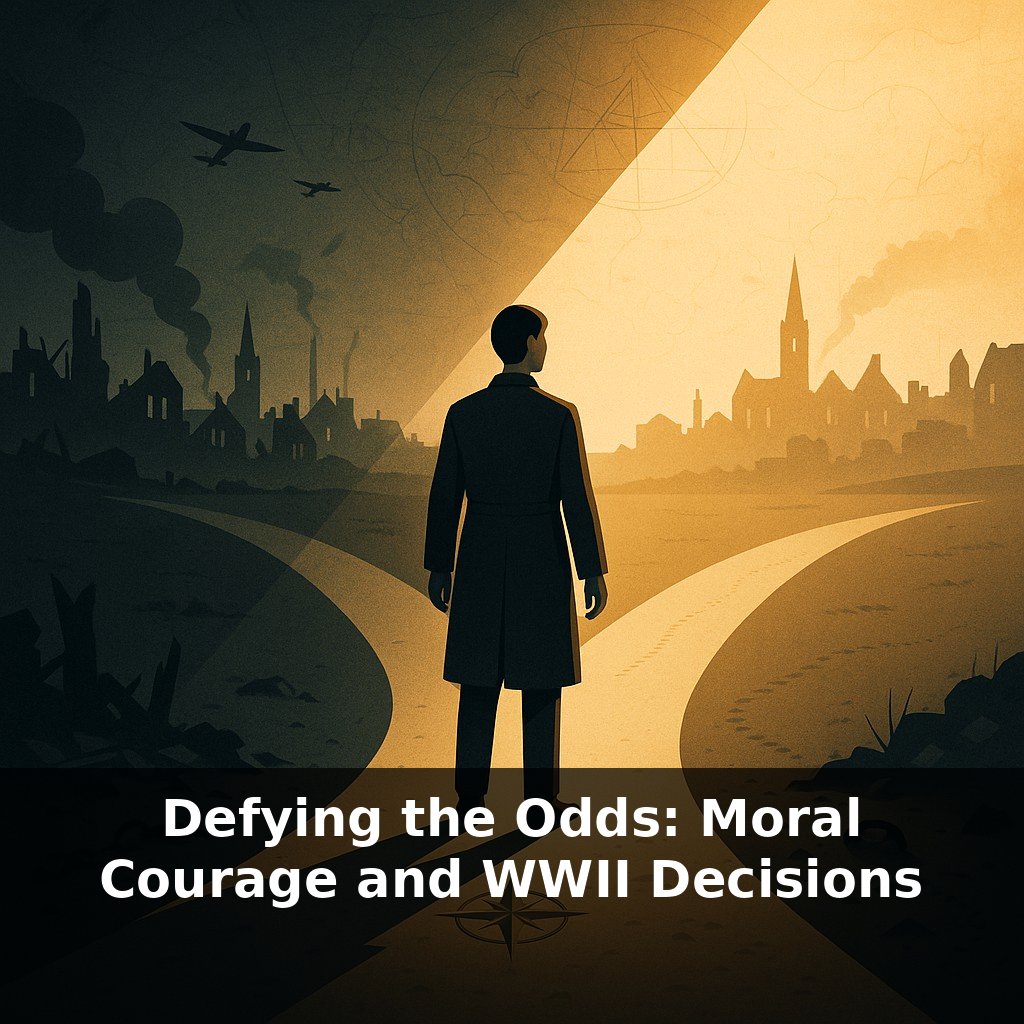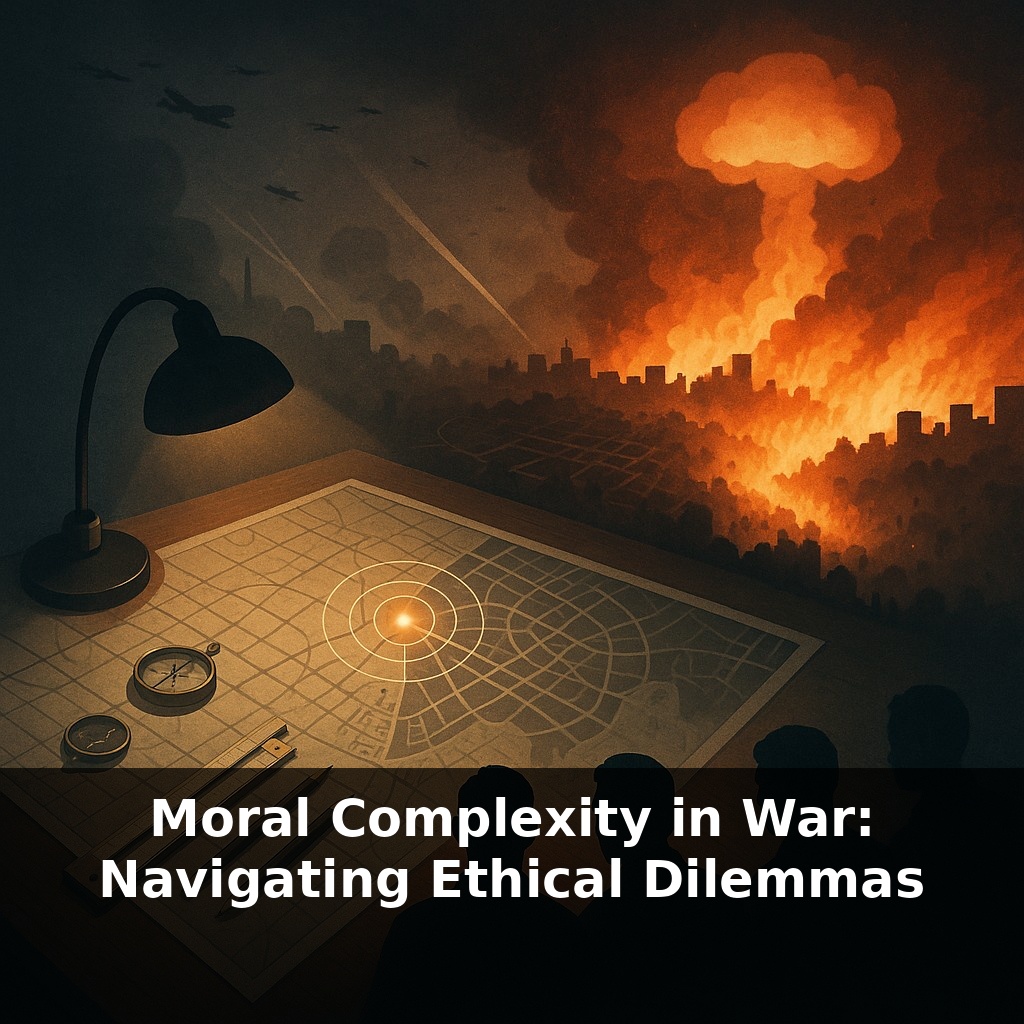
A single week in Hamburg turned the night sky into a wall of fire and erased tens of thousands of civilian lives—by design, not by accident. In this episode, we step into the rooms where leaders chose between defeating evil and becoming something like it.
The firestorms over Europe and the mushroom clouds over Japan didn’t just happen; they were argued into existence in cramped offices, drafty war rooms, and secret laboratories. People with slide rules, maps, and half-known intelligence reports tried to calculate the “least bad” option when every path seemed to end in ashes. A bomber crewman over Dresden, a Japanese doctor in Hiroshima, a codebreaker in Bletchley Park, and a prosecutor at Nuremberg all inhabited different fragments of the same moral earthquake: choices where saving strangers meant abandoning others, where loyalty to country pulled against loyalty to conscience.
In this series, we won’t ask, “What would you have done?” as if there were clean answers. Instead, we’ll trace how ordinary minds were stretched, twisted, and sometimes broken by pressures that turned ethics from a neat rulebook into something more like reading shifting winds in a storm.
We’ll move through four vantage points. First, decision-makers: the generals, scientists, and ministers whose signatures redirected entire campaigns, often guided by fragmentary reports and wishful estimates. Second, the constrained: soldiers, nurses, and resisters whose “choices” were framed by strict orders and fear of reprisal. Third, the overlooked: civilians in bombed cities, occupied villages, and prison camps whose daily survival forced quiet bargains. Finally, the judges—during and after the war—who tried to turn this chaos into rules future generations might actually follow.
When commanders approved the first waves of city bombing, many were not thinking in lofty abstractions but in columns of numbers: projected enemy factory output, expected troop casualties, bomber losses. Moral weight was translated into spreadsheets before there were spreadsheets. Civilian deaths became “spillover,” a term that let people keep talking without choking on each sentence.
Something similar happened inside the Manhattan Project. Physicists who had once argued about obscure equations now argued about blast radii and radiation sickness. Some told themselves that building the bomb was the only way to prevent a Nazi bomb. Others clung to a grim arithmetic: one catastrophic demonstration now might avert a drawn-out invasion later. Within the same laboratory, you could find fierce advocates of using the weapon on cities and equally fierce critics pleading for a symbolic test instead. The moral map was fractured even before Hiroshima appeared on any target list.
Intelligence officers faced a different kind of vertigo. When intercepted messages revealed plans for attacks that could not be stopped without revealing the codebreaking success, they sometimes stood by and watched the disaster unfold. Their duty to save as many as possible collided with the duty to protect a secret that, they believed, would save even more lives over months and years. The cruelty lay not only in the deaths, but in the knowledge that those deaths had been, in some sense, chosen.
Meanwhile, legal thinkers quietly drafted what would become the post-war trials. They wrestled with questions that had barely existed in written law: Could “following orders” shield someone who organized mass murder from a desk? Were factory owners who supplied poison gas as culpable as the guards who used it? The answers they crafted did not erase the horror, but they did something else: they sketched a line between killing in war and annihilating whole populations as a policy.
Across these domains, the familiar language of honor, courage, and victory kept colliding with something more unsettling: responsibility stretched across hierarchies, technologies, and time.
A field surgeon choosing which wounded to treat first, a resistance courier deciding whether to risk an entire network to save one captured comrade, a submarine captain debating whether to surface for survivors and expose his crew—each carried a private calculus that would never appear in official communiqués. Their notebooks, if they kept any, rarely mentioned abstractions; they listed times, distances, blood loss, fuel reserves. One nurse might quietly swap bandage supplies from “approved” patients to those the system had written off. A junior officer might delay relaying an order by minutes, hoping events would make it obsolete. At the diplomatic level, small countries bartered concessions—port access, votes, quiet silence about atrocities—for the thinnest promise of protection. Moral choices clustered in these small, almost invisible adjustments, less like grand speeches and more like a pianist altering a single note that subtly changes the entire chord.
In today’s conflicts, that same fractured moral map runs through code, satellites, and livestreams. A drone operator can watch a target tuck a child into bed, then wait for a lawyer’s green light that may never feel green enough. Viral images can turn one destroyed building into a global rallying cry while dozens of quieter tragedies pass unnoticed. Like shifting weather fronts, law, public outrage, and military necessity collide, forcing us to keep redrawing where “acceptable” ends. Your challenge this week: trace one news story about war across three different sources. Note what each highlights, excuses, or leaves unsaid. By the end, ask yourself not “Who is right?” but “Whose harms are visible here, and whose are offstage?”
In the end, war’s hardest questions rarely come with closing arguments; they trail us like aftershocks, resurfacing in veterans’ memories, in memorials, in late-night votes on new weapons. Each generation rewrites the margins of old decisions, like adding pencil notes to a well-worn score. The music keeps changing, but the dissonance never fully resolves.
Start with this tiny habit: When you hear or read a news story about an ongoing conflict, pause and spend 10 seconds silently asking yourself, “What might this look like from the perspective of a civilian on the other side?” Then, add one more 10‑second question: “What moral trade‑off might the people making decisions here be facing—like choosing between protecting civilians and protecting their own troops?” If you catch yourself reacting with quick judgment (“they’re just evil” or “they’re obviously right”), simply rephrase it once as a question: “What else might be going on here that I don’t see?”