Overcoming Delegation Anxiety
📝 Transcript
Right now, somewhere, a manager is working late, redoing a project they already assigned—because letting go feels more stressful than doing it themselves. Yet CEOs who truly delegate well generate about one‑third more revenue. So why does handing work away feel so risky?
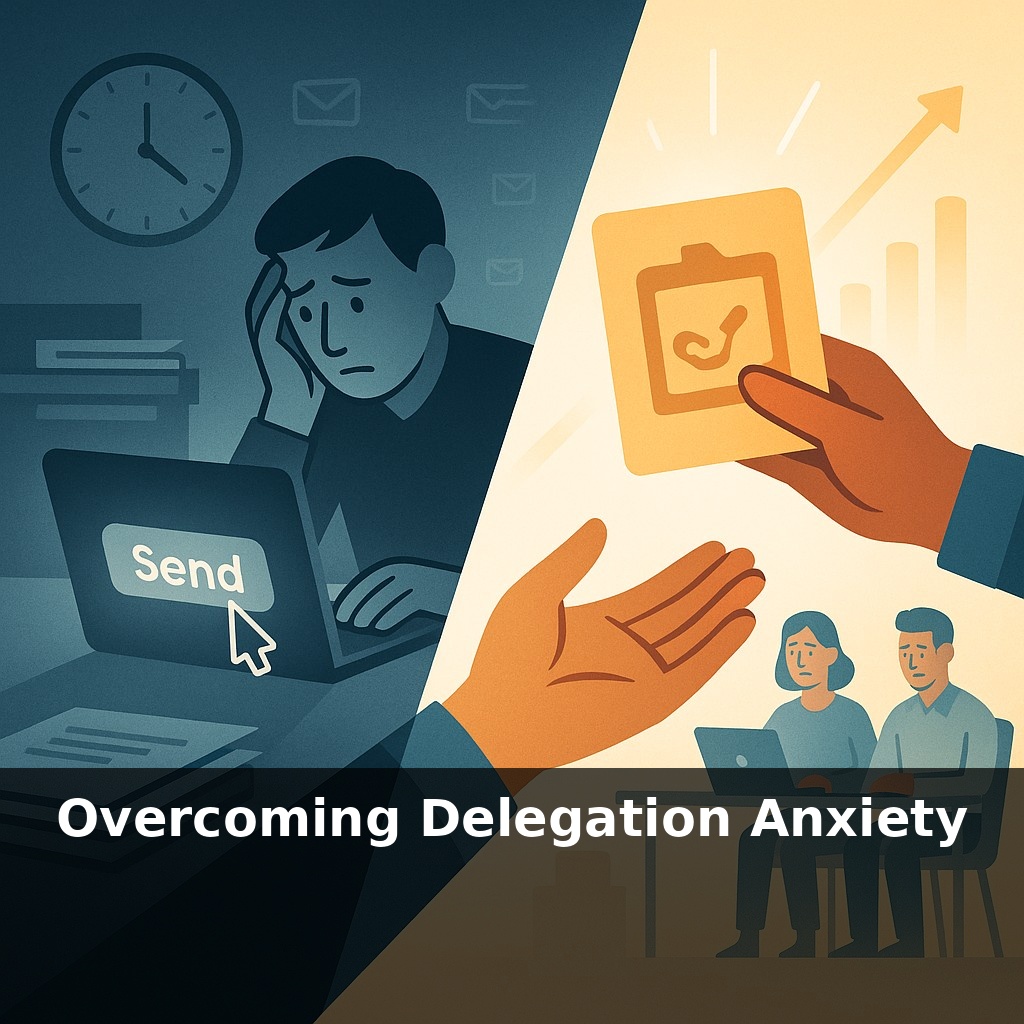
Think about the last time you hesitated before hitting “send” on an email assigning a critical task. Your cursor hovered, your mind started listing everything that could go wrong, and somehow it felt safer to just keep the work on your plate. That micro-moment isn’t just indecision; it’s your brain quietly defending its comfort zone. Under the surface, three forces are usually colliding: a belief that only your version will be “good enough,” a fear that others will finally see you’re not as capable as they think, and a stress response that treats letting go like a threat. Like trying to fall asleep on a turbulent flight, your body insists on staying “on alert,” even when you logically know you’re not the pilot. In this episode, we’ll unpack those hidden forces so you can recognize them in real time.
Those forces don’t just live in your head; they quietly shape your calendar, your team culture, and even your career ceiling. You say yes to “just one more” project, then spend evenings stitching everything together like a tailor fixing seams no one else was trusted to sew. Over time, your team learns to wait for your decisions, not make their own. Promotions go to people who scale through others, while you become known as “reliable” but overloaded. The real trap isn’t doing too much—it’s teaching everyone around you that important work can’t move unless you’re touching it.
Here’s the twist: your reluctance to delegate isn’t just “a bad habit” or a time‑management flaw. It’s your brain running a series of biased predictions about the future—and then treating those guesses as facts.
Perfectionism bias whispers, “If it doesn’t match my exact standard or method, the outcome will be unacceptable.” Notice the hidden rule there: not just “high quality,” but “my way or failure.” That turns every handoff into a binary choice in your mind: either you do it, or quality collapses. No wonder your nervous system spikes.
Loss‑of‑control bias adds another layer: the feeling that once you assign a task, you have no levers left. In reality, delegation has multiple dials—scope, timeline, decision rights, check‑in points, success criteria—but under stress, your mind flattens it into “in control vs. out of control.” That distorted framing makes even small experiments with sharing work feel disproportionately risky.
Then there’s the identity piece. If part of your self‑worth comes from being “the one who can handle anything,” delegation can feel like a quiet identity downgrade. Impostor thoughts weaponize this: “If I ask for help, they’ll realize I’m not actually that strong / smart / capable.” So you protect the identity, but at the cost of your bandwidth.
Here’s where structured delegation frameworks matter. Tools like the “5 Levels of Delegation” give your brain a middle ground between clinging and dropping. Instead of a vague “Can you take this?”, you might say, “Draft options and I’ll decide,” or “Decide, but keep me informed at these checkpoints.” Each level calibrates how much authority you transfer and how often you reconnect. This reduces ambiguity—one of the main fuels for anxiety.
Psychological safety is the social counterpart. When your team knows that learning, asking questions, and early warnings are welcome, delegation stops feeling like pushing people off a cliff and starts to resemble walking a trail together: you may not carry every backpack, but you’re very much on the path with them.
Think of a product lead at a growing startup who keeps all client presentations. Instead of handing them off entirely, she starts by sharing just the narrative and lets a senior designer propose visuals. The first version is clumsy, but it reveals exactly which parts she’s been over‑protecting. Over three cycles, they co‑create a checklist: story beats, brand nuances, non‑negotiables. Soon, “her” deck becomes “our” system, and she’s reviewing, not rebuilding.
Another example: an engineering manager knows code reviews pile up when he’s in back‑to‑back meetings. He experiments by appointing two “quality stewards” for a month. Their role isn’t to replace his judgment; it’s to own specific review rules and escalate only edge cases. The anxiety doesn’t vanish, but it gains a boundary: he’s nervous about 10% of decisions, not 100%.
Like a painter moving from doing every brushstroke to sketching the outline and palette, these leaders shift from owning tasks to owning standards and learning loops.
As tools quietly take over who‑does‑what logistics, your real edge becomes how you design *relationships* around shared work. Think less “traffic cop,” more “urban planner” for collaboration: you’re shaping flows, not directing every car. Neuro‑leadership training will likely treat your worry signals as raw data to be re‑trained, not ignored. The leaders who practice this early won’t just feel calmer—they’ll be trusted with messier, more strategic problems.
Your challenge this week: pick ONE recurring task you currently keep to yourself. Before you touch it, force yourself to write a 3‑line “delegation brief” as if you *had* to hand it off tomorrow: 1) desired outcome, 2) key constraints, 3) how you’d know it was done well. You don’t have to delegate it yet—but by the end of the week, choose one version of that brief and test it with a real person.
Focus on how each delegation task changes your overall schedule. Chart the minutes saved on your weekly planner after each handoff attempt. Notice which skills your team reveals when you stop pre‑deciding their limits. That curiosity—more than any framework—is what quietly rewires your leadership.
Try this experiment: Pick one recurring task you usually grip tightly—like drafting the weekly team update or scheduling client check-ins—and delegate it fully to one person for the next 7 days, giving them your desired outcome, deadline, and 3 clear guardrails (e.g., budget cap, brand tone, approval step). Before you hand it off, secretly write down the “disaster scenarios” you’re anxious about (e.g., angry client, missed deadline, sloppy work) and rate each from 1–10 on how likely you think it is. For the whole week, resist jumping in unless one of your guardrails is truly crossed; instead, respond only with questions like, “What options do you see?” and “What would you do next?” At the end of the week, compare what actually happened to your disaster list and re-rate how likely those fears feel now, then decide one more task you’re willing to delegate at the same level—or with slightly fewer guardrails.
From this course

Delegating for Growth
5 episodesUnlock all episodes
Full access to 5 episodes and everything on OwlUp.
Subscribe — $1.99/monthLess than a coffee ☕ · Cancel anytime