Your team’s results might depend less on talent and more on how much freedom you *don’t* give them. In one global study, only about half of employees said they knew what success even looked like. Now, here’s the twist: the teams with the clearest rules also felt the freest.
So if clarity and freedom can actually reinforce each other, where do most managers go wrong? Often in the *middle*: goals sound reasonable but are fuzzy, and autonomy is promised but quietly taken back through constant “quick checks” and steering. The result is a weird mix of anxiety and hesitation—people move, then slam on the brakes, unsure what really matters or how much authority they have.
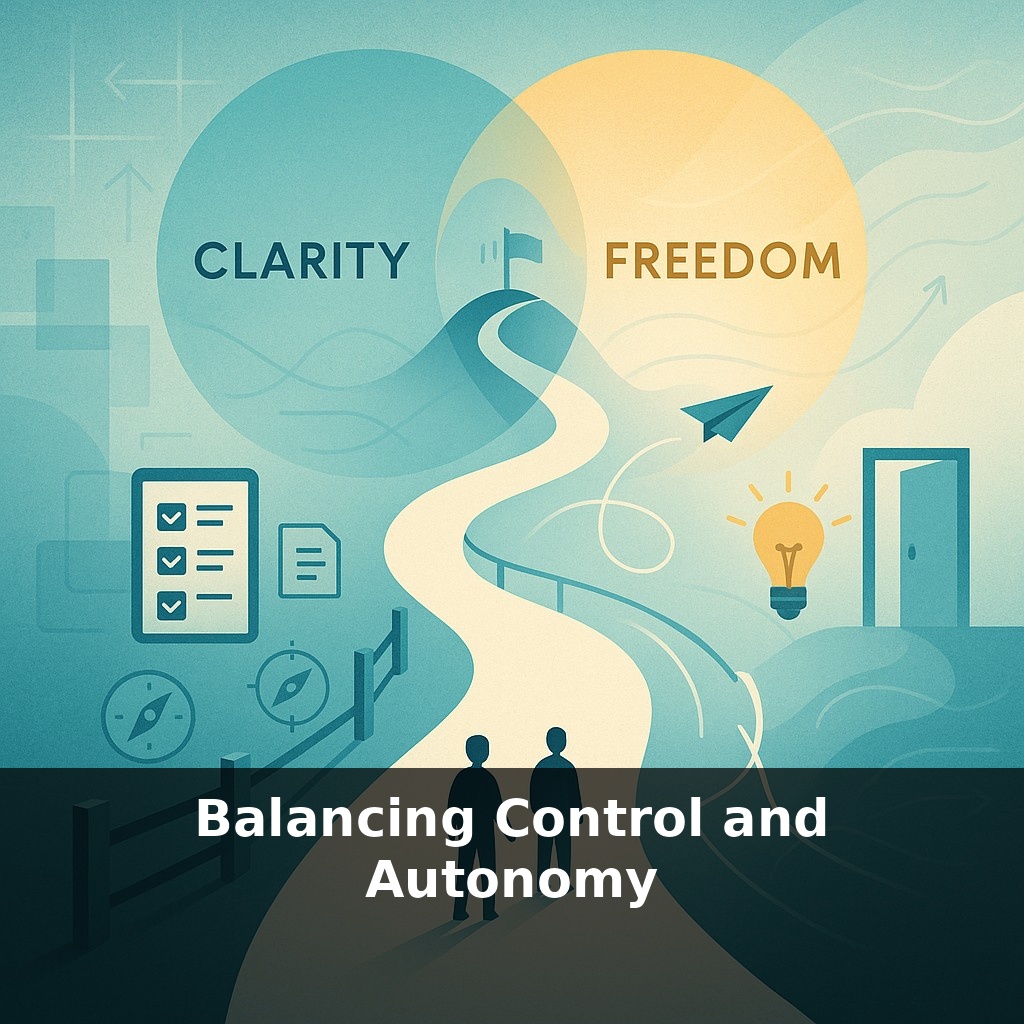
Here’s the nuance the research surfaces: top teams don’t just know *what* to deliver; they know which 2–3 constraints are sacred and which decisions are truly theirs. Like a hiking trail marked only at critical junctions, the path isn’t scripted step by step—but it’s also not a wilderness free-for-all. That selective structure is what turns autonomy into focused, confident action rather than polite chaos.
That balance is surprisingly rare. Many managers either grip tighter whenever stakes rise or swing to “hands off” to seem empowering. Research hints at why: when pressure increases, our threat response narrows focus to risk avoidance, not thoughtful delegation. So leaders overcorrect—either prescribing every move or disappearing until there’s a fire. The teams that avoid this whiplash usually do something different: they make decision rights explicit. Who owns trade-offs on speed vs. quality? Who can say “no” to extra work? Those calls aren’t left to mood or hierarchy in the moment.
Control and autonomy start to work *for* you when you split work into two buckets: “non‑negotiables” and “negotiables”—and then actually behave that way.
Non‑negotiables are the few things you, as the leader, truly own: outcomes, boundaries, and red lines. Think: “We must launch by June 30,” “We don’t ship anything that risks customer data,” “We won’t exceed this budget.” These aren’t vibes; they’re crisp commitments. The more concrete they are, the easier it is for people to move quickly without circling back for permission.
Negotiables are everything else: approach, sequencing, tooling, experiments, stakeholder tactics. This is where you deliberately *stop* deciding. You might ask sharp questions, but you don’t quietly reclaim the steering wheel. When a choice clearly sits in the negotiable bucket and still boomerangs to you, that’s a signal: the scope of real decision rights probably isn’t as clear as you think.
One practical move: define decisions by *type*, not by who shouts the loudest in meetings. For example: - Product: “The PM owns trade‑offs between scope and schedule within this release.” - Engineering: “The tech lead owns how we meet performance targets.” - Sales: “The regional lead can discount up to X% without higher approval.”
Notice what this does. It turns fuzzy “ownership” into visible, testable rules. People know when they’re expected to decide, and you know when intervening would break the deal.
Large companies that do this well (like Toyota with its andon cord, or Netflix with its “context, not control” doctrine) don’t rely on heroic managers. They rely on a shared understanding of *who* decides *what* under *which* conditions. That’s how they scale both discipline and initiative.
A simple way to sanity‑check yourself: before weighing in, ask, “Am I protecting a non‑negotiable, or am I editing a negotiable because it’s not how I’d do it?” If it’s the latter, your “help” may be silently shrinking the very space your team needs to grow.
Consider a product leader at a fast-growing startup launching a new pricing model. She sets three non‑negotiables: “We must not confuse existing customers, we need a clear story finance can defend, and we go live before the investor update.” Then she draws a visible line: messaging, specific price points, and rollout tactics sit with the PM and GTM lead. Her role shifts from “approver of everything” to “guardian of the few lines we cannot cross.”
At first, the team keeps asking, “Is this okay?” She responds with, “Which bucket is this in?” and pushes the choice back when it’s clearly negotiable. Within two sprints, patterns emerge: fewer status meetings, more proactive trade‑off calls surfaced early, and a measurable drop in last‑minute escalations.
Think of it like planning a hiking trip with friends: you lock in the destination, dates, and safety rules, but let each person choose their pace, snacks, and side stops. The journey stays coordinated, but no one feels dragged.
As work becomes more distributed and algorithmically observed, the real frontier is *who* interprets the data. Will dashboards become levers for tighter grip, or mirrors teams use to course‑correct themselves? Leaders who share live metrics and invite joint sense‑making turn monitoring into a co‑owned instrument panel. Like gardeners tracking soil and weather, they adjust conditions rather than micromanaging every leaf, letting teams adapt locally while the system learns globally.
Treat this as an ongoing craft. Each project is a new canvas to test which few rules truly matter and where you can step back. Over time, patterns emerge—like learning which spices define a dish and which are optional. Keep tuning those boundaries in dialogue with your team, and you’ll grow leaders, not just finish tasks.
Here’s your challenge this week: Pick one area where you’ve been micromanaging (like how your team runs meetings or handles client follow-ups) and hand over full ownership to one person, including the decisions, the process, and the timeline. Before you delegate, record a 3-minute Loom or voice note explaining only the outcome you care about and the non‑negotiables—do not give step‑by‑step instructions. Then, for the next 7 days, resist the urge to “check in” or “fix” their work; instead, schedule just one 20‑minute autonomy debrief at the end of the week to ask what support they actually needed and what you can loosen even more.