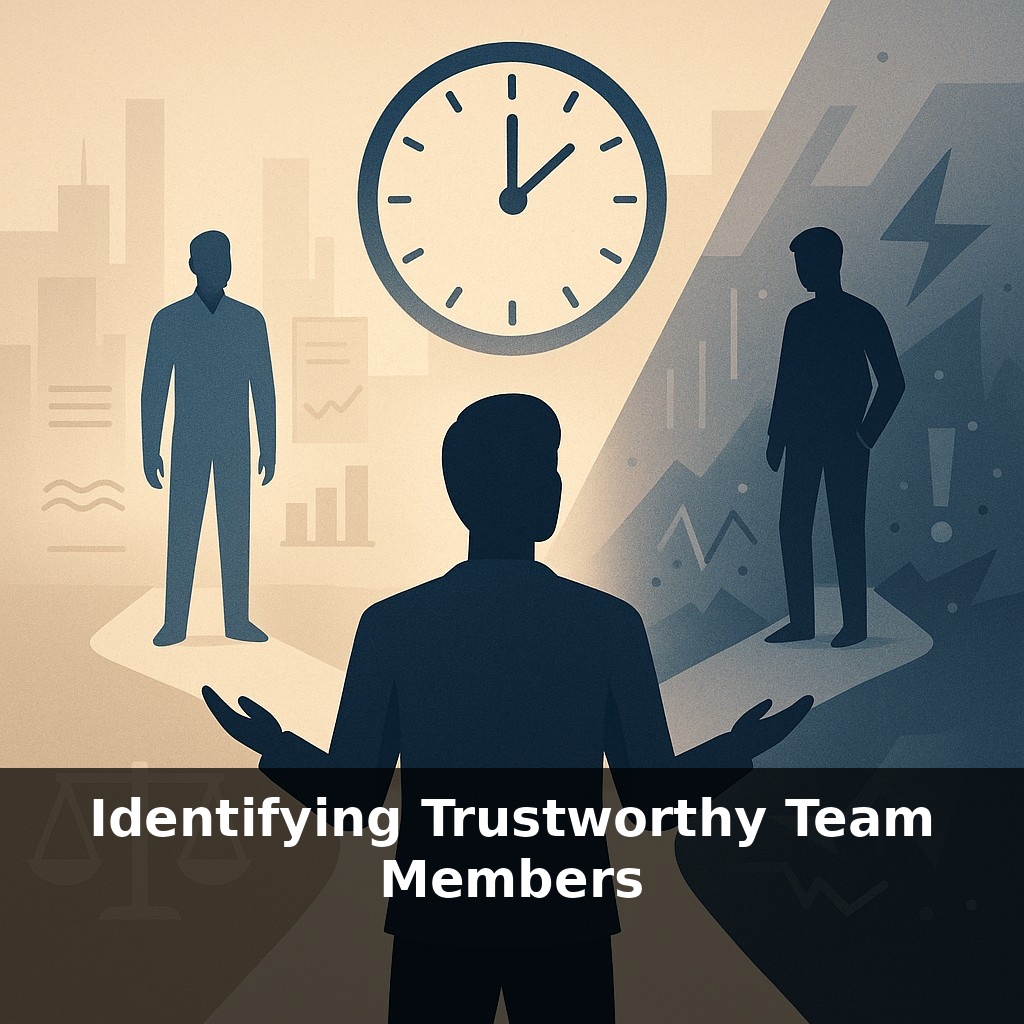
Your next promotion might depend less on your talent, and more on who you trust. A deadline is crashing toward you, two teammates volunteer, and you have seconds to decide. One choice doubles your results; the other quietly sinks the project. How do you really know who to bet on?
Here’s the twist most leaders miss: “trustworthy” isn’t a single trait, it’s a pattern of behavior you can measure. Some people shine in calm waters and disappear in a storm. Others are quiet in meetings but flawless when the stakes are highest. Promotion‑level delegation depends on seeing those patterns clearly, not just rewarding whoever talks the loudest or seems most confident.
Think about how different teammates show up across three moments: when a task is fuzzy, when it’s tedious, and when it’s on fire. The person who asks sharp clarifying questions in fuzzy situations may be your best bet for ambiguous projects. The one who delivers boring work on time, every time, is a safer pair of hands for compliance‑heavy tasks. The calm problem‑solver in a crisis might be the one you trust with your reputation.
So how do you go beyond “gut feel” without turning into a robot with a spreadsheet? Start by noticing three quieter signals: how someone talks about past work, how they respond when you raise the bar, and how they handle visibility. In 1:1s, listen for specifics instead of vague claims—concrete examples are like street signs pointing to real behavior. Then, when you stretch them—a tougher deadline, a messier problem—watch whether they seek clarity, hide, or overpromise. Finally, see what happens when credit or blame is on the line; that’s where integrity and real reliability usually show up.
Now add structure to what you’re already noticing. Researchers break “can I trust you with this?” into three practical buckets: ability, integrity, and benevolence. Think of them as three separate dials you’re constantly adjusting based on evidence, not impressions.
Ability is the “can they actually do this?” dial. You’re not judging intelligence in general; you’re looking at fit between the person and this specific kind of work. Start tracking where someone produces clean work with low rework, where they need hand‑holding, and where they quietly invent better ways of doing things. Over a month, you’ll see clusters emerge: the person who ramps fast on new tools, the one who’s gold on stakeholder wrangling, the one who spots risk before others. Ability is rarely uniform—map it by task type, not by role title.
Integrity is the “do their words line up with reality?” dial. The fastest test isn’t a crisis; it’s small promises. Notice micro‑commitments: “I’ll send that by end of day,” “I’ll follow up with finance,” “I’ll review your draft tonight.” When those tiny agreements slip without acknowledgment, treat that as a data point, not a fluke. Over time, you’re looking for three habits: they tell you early when they’re off track, they adjust scope instead of secretly lowering quality, and their version of events matches what others experienced.
Benevolence is the “are they also watching my back and the team’s?” dial. This shows up in how they handle trade‑offs. When work gets tight, do they hoard information or pull others in? When they catch an error that makes someone look bad, do they fix it quietly, escalate performatively, or weaponize it later? A benevolent teammate naturally shares context, protects focus, and spreads credit instead of collecting it.
To move beyond your own biases, pair these dials with lightweight evidence: quick peer pulses after joint work, structured reference checks for new hires, and short retros after major deliveries. You’re not creating bureaucracy; you’re building a living dashboard of who’s ready for which kind of responsibility, so that when the high‑stakes moment comes, your choice is already half‑made.
Think of two engineers on your team. Both hit their sprint goals. But watch what happens in the gray areas. One surfaces dependencies early, loops in design before there’s a clash, and leaves notes so anyone can pick up their work. The other closes tickets fast but leaves a wake of unanswered questions. Same output on paper, totally different risk profile when you’re delegating something that touches multiple functions.
Or picture a cross‑functional launch. You hand ownership of the rollout plan to someone who’s never led end‑to‑end. A week later, they bring you a draft with three explicit risks, owner names, and decisions they need from you. Another person might bring a polished deck but no clear asks, no alternative paths. The difference isn’t effort; it’s how easy they make it for you to see around corners.
That’s your clue: the people you can lean on hardest don’t just “do their part”—they make the whole system less fragile when stakes, scrutiny, and moving parts all increase at once.
You’ll soon have dashboards full of “trust signals” generated by tools that watch how work actually flows: response lag, handoff quality, follow‑through across systems. It’s like having a time‑lapse view of a forest, not just snapshots of a single tree. The opportunity: spot who quietly stabilizes everything around them. The risk: turning people into data points. The leaders who win will invite scrutiny of the system, not just of individuals.
Over time, you’ll notice something subtle: the people you rely on most don’t just “deliver,” they change how everyone around them works. Like a steady river cutting a new path through rock, their habits reshape meetings, handoffs, even how risks are surfaced. Let your next stretch assignment be a test: who quietly makes the whole system flow more smoothly?
Before next week, ask yourself: 1) “Looking at my current team, who consistently does what they say they’ll do—even on the small stuff like meeting prep, follow-ups, or deadlines—and where have I been ignoring those patterns?” 2) “When was the last time someone on my team told me a hard truth or pushed back respectfully—what did they say, how did I react, and what does that reveal about who I actually trust?” 3) “If I had to bet my reputation on three people for a critical project tomorrow, who would I choose based on their past behavior (not potential), and what’s one specific conversation I can have with each of them this week to either deepen or clarify that trust?”