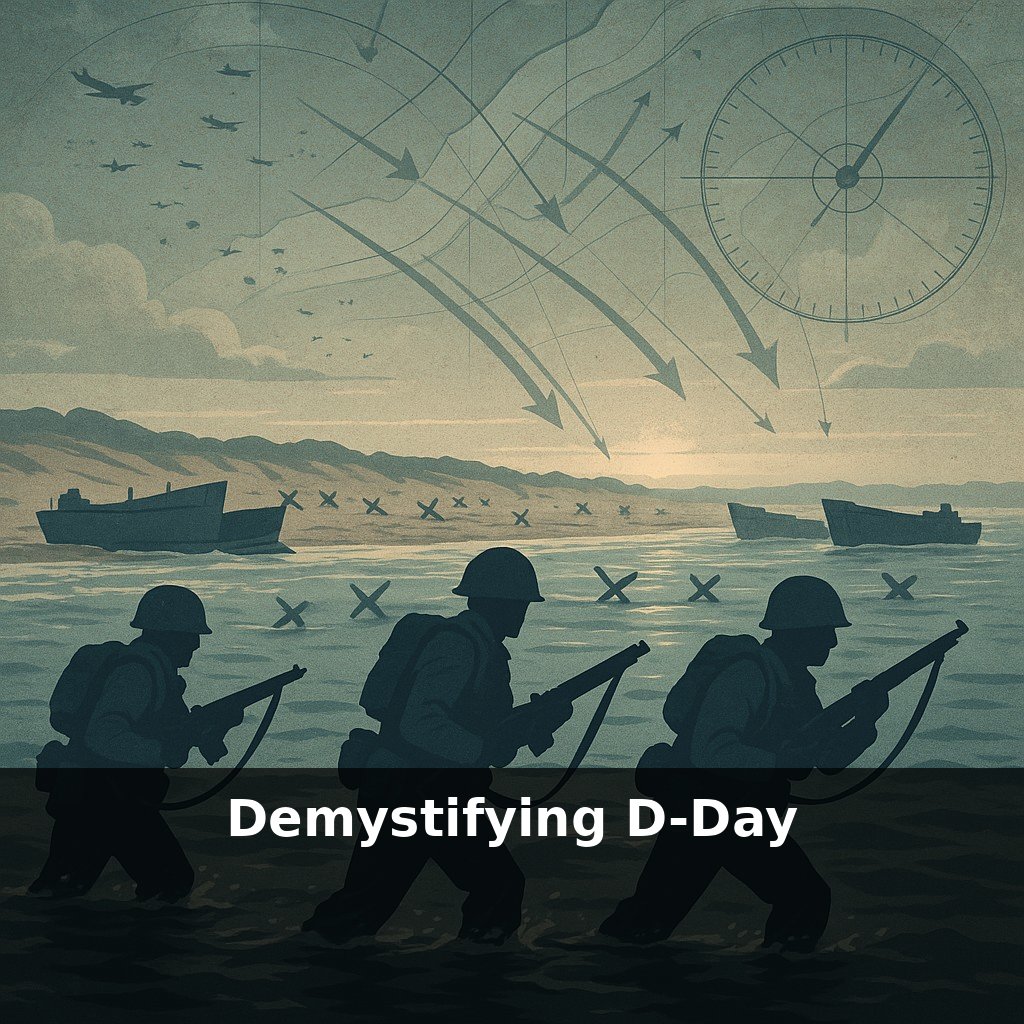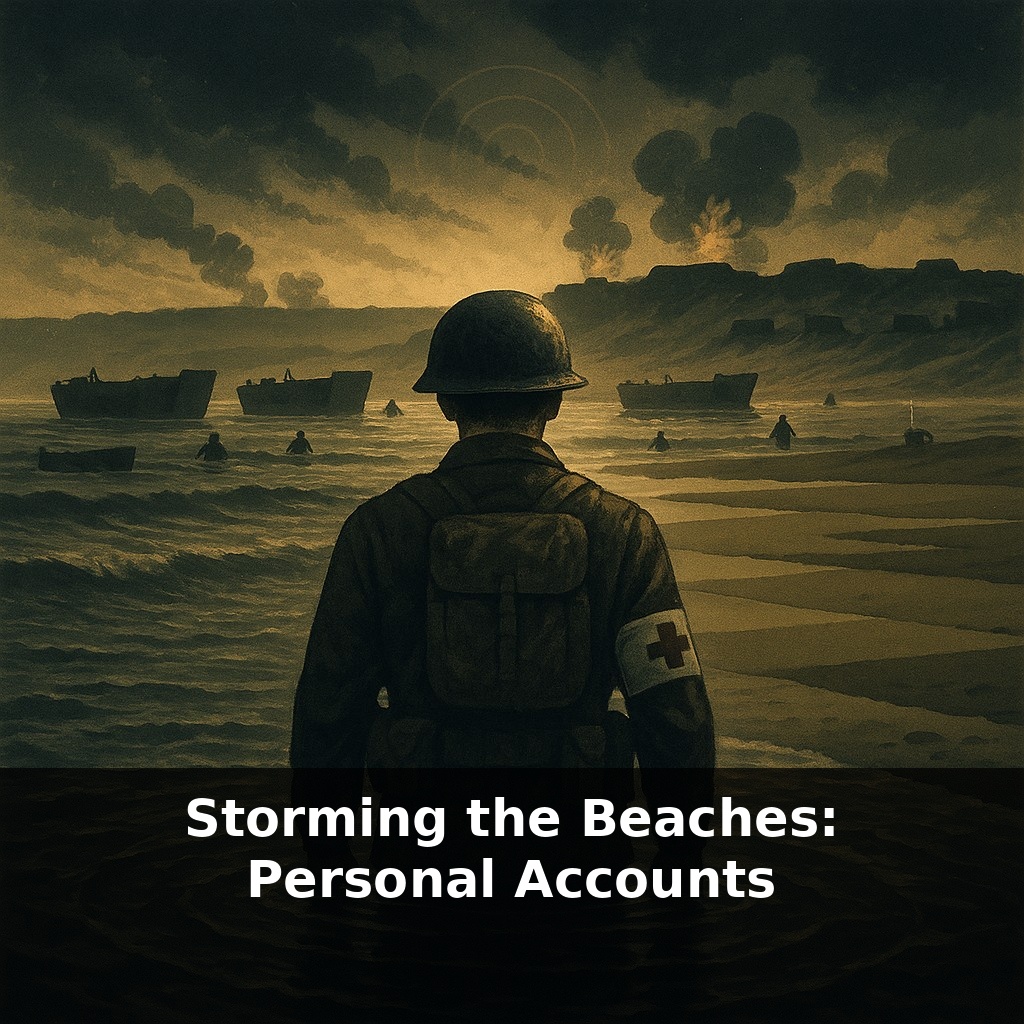
Gunfire starts before the ramp even drops. A medic’s first patient is his own friend, bleeding in the surf. A young German gunner hesitates for half a second—and lives because of it. One invasion, five beaches, thousands of stories where a single heartbeat changes everything.
Some accounts sound almost impossible: a Canadian sapper counting his own steps through smoke because his map is useless; a British officer ordering tea brewed in a crater between bombardments; a German radio operator quietly switching frequencies when his unit’s net dissolves into static. On paper, D-Day looks like columns of numbers and arrows on a staff map. Up close, it feels more like trying to debug a crashing system in real time—every failed “patch” costs lives, every workaround matters. Terrain that planners saw as colored contours became flooded ditches, shingle banks, slit trenches that sheltered or trapped men at random. Oral histories reveal how quickly plans frayed and how often corporals, not colonels, made the calls that opened an exit off the sand or sealed a dead end. In this episode, we’ll follow those split-second choices at eye level.
Historians often argue about grand strategy—who chose Normandy, who misread German reserves—but in the background logs and unit diaries, a quieter pattern emerges: tiny decisions scaling into massive outcomes. A junior officer shifts his platoon 30 yards and suddenly they’re shielded by a sand ridge; a radio set fails and a whole company advances blind; a single sapper clears one more gap than scheduled and armor rolls inland an hour earlier than predicted. Think of it as a chain of micro-updates to a live system: each local “fix” either stabilizes the wider operation or pushes it closer to cascading failure.
The view from the command ship’s plotting room and the view from the waterline barely resemble each other. Official reports list “H-Hour: 0630, first wave lands,” but the men in those first wave craft remember details the logs never capture: which side of the ramp the tallest man chose, the sound of someone vomiting into their own helmet, the moment they realized the landmarks from their briefings were either hidden by smoke or simply wrong.
On Utah, the wrong landmarks turned out to be a blessing. Strong currents and navigational errors pushed many landing craft nearly 2,000 yards south of their intended zone. On a map, that’s a glaring mistake. To the troops, it manifested as a subtle, creeping disorientation—church spires not where they should be, causeways at odd angles. Yet when officers on the sand compared what they saw with what they’d rehearsed, they did something the operations order hadn’t anticipated: they collectively decided not to waste time shifting north under fire. That improvised “we’ll start the war from here” mindset helped them bypass some of the most heavily prepared German positions.
Omaha’s accounts read very differently. Here, archival overlays of tide tables, aerial photos, and after-action reports show a lethal convergence: obstacles exposed just enough to trap vehicles, but not enough for engineers to clear them quickly; shingle that offered cover but funneled movement; defensive positions with interlocking arcs that left only narrow corridors of relative safety. Survivors later remembered watching officers cut through that chaos by physically walking the line, shouting specific orders to tiny clusters of men: “You, with me—five yards between each of you, move only when I move.” In many sectors, progress looked less like a wave advancing and more like scattered knots of three to ten soldiers gradually stitching a path inland.
Further east, British and Canadian testimony highlights a different pattern: the shock of seeing specialized armor arrive more or less on time and in one piece. When “Funnies” crushed wire or lobbed petard charges into concrete, infantry often describe a palpable psychological shift—defenses that had seemed monolithic suddenly felt hackable, like discovering a hidden admin login that turns an impregnable system into something you can reconfigure under pressure.
Some of the most revealing personal accounts come from people whose job was supposed to be simple—until it wasn’t. Signalers who’d trained to pass tidy coded messages describe, instead, relaying garbled fragments by hand between beached craft because headsets were soaked or smashed. Naval gunfire observers talk about timing corrections between shell impacts and the next wave’s advance so closely that a thirty‑second delay felt like a lifetime. One French civilian remembered chalk marks on her barn wall, left by a commando patrol to guide follow‑on units through hedgerows before dawn; her home became a waypoint in someone else’s battle plan.
If the high‑level operation looked like a carefully architected bridge, these testimonies show the on‑the‑spot shims and bolts hammered in by whoever was closest when a gap appeared. Riflemen fetched sandbags, drivers became stretcher‑bearers, cooks hauled ammunition—each person quietly rewriting their own “job description” just enough to keep the whole structure from buckling.
Policy makers now mine these memories the way engineers stress‑test a prototype: to find failure points before metal meets load. Future amphibious doctrines fold in drones, autonomous landing craft, and real‑time data, yet still wrestle with an old dilemma—how much uncertainty can you push onto small units? As AI tools start to “revive” veterans’ voices, historians debate who curates those stories, and what it means when an algorithm finishes a sentence a soldier never got to end.
Each account is less a finished story than a fragment—like single pixels in a vast, shifting image. Zoomed out, patterns emerge: who got training that matched reality, whose radios, boots, or briefings failed, where luck disguised itself as planning. Your challenge this week: when you face a rushed choice, pause long enough to notice which tiny detail you’re unconsciously betting on.