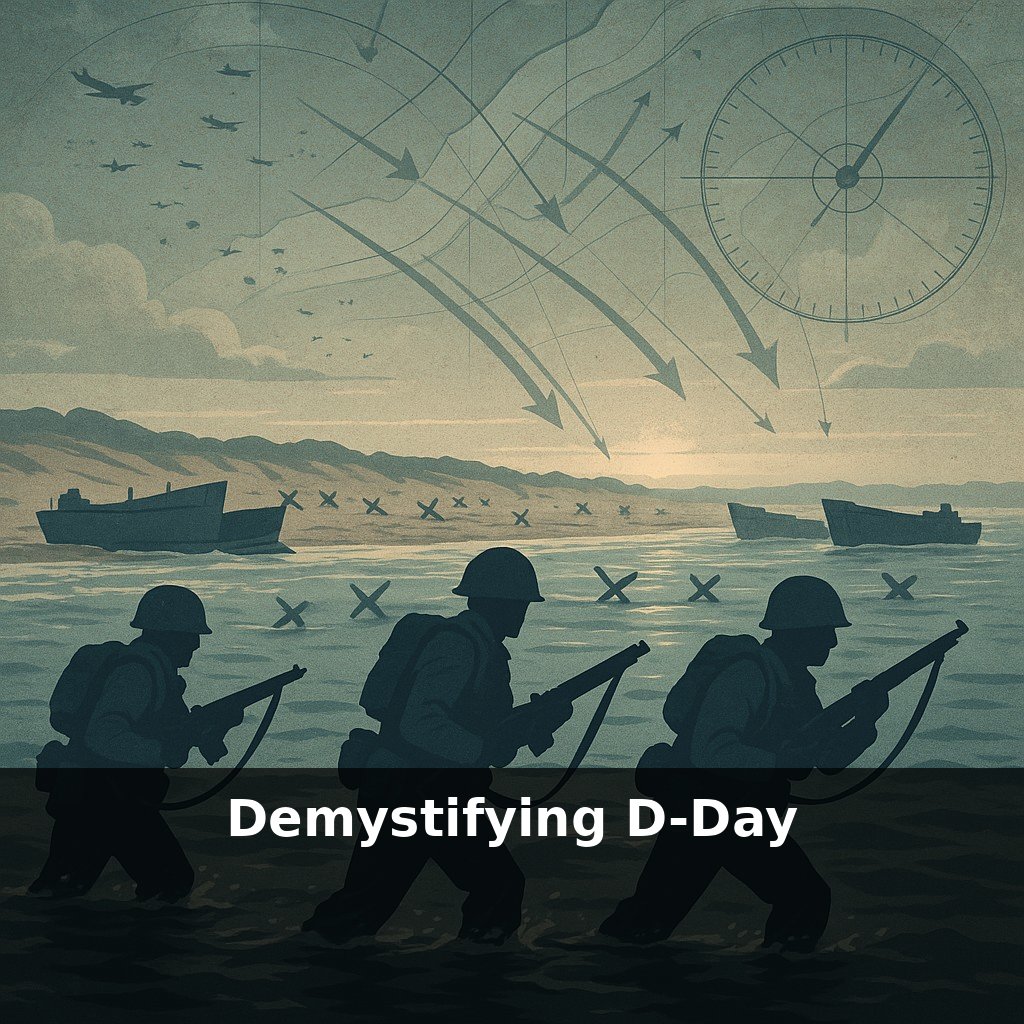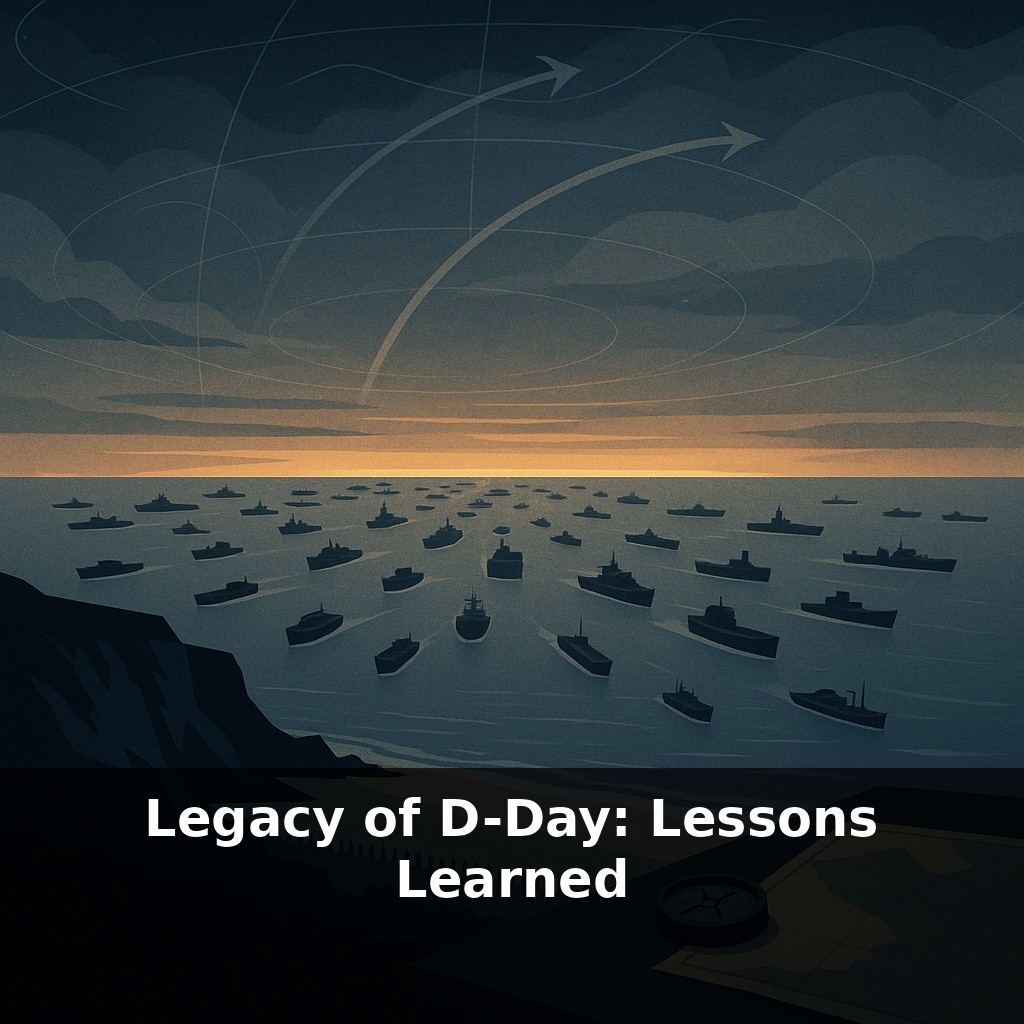
Before sunrise on D‑Day, the largest armada in history moved toward France—and almost didn’t go. One weather report, one hesitant decision, and the course of the war could have flipped. In this episode, we’ll unpack how that fragile gamble still shapes military strategy today.
156,000 troops crossed the Channel on D‑Day, but the real legacy isn’t just how many arrived—it’s *how* they got there together. Behind the beach landings lay 11 months of rehearsals, war games, and arguments over details as small as which units would carry extra bandages and who controlled which radio frequencies. The operation fused air, sea, and land power in a way that forced Allied planners to think less like separate services and more like parts of a single system. That mindset—coordinating specialists under one plan—now underpins everything from modern joint commands to how disaster responses are organized. The lessons weren’t only technical, either. D‑Day showed how shared purpose can hold a fractious coalition together, even when plans go wrong and losses mount. In this episode, we’ll explore how those lessons still echo in today’s conflicts and crises.
D‑Day’s legacy sits at an interesting crossroads: it’s both a case study in hard military science and a powerful story societies tell about themselves. On one level, you have concrete outputs—doctrine for amphibious assaults, checklists for coordinating air and naval fire, and lessons on moving staggering quantities of fuel, food, and ammunition without collapsing the system. On another, you have its moral afterlife: commemorations, films, speeches that frame it as proof that free nations can still mobilize when it matters. Those two layers—technical blueprint and enduring myth—keep feeding into each other.
“D‑Day did not produce victory, but it made victory possible,” historian Max Hastings observed. That difference—between a single dramatic event and the slow grind it enables—is at the heart of D‑Day’s real legacy.
Start with scale. In the five months after 6 June, just one artificial harbor—Mulberry ‘B’ at Arromanches—pushed ashore 2.5 million men, 500,000 vehicles, and 4 million tons of supplies. That wasn’t improvisation; it was logistics treated as a weapon. Modern planners studying humanitarian corridors, cyber‑defense, or pandemic supply chains still come back to this: success depends less on the first “strike” than on whether you can sustain effort day after day without the system seizing up.
The operation also rewired how militaries think about information. Months of deception operations—fake armies, bogus radio traffic, double agents—were designed to fix German attention on the wrong coastline. Today’s doctrines on “information superiority,” from social media campaigns to electronic warfare, echo that insight: where the enemy *thinks* you are can matter more than where you actually are.
Then there’s the multinational piece. Twelve nations contributed forces on and around 6 June 1944, from Polish destroyers to Free French commandos. What looks, in hindsight, like a unified effort was in reality a tangle of different languages, doctrines, and political red lines. Out of that friction grew habits we now take for granted: standardized procedures, shared planning staffs, common training. NATO’s ability to plug, say, a Norwegian unit into an American‑led task force without starting from scratch is a direct descendant of those Normandy lessons.
D‑Day’s afterlife in public memory adds another layer. Films, speeches, and commemorations have turned it into a kind of moral shorthand: democracies can act decisively when they agree on the stakes. That story isn’t neutral—it’s been used to justify interventions and, at times, to oversimplify messy conflicts by casting every opponent as “the new tyranny.” Yet even critics of that rhetoric often invoke D‑Day’s victims and veterans as a reminder to treat war as a last resort.
The paradox is that the same event teaches both how to wage large‑scale war more effectively and why its costs should make leaders hesitate before doing so again.
Think of Normandy’s planning culture as closer to a modern open‑source software project than a rigid top‑down codebase. British, American, Canadian, and smaller Allied teams brought incompatible “systems” to the table—different radios, map grids, even terminology. Instead of forcing everyone to rewrite their “code,” planners created interfaces: shared symbols, joint briefing cells, combined targeting boards. You see the descendant of that approach when a UN relief mission today merges data from NGOs, militaries, and local governments into a single operations picture, despite wildly different tools and standards.
There’s also a leadership lesson companies now quietly copy. Senior commanders in 1944 set only a few non‑negotiables—overall objectives, timing windows, broad sectors—while letting subordinate units improvise under fire. Tech firms running complex product launches mimic this: a hard release date, clear user goals, but freedom for engineering, marketing, and support to solve problems their own way as reality pushes back against the plan.
4,400 Allied dead in a single day still echo in how we plan risk now. The next Overlord‑scale test may unfold in code and satellites as much as on beaches: AI sorting sensor floods, drones probing defenses, alliances rehearsing landings on hostile, missile‑ringed shores. Your challenge this week: when you see a headline about NATO, Taiwan, or cyber‑exercises, ask yourself—not “who wins?”—but “who’s quietly rehearsing the next Normandy?”
D‑Day’s echo isn’t just in war rooms; it’s in how cities prep for floods, how space agencies choreograph launches, how global teams sync product rollouts across time zones. Like an intricate bridge, its lessons span from 1944 beaches to today’s crises, carrying one question forward: when stakes spike, who can actually align plans, people, and principles?
Before next week, ask yourself: “Where in my life right now do I need the kind of deliberate preparation the Allies used before D-Day—planning logistics, gathering ‘intel’ (information), and lining up allies—rather than just charging ahead?” “If I treated the next 30 days like a ‘landing operation’ on one important goal, what would be my version of the beachhead (the first, clear, measurable win), and what support would I need to secure it?” “Looking at how the D-Day soldiers acted despite fear, what is one decision I’ve been postponing that I could commit to a specific date and time this week, as my own small act of courage?”