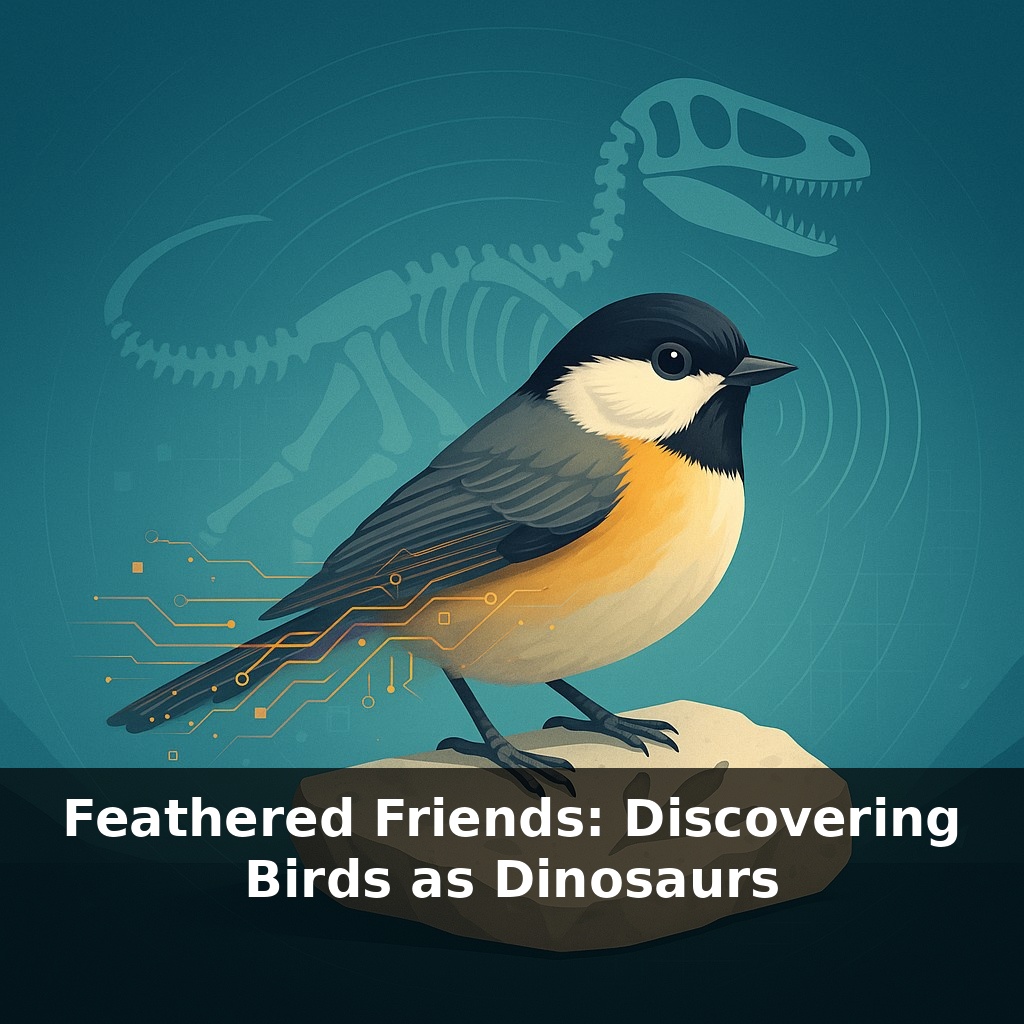
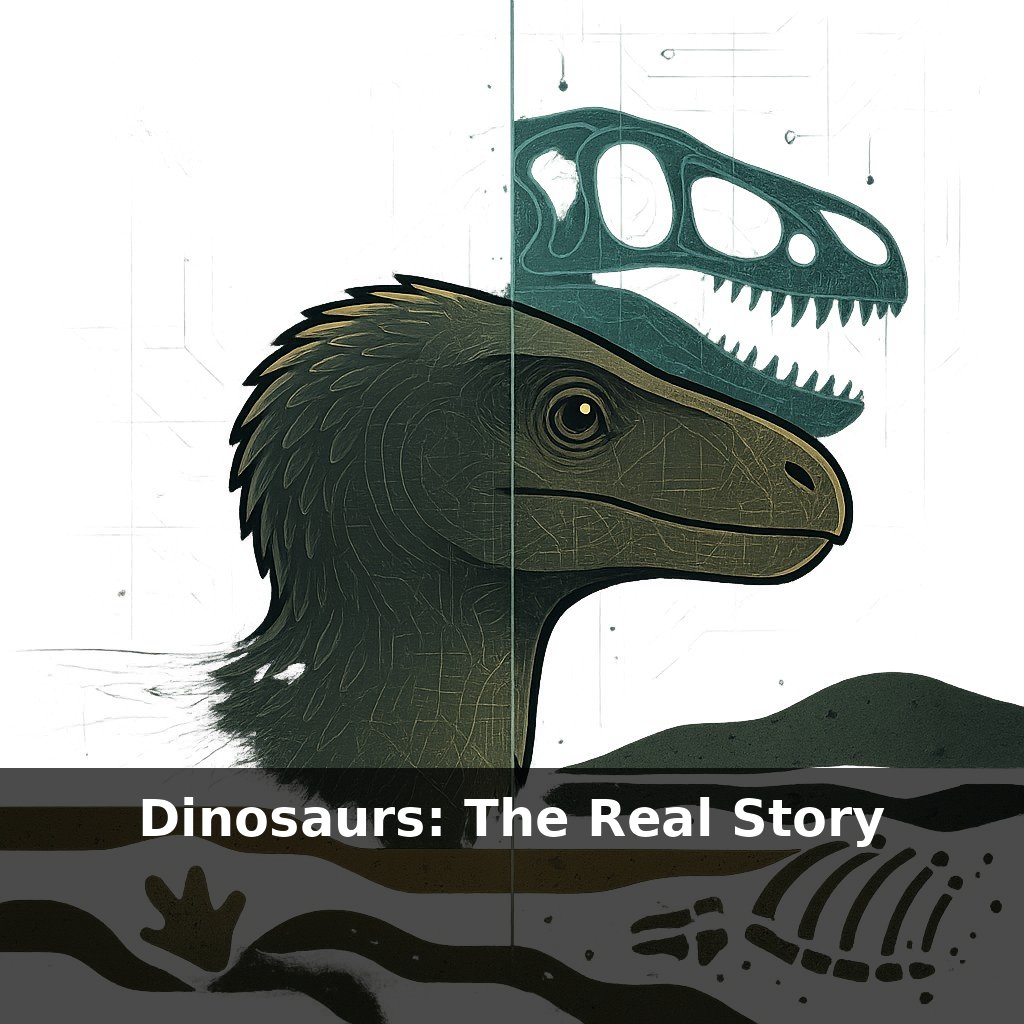
From terrifying ground hunters to the chickadees and crows now ruling our skies, the evolutionary journey of dinosaurs is astonishing. In this episode, we’ll track fossils, feathers, and flight, revealing how these ancient creatures became the melodic symbols of resilience perched near us today.
Some of the most high‑tech “dinosaurs” alive today are hiding in plain sight on city sidewalks and backyard feeders. That sparrow kicking crumbs at your feet? It’s running on a musculoskeletal system first trial‑tested in Cretaceous undergrowth. This time, instead of asking how ancient predators took to the air, we’ll zoom in on how much of that dinosaur blueprint is still quietly operating inside a pigeon’s stride or a hawk’s stare. Modern birds carry an unexpected toolkit: precision balance that lets them land on swaying branches, ultra‑efficient lungs tuned for thin mountain air, and vision sharp enough to track insects at highway speeds. Think of a jazz musician riffing on a classic standard—the melody is familiar, but every run and rhythm is newly improvised. In the same way, birds are constantly remixing their dinosaur heritage into fresh solutions for surviving our changing world.
What’s easy to miss is how much living birds are still experimenting with being dinosaurs. A hummingbird’s hovering isn’t just cute; it’s a radical tweak of limb control that lets it tap nectar like a tiny aerial surgeon. Penguins have traded air for water, turning their wings into flippers that “fly” through the sea at highway‑zone speeds. Ground birds such as emus and ostriches push speed and stamina to track‑runner extremes. And then there are parrots and corvids, using inherited brainpower in ways that look uncomfortably close to the kind of problem‑solving we once claimed as uniquely human.
Peer inside a modern bird and you keep tripping over very old ideas. Start with the skeleton. That stiff, fused tail in a crow? It’s the trimmed‑down echo of a long, flexible dinosaur tail, now repurposed as an airborne rudder. The wrist that lets a hawk snap its wing into a tight fold is the same basic joint a dromaeosaurid used to quickly retract its killing clawed hand. Paleontologists count at least 35 such shared skeletal quirks, from the S‑curved neck to the half‑moon‑shaped wrist bone that controls how the arm sweeps through space.
The feet tell an equally ancient story. Many birds still carry the classic three‑forward, one‑back toe layout of their theropod relatives. Swap the scaly skin and you’re looking at a predator’s grasping toolkit, retuned for perching, paddling, or sprinting. Raptors like eagles and owls show this most clearly: their talons lock down on prey with a grip that would be familiar—if terrifying—to a small Cretaceous hunter.
Then there’s behavior. Watch a rooster strut, head bobbing while the body glides; that head‑stabilizing trick turns up in dinosaur trackway studies suggesting similar gait control. Courtship dances in birds of paradise, cranes, and grebes look flamboyant, but the basic choreography—displays of plumage, synchronized steps, dramatic vocalizations—maps well onto what elaborate crests, frills, and tail fans likely meant for many non‑avian dinosaurs: social signals broadcast in bright colors and bold motions.
Brains may be where the dinosaur legacy is most underestimated. CT scans of fossil skulls show enlarged regions for vision, balance, and complex movement planning in many small theropods, overlapping the pattern in today’s parrots and corvids. When a New Caledonian crow shapes a hook from a twig to fish out food, it’s not inventing intelligence from scratch; it’s extending a deep lineage of sensorimotor sophistication that once guided agile hunters through dense undergrowth.
If you graphed all this—bones, feet, behavior, brains—you’d see a continuous line, not a broken one. Birds didn’t step out of the dinosaur story; they edited the script and kept the production running.
Think about how differently bird “dinosaurs” tackle the same problem: getting from point A to point B. A raven on a city street uses short wingbeats and clever glides to thread between buildings, the way a basketball point guard weaves through defenders, constantly shifting direction without losing control. Swifts take the opposite route, committing almost their entire lives to the air; some sleep on the wing and may not land for months, turning the sky into a kind of invisible racetrack they never step off.
On the ground, a roadrunner mixing bursts of sprinting with sudden freezes feels closer to a stealthy track sprinter than a cartoon character—each pause a calculated reset of its pursuit. In the water, anhingas spear fish with a lightning jab and then spread their soaked wings to dry, effectively toggling between “submarine mode” and “solar panel mode.” Even song shows this tinkering: lyrebirds sampling chainsaws and camera shutters fold human noise into their calls, as if an ancient communication system has been handed a modern soundboard and told to improvise.
Every bird on a power line is a live test case for resilience. As climate zones shift, these “urban dinosaurs” alter migration routes, breeding times, even body sizes; scientists track those tweaks the way software engineers watch real‑time patches roll out. The same comparative data that helps forecast which species may vanish first also feeds into human medicine, from bone‑healing tricks to respiratory care, turning every flock into a moving research library of survival strategies.
Step outside and the “dinosaur story” is still being drafted overhead: GPS‑tagged storks redrawing flyways, city crows learning to drop nuts at traffic lights, backyard jays caching seeds that replant forests like accidental gardeners. Your challenge this week: pick one bird you see often and track how its routine shifts with weather, light, and human noise.