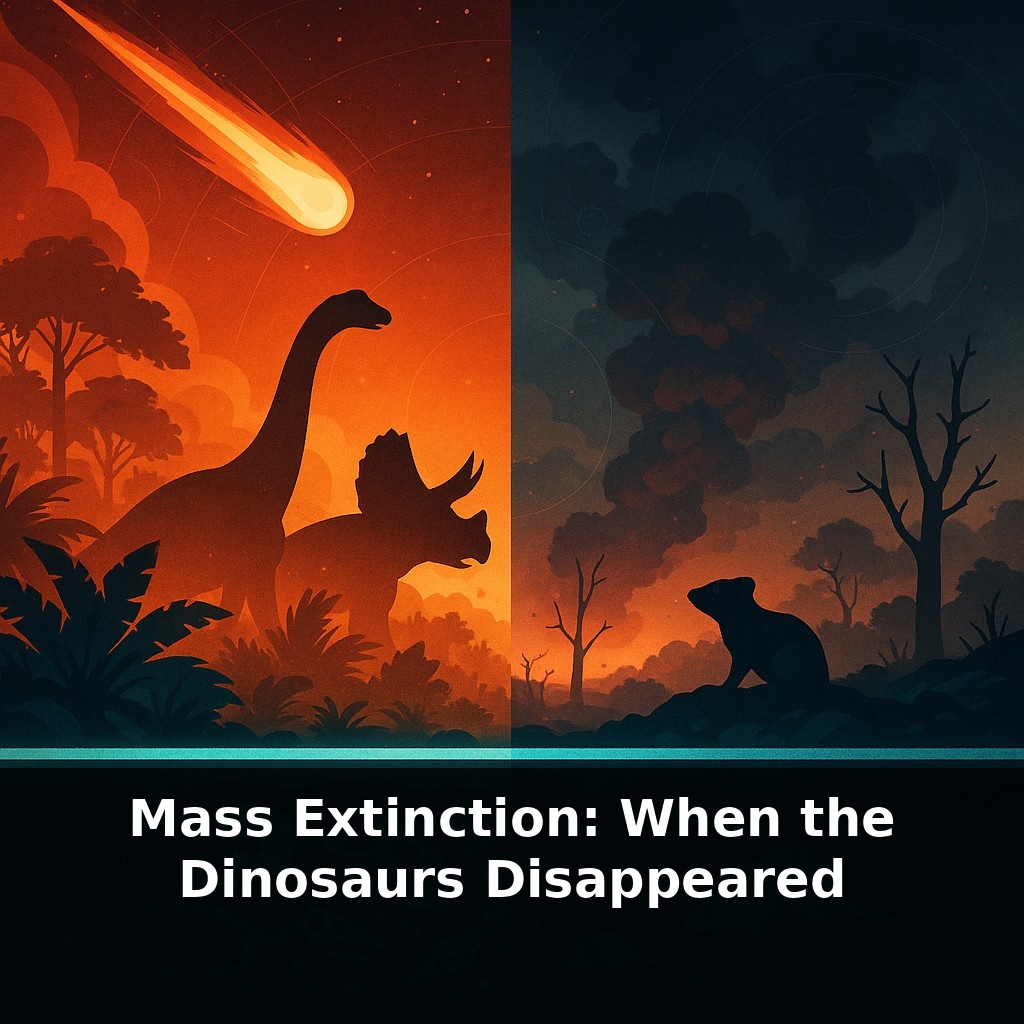
A single day, 66 million years ago, ended about three out of every four species on Earth. In one scene, forests fall silent; in another, tiny mammals dig deeper underground. Same planet, same moment—two utterly different fates. How does one catastrophe choose its survivors?
Some of the most important clues to that “choice” are not in dinosaur bones at all, but in rocks no thicker than a paperback book. Around the world, from New Zealand sea cliffs to Italian hillsides, there’s a razor-thin band of clay marking the exact turning point: above it, fossils of a changed world; below it, the last traces of the old one. Inside that layer scientists find tiny glassy droplets, shocked minerals, and an unexpected chemical signature that doesn’t match Earth’s usual recipe. It’s less like a crime scene with a single smoking gun and more like a scattered file of forensic reports, each preserving a few seconds of a catastrophe that lasted hours to years. To reconstruct that day, researchers combine geology, physics, climate modeling, and even nuclear test data, treating the whole planet as their laboratory notebook.
At first glance that thin boundary looks uniform, but zooming in reveals wild regional differences. In some places it’s loaded with charcoal; in others, tiny shells vanish abruptly; elsewhere, pollen from lush forests is replaced by spores from hardy, weedy plants. It’s less a single line than a stack of local “news reports” filed in the hours, weeks, and centuries after impact. By lining those reports up, scientists try to reconstruct not just that awful day, but the sequence: firestorm, darkness, freezing, then a greenhouse rebound that, like a boxer’s counterpunch, hit ecosystems already on the ropes.
If you could scroll through that boundary layer like a timeline, the first “frame” would be violent. Just above the disrupted sediments and tangled debris, there’s evidence of a colossal wave: deposits of sand and ripped-up seafloor dumped far inland around the Gulf of Mexico and even into what’s now the interior of North America. Those tsunami beds tell us water sloshed back and forth for hours, reshaping coasts long after the impact fireball faded.
A few millimeters higher, the story shifts from water to air. Spherules—those tiny glassy droplets already noted—show up in thick “rainout” layers closer to Chicxulub, thinning with distance. Mixed among them are grains whose crystal structures have been warped by brief, monstrous pressures. From their size, chemistry, and distribution, researchers infer the angle and direction of impact, like reconstructing a car crash from skid marks and shattered headlights.
Charcoal-rich horizons in some regions point to forests that didn’t just die, but burned. One camp argues for a brief, global broiling from infrared radiation as ejecta re-entered the atmosphere; another suggests more patchy, regional fires sparked by hot debris. Either way, the charcoal marks landscapes suddenly stripped of shade and leaf litter—bad news for large plant‑eaters, but a temporary bonanza for scavengers.
Then the shells and microfossils thin or vanish. In marine cores, foraminifera and ammonites drop out in a sharp step, replaced by a few small, hardy species. On land, pollen counts flip: diverse trees give way to ferns and opportunistic plants. It’s the ecological equivalent of a championship team benched overnight and the substitutes scrambling onto the field.
Yet even in this chaos, the record shows pockets of continuity. Some deep‑sea communities seem to ride out the worst with muted losses, hinting that depth and distance from coasts offered partial shelter. Freshwater systems often fare better than the open ocean; their sediments preserve fish and amphibians that bridge the boundary with fewer gaps.
Linking all these local stories are subtle shifts in carbon and oxygen isotopes through the layer, tracking swings in temperature and the balance between life in the sea and on land. These squiggly lines on lab printouts are, in effect, the vital signs of a planet in intensive care, letting scientists time not just the blow itself, but each aftershock in Earth’s slow path toward recovery.
In practice, scientists treat each site like a different medical chart from the same patient. A core drilled off the New Jersey coast, for instance, preserves stacked tsunami sands overlain by a sudden shift in tiny seafloor communities, while Italian limestones capture a razor‑sharp drop in open‑ocean plankton, hinting at how quickly surface waters starved. Inland, sections in Montana and Alberta record an abrupt turnover from diverse leaf types to low, scrubby vegetation, mirroring how fire‑prone regions recover today after megafires. Even polar records chiseled from Antarctic and New Zealand outcrops show how high‑latitude ecosystems were jolted, then slowly reassembled with a different cast of species. When researchers compare these “charts” across continents, they can separate local trauma—like regional wildfires or coastal flooding—from truly global stressors that show up everywhere, such as prolonged dimming of sunlight and disrupted climate cycles that echoed from the tropics to the poles.
Those boundary “charts” don’t just close a dinosaur chapter; they draft blueprints for our future. As we refine dates and climate signals, the K–Pg becomes a stress‑test manual for Earth systems: how quickly oceans flip, how food webs re‑shuffle, how long recovery really takes. Like a coach replaying an old, brutal match, scientists study each misstep and lucky break to see which traits—small size, flexibility, broad diets, varied habitats—turned crisis into a fresh start.
In the end, that thin boundary is less a tombstone than a bookmark. The story that follows includes mammals radiating like startup teams after a market reset, birds testing new ecological “jobs,” and reefs rebuilding with different architects. By reading it closely, we’re not just learning how worlds end, but how radically different ones begin.
Here’s your challenge this week: pick one modern human-driven “extinction driver” discussed in the episode—like habitat loss, climate change, or invasive species—and trace its full impact on a single real species (for example, orangutans, monarch butterflies, or coral reefs) using at least three credible sources. Then, choose one concrete lifestyle shift that directly reduces your contribution to that driver (e.g., cutting beef dinners to once a week to lower deforestation pressure, or replacing one weekly car errand with walking or biking) and commit to doing it every day for the next seven days. Before the week ends, share what you learned about that species and the change you made with at least one other person, connecting it explicitly to how we might avoid a human-caused “sixth mass extinction.”