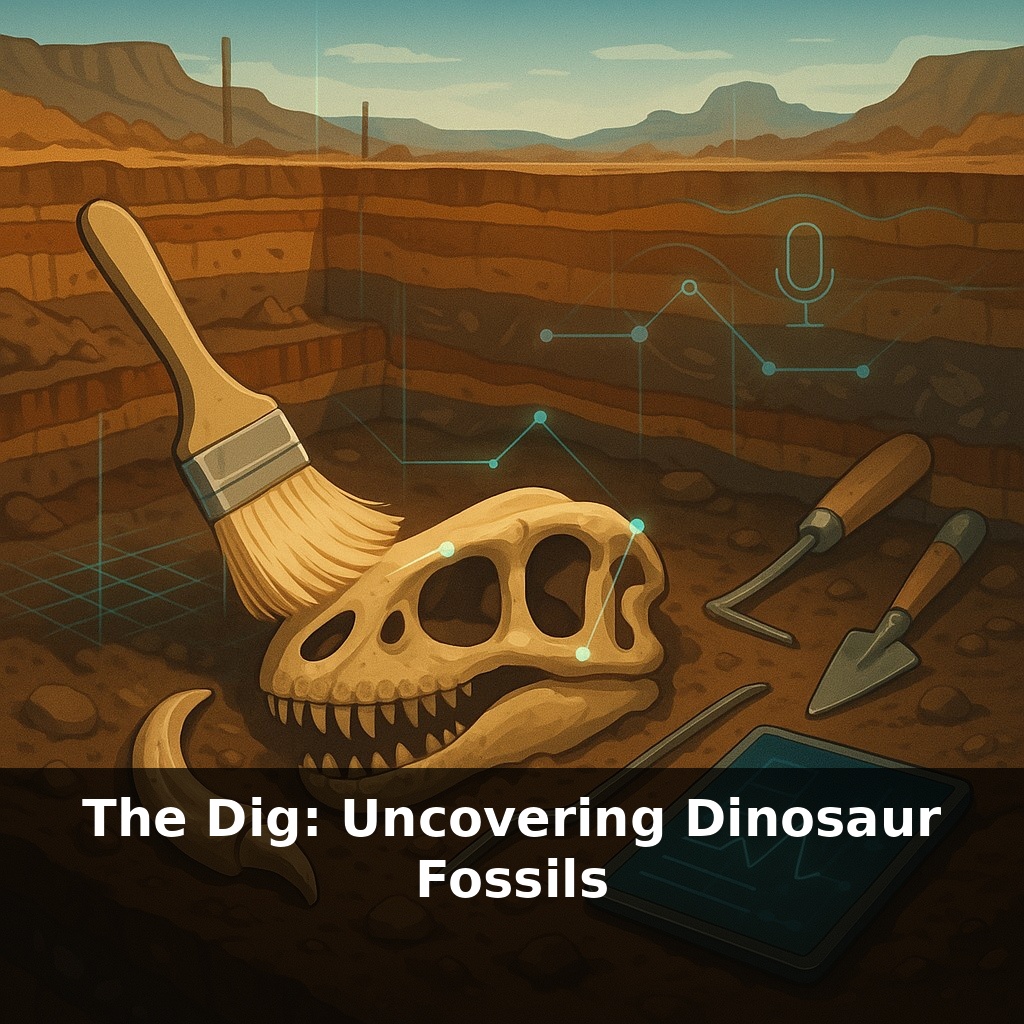
A dinosaur skeleton is almost never found as a complete set of bones. It’s usually scattered, shattered, and buried under stories of rock. In this episode, we drop into the dig site itself—following each tiny clue from dusty fragment to living, breathing dinosaur science.
Roughly 700 non-avian dinosaur species have names, yet that might be only a third of what once stomped across Earth. In this episode, we follow the trail from a nondescript patch of badlands to the moment a fossil is ready to rewrite a textbook. Paleontologists don’t just stumble on bones; they read rocks like layered biographies, using stratigraphy to narrow down where in a cliff face a dinosaur-sized secret might be hiding. In the field, they map every fragment’s position, then jacket the most promising pieces in plaster for the slow, careful work back in the lab. There, CT scanners peel back stone without a single physical cut, and radiometric dates on tiny zircon crystals lock fossils into a timeline stretching over 230 million years. We’ll see how these tools turn scattered remains into hard numbers about dinosaur age, size, feathers, and even ancient climates.
Out on the outcrop, the real search begins long before anyone swings a pickaxe. Teams hike for hours, scanning for subtle signs: a hint of bone weathering from a slope, a darker streak in the sediment, a layer that matches a promising horizon miles away. They flag these spots, log GPS coordinates, and sketch detailed maps so nothing is “found” only once. Then comes the slow work: peeling back overburden, brushing away loose grains, tracing each exposed edge of fossil until a pattern emerges—maybe limb bones, maybe ribs, maybe something no one has seen in the rock record before.
Kneeling in the dust, the crew switches from scouting to surgery. First rule: don’t chase the big bones. They start with the scraps—chips, splinters, isolated vertebrae—because those scattered pieces outline the hidden body. Each fragment gets a field number, a dot on a site map, a note in a log. When you see those dots cluster in a curve, you might be tracing a tail; in a tight knot, maybe a hip or skull.
As more bone appears, tools shrink. Shovels give way to trowels, then dental picks, then paintbrushes and bamboo skewers. One careless jab can erase a tooth mark from a predator, or a delicate ridge where feathers once anchored. Teams clear a buffer of rock around each major piece, leaving it perched on a pedestal of sediment. Only when its shape and connections are clear do they commit to lifting it.
Before anything moves, they record context from every angle: high-res photos, drone shots, even photogrammetry models that let them reconstruct the site digitally down to millimeters. Sediment samples go into labeled bags so later someone can read grains, pollen, and chemical traces for clues about rivers, droughts, or ashfall.
Now the plaster jackets come out. The crew wraps bone and surrounding rock in wet plaster and burlap, like putting a cast on a broken limb. For giants like “Scotty” the T. rex, a single jacketed block can weigh more than a car; heavy equipment and careful rigging turn the quarry into a slow-motion logistics puzzle. Each jacket’s underside stays unprepared in the field; the real unveiling waits for the lab.
Back indoors, technicians flip the jackets and begin trimming away rock. Under microscopes, they consolidate crumbly surfaces with thin glues, rescuing textures you’d never spot at the outcrop: vascular grooves, muscle scars, the faint quill knobs that pushed feathered dinosaurs past speculation. Preparation can take months for a single skull.
Meanwhile, other specialists work the surrounding rock. Thin sections reveal tiny volcanic crystals that can be dated precisely, locking this death scene into the wider dinosaur timeline. Microfossils—snails, fish scales, spores—narrow down lakes versus floodplains, dry seasons versus lush intervals. Together, the growing dataset shifts the find from “a neat skeleton” to a datapoint in a continent-wide story: who lived where, in what numbers, under which ancient climate swings.
Sometimes the most revealing fossils aren’t the photogenic skulls, but the strange extras that travel with them. A single shed tooth beside a limb might show that a predator scavenged the carcass. A cluster of parallel scratch marks nearby can hint at herd behavior or migration routes. Thin, curved bones preserved in the chest region can betray the outline of a breathing system more like a bird’s than a reptile’s, shifting how we picture dinosaur endurance and metabolism.
The rock can hold social clues too. Nesting grounds with layered clutches of eggs suggest repeated seasonal returns to the same safe spot. Growth rings inside limb bones, sliced and polished like cross‑sections of a tree, reveal spurts and slowdowns in development—evidence for teenagers and late bloomers in dinosaur populations. And when a fossil shows healed fractures or infections, researchers glimpse survival stories: animals that limped on, compensated, maybe leaned on their group. One articulated skeleton can redraw anatomy; a site full of such details starts to redraw behavior.
Building on these observations, the future of excavation may soon begin with technologies such as satellite maps and neural-net predictions, introducing a new era of fossil discovery long before a boot hits the ground. Algorithms could flag subtle patterns in rock outcrops the way music apps spot hidden genres, turning entire continents into searchable fossil playlists. Synchrotron beams might tease out ghostly pigments or proteins, giving us color swatches instead of gray silhouettes. And as thawing polar rock yields creatures adapted to darkness, their strategies could guide how we think about surviving on Mars or Europa.
Each new fossil, from Nyasasaurus hints to feathered cousins, stretches the dinosaur playlist further back and broadens its styles. Your challenge this week: treat everyday rocks like mystery novels. Study a single stone you find—its layers, colors, grains—and jot one question it raises about deep time. That curiosity is the first tool in any future dig.