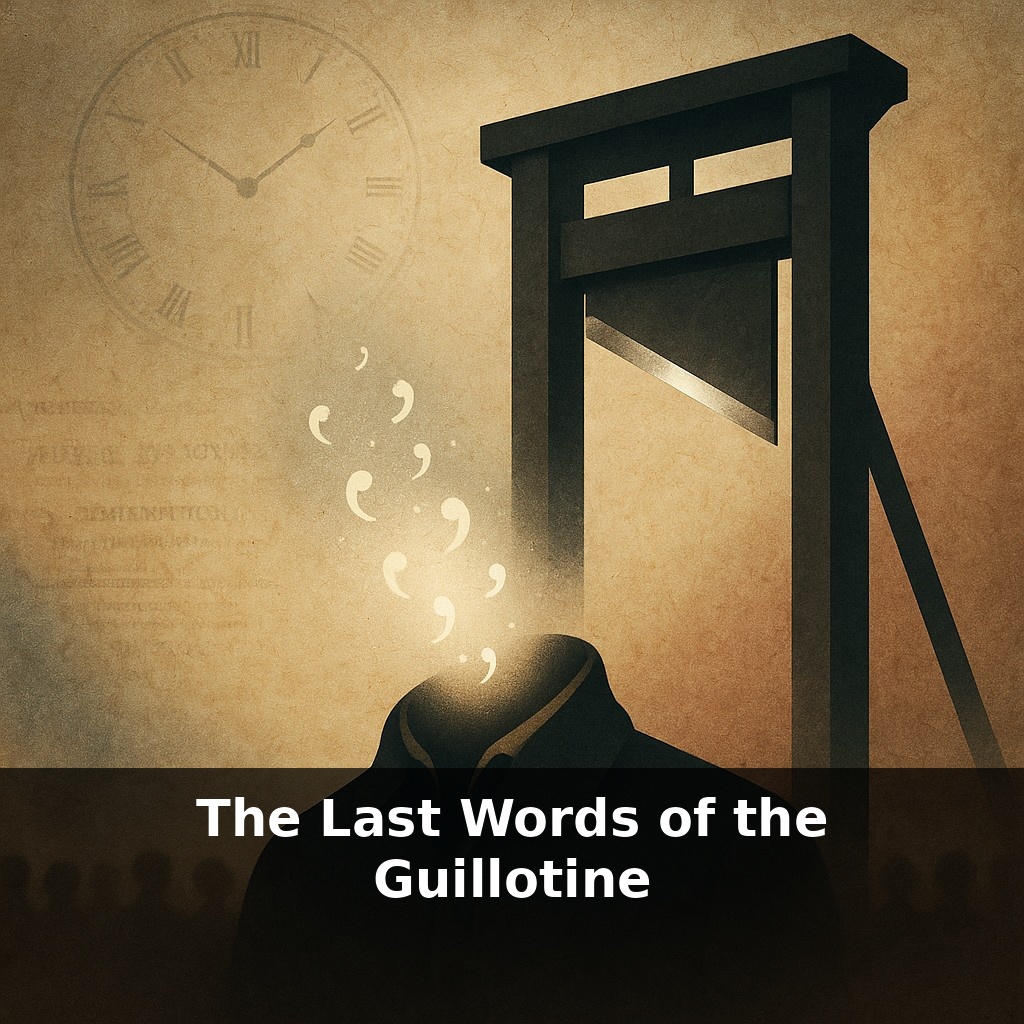
About half a lifetime ago, in the late 1900s, France still ended lives with a machine born in the age of powdered wigs and revolutions. Crowds gathered, not just to see a head fall, but to hear a final sentence—sometimes braver, funnier, or more political than any last speech.
Some of the most famous lines spoken before the blade fell weren’t shouted to the crowd at all—they were murmured to the executioner. A condemned man might fuss over the angle of his collar, or apologize for having “given you so much trouble,” the way someone today might nervously joke with a dentist before the drill starts. Others asked for small mercies: a faster cart, a tighter strap, a word to a waiting spouse. And then there were the practical questions—“Will it hurt?”—answered with rehearsed reassurances from men who watched heads drop for a living. In these tiny exchanges, half-private and half-theatre, terror, politeness, defiance and denial all jostled together. The last words we remember are only a sliver; around them was a whole choreography of human awkwardness in the shadow of an inhumanly efficient death.
Some of those murmured lines survived only because someone bothered to write them down. Executioners’ ledgers, police reports, cheap pamphlets and whispered café stories all competed to fix a “definitive” version of a person’s last seconds. It was less a neutral transcript than a tug-of-war over meaning: royalists polishing martyrs, Jacobins polishing monsters, and printers polishing whatever would sell. In that sense, a final phrase worked like a headline on a controversial article—short, dramatic, and instantly framing how the whole life beneath it would be read.
For revolutionaries, those last lines at the scaffold became a kind of political product: short, portable, endlessly copied. The most useful ones were crisp and quotable. Charlotte Corday, who killed Jean-Paul Marat, was remembered for calmly correcting the executioner who knocked off her cap—“Thank you, sir, but it is not yet time.” Whether or not she said it that way, the phrase let royalists market her as self-possessed, almost aristocratically unbothered by the blade. On the other side, Jacobin pamphlets loved angry or foolish outbursts from nobles. A panicked plea or a whine about lost property could be boiled down to a single ugly sentence that “proved” an entire class was cowardly and corrupt.
Then there were the jokes. Some condemned people reached for humor the way others reached for prayer. One man supposedly told the executioner, “Don’t miss,” as if they were about to start a friendly game, not a killing. Another is said to have apologized that his hair was going white—that would make the job harder to clean. Historians suspect many of these quips were polished or invented after the fact; the point wasn’t accuracy, it was a punchline that reassured the living that death could be faced with a shrug. A crowd repeating a funny last word on the way home was a crowd processing horror in a socially acceptable way.
But not everyone cooperated with the script. Some refused to speak at all, depriving enemies and admirers of a neat quote. Silence could be infuriating for authorities who wanted a confession or a display of remorse. It could also be dangerous for families, who preferred their relative to go down in history with at least one line that made them look good. Letters smuggled from prison sometimes tried to script the moment in advance: “If they say I begged, do not believe them.” Even in death, people anticipated spin.
Over time, patterns emerged. Women were edited to sound virtuous or hysterical, depending on who was writing. Poor thieves and servants rarely had their words preserved unless they fit a moral tale: either grateful acceptance of justice or defiant proof that “the people” were still angry. Famous men, by contrast, generated whole competing scripts. The same syllable—“Liberté…”—could be printed as a cry of freedom by one side and cut mid-sentence by another, to suggest cowardice.
The machine fell at the same speed on everyone, but the sentences attached to each falling head moved at wildly different speeds through society. In that sense they behaved less like literal speech and more like early viral posts: compressed, emotional fragments, endlessly forwarded, constantly edited, and always saying as much about the sharers as about the speaker who supposedly uttered them.
Sometimes the most revealing cases are the ones that don’t quite “work” as final lines. Take the young republican who tried to shout a full slogan, only to be drowned out by drumrolls. Pamphlets filled the silence for him, each faction supplying its preferred missing words. Or the distracted artisan who, according to one clerk, spent his final minute complaining not about injustice but about a botched business deal. That story circulated in workers’ circles as a bitter joke about how thoroughly everyday worries colonize our minds.
You can see a spectrum. At one end are sleek, quotable phrases that move cleanly from scaffold to street to broadside, like a well-designed app that runs on any device. At the other are glitchy, half-heard fragments, too odd or private to travel far, which survive only when some bored clerk bothers to copy them into a margin. Those messy remnants hint at a much larger archive of unrecorded last thoughts—unfinished lists, sudden cravings, stray memories—that died the moment the blade fell.
Today, scholars mine court files, parish notes, even marginal doodles to trace how a single phrase mutates over decades. A proud shout in one notebook becomes a muttered regret in another, like a melody drifting between instruments. Digital projects now layer these variants on maps and timelines, letting users “scrub” through versions and see which political climates favored which edits. In that view, each alteration becomes evidence, not noise—a clue to what a shaken society needed its dead to say.
When we sift these fractured voices now, we’re not just chasing morbid quotes; we’re reverse‑engineering how fear, hope, and gossip hardened into “history.” Your challenge this week: notice the tiny phrases that friends or headlines repeat like verdicts. Which parts of a complex life get trimmed away so a story can travel faster than the person it describes?