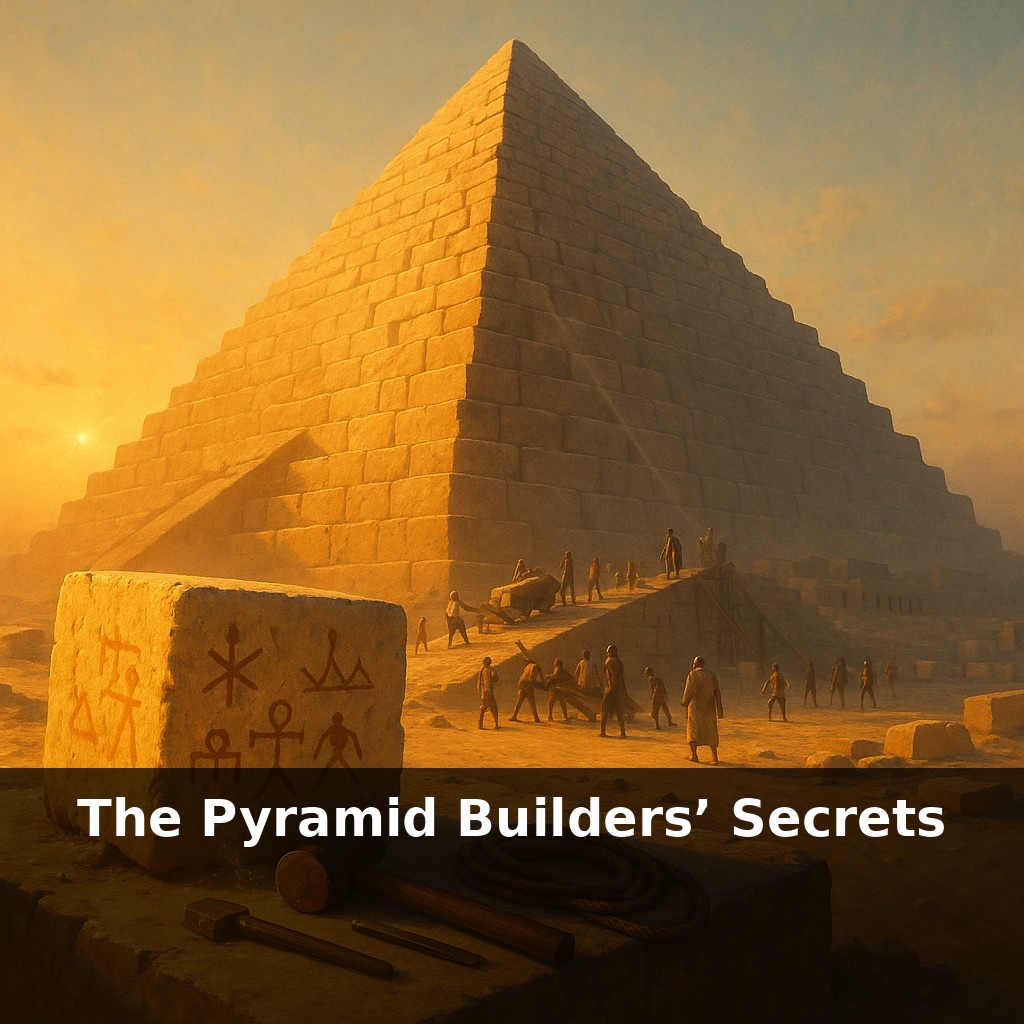
Workers’ graffiti inside the Great Pyramid casually names construction crews—as if the world’s most famous monument was just another job site. Today, close your eyes and step onto that site: dust, shouting overseers, and a deadline the pharaoh absolutely will not extend.
No blueprints survive from Giza, yet the project’s scale is written into the landscape. South of the plateau, a planned settlement—Heit el-Ghurab—covers roughly 13 hectares, with long galleries that could dorm hundreds of specialists in tight rows. Excavations show bakeries with circular ovens clustered in blocks; one complex alone could turn out thousands of loaves per day. Nearby, cattle bones form mounds: cuts from at least tens of thousands of animals, implying steady, organized provisioning rather than sporadic feasts. Ostraca and sealings record deliveries of grain, oil, and linen, tying this “pyramid town” into a wider network of Nile estates and Delta farms. The monument rising in stone depended on an invisible pyramid of logistics: farmers, herders, potters, boatmen, scribes—most never set foot on the plateau, yet their output arrived precisely when and where it was needed.
Alongside that support network, the core engineering team faced brutal math. To finish Khufu’s pyramid in about 25 years, stone had to arrive at the plateau at an average pace of roughly 250 blocks per day—more during peak seasons. Quarry marks show blocks pre-measured to standard sizes, turning the desert into an open-air assembly line. Surveyors using cords and simple sighting tools established a reference grid, then checked it repeatedly as courses rose. Recent experiments suggest that by wetting desert sand, teams of 20–30 could drag 2.5‑ton blocks on sleds at workable speeds along prepared tracks.
Stone on the plateau was only the final act of a longer journey that began at the quarries. To the southeast, at Tura, bright limestone was cut into standardized blocks; to the south, at Aswan, granite monoliths weighing up to 70 tons were pried from bedrock. At one Aswan quarry, an unfinished obelisk—about 42 m long and over 1,000 t—still lies half-separated, its underside cradled on stone “ribs” that chisels and pounding stones were slowly undercut. Red ochre lines mark where teams intended to split or trim, a frozen snapshot of work-in-progress.
Toolkits were simple: copper chisels, dolerite pounding stones, wooden mallets, stone hammers, and long wooden levers. Yet when multiplied by thousands of blows per day across dozens of teams, those tools reshaped cliffs. Analysis of chisel marks and quarry faces suggests systematic sequencing: rough detachment, trimming to target dimensions, then fine dressing near the construction site where final fitting mattered most.
Moving the stone relied on water as much as muscle. Flood-season canals brought boats almost to the base of the plateau. Archaeologists have traced an ancient harbor area north of Giza; cores reveal Nile silts beneath what is now desert. A typical transport barge—about 20–25 m long—could carry 20–30 standard blocks at a time. To sustain 250 blocks per day, only 10–15 such trips were needed, provided loading ramps, mooring posts, and crews of oarsmen and stevedores kept a tight schedule.
On land, the challenge was height. Instead of one colossal ramp, evidence points to a sequence of shorter ramps, turns, and platforms. Mudbrick, rubble, and gypsum plaster formed temporary causeways, some only a few meters high before being extended or re-angled. Experimental reconstructions show that with gradients around 8–10%, a team of 20–30 could haul 2.5‑ton blocks up such ramps, especially when sled runners were soaked to cut friction by nearly half.
At the top, precision took over. Corner blocks locked key reference points; gypsum plaster beds—sometimes less than 1 mm thick—let masons micro-adjust height. A slight error at course 20 could be corrected at course 22, but only if daily measurements caught it. That meant constant checking, recording, and recalculating: numbers and not just muscle held the shape together.
At the micro level, traces of routine decisions show how this vast system actually ran. At a smaller pyramid complex, one storage area held about 50 large ceramic beer jars; if each jar held 2.5 liters and was emptied daily, that’s 125 liters—enough for roughly 60–70 laborers on standard rations. Scale that up: supply 2,000 people and you need nearly 4,000 liters per day, plus grain for perhaps 4,000–5,000 loaves. One bakery trench at Giza contained over 80 bread molds; if each mold produced 20 loaves per day, that single unit could bake 1,600 loaves—only a fraction of the total needed, implying multiple parallel bakeries operating in shifts.
Coordinating such throughput is closer to running a high‑frequency data center than a simple building site: you can’t let the “network” of stone, food, and tools stall, or hundreds of specialists stand idle. Archaeologists have even found repair areas with discarded sled runners and tool fragments, hinting at maintenance crews whose entire job was to keep that flow from breaking.
Today’s engineering labs treat Giza as a full‑scale test site. Laser scans with 5 mm resolution feed “digital twins” so precise that shifting a single 2.5 t block in the model alters stress maps in real time. Muon detectors can spot hidden voids just 1% of the pyramid’s volume. Your challenge this week: compare one modern megaproject—say a 200 km rail line—to the pyramids and list 3 coordination lessons we still haven’t matched.
Treat their methods as a toolkit, not a relic. One inscription notes a team moving 16 blocks in a day; over 150 days that’s 2,400 blocks—nearly 6,000 t of stone. For your own “pyramids”—a 3‑month product sprint, a 50,000‑word thesis—steal their playbook: fixed crews, clear quotas, daily checks, and support systems sized from real numbers, not guesses.
Try this experiment: Pick a current “impossible” project and break it into three “pyramid levels” like the Egyptians: foundation (massive, repetitive work), middle layer (coordination and logistics), and capstone (precision, high-skill work). For one week, schedule your days like a work gang on the Giza plateau: batch all your foundation tasks together in long, uninterrupted blocks, then a shorter block for coordination (emails, meetings, planning), and finish with a tight, focused capstone block for your highest-skill task. Track two things daily—how far you got on the overall “pyramid” and when you felt the least mental friction—and at week’s end, adjust your time blocks based on where you were surprisingly fast or slow, just like ancient builders tweaking ramps and teams.