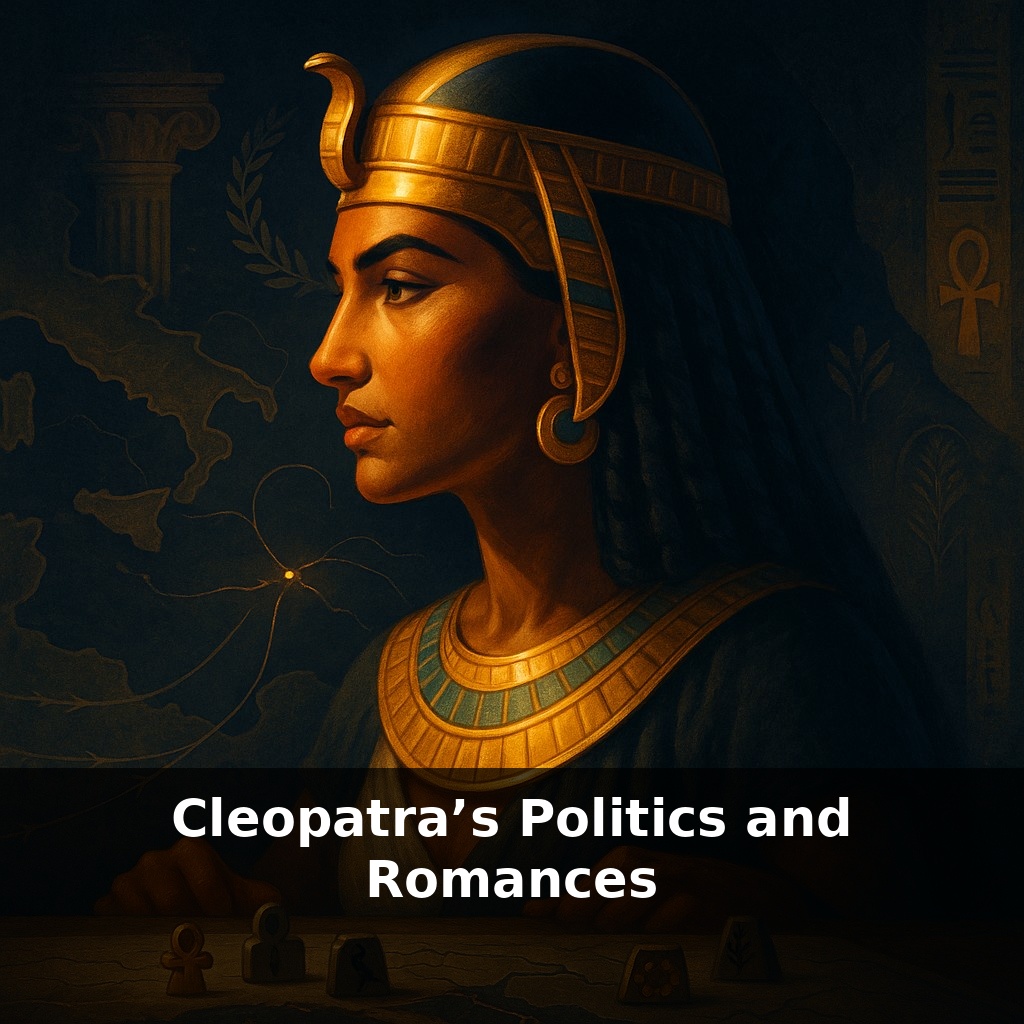
A queen who spoke more languages than most modern diplomats, controlled the breadbasket of the Mediterranean, and turned romance into foreign policy. Tonight, we step into Cleopatra’s war room, where every whispered promise could redraw the map of the ancient world.
In Rome, senators sneered that Cleopatra had “bewitched” Caesar and Antony, as if empires could fall to perfume and eyeliner. But follow the paper trail—papyrus decrees, tax reforms, military payments—and a different pattern appears: a ruler treating intimacy like a carefully calibrated investment portfolio, risking everything only when the potential returns were geopolitical.
She restructured debts, revived trade routes, and tightened control over customs like a modern state scrambling to avoid default. Her banquets with Roman power brokers weren’t just parties; they were negotiations with better lighting. When she sailed to Tarsus to meet Antony, the spectacle wasn’t vanity—it was a calculated signal of creditworthiness and stability to Rome’s war-tired elite.
In this episode, we’re not asking who Cleopatra loved, but what, exactly, she was buying with that love.
Yet Cleopatra wasn’t operating from a position of comfort. When she took the throne, Egypt was politically fragile, squeezed between Roman creditors and rival dynasties, its prestige faded since the days of earlier pharaohs. Her first task was survival: secure recognition from Rome without becoming its client. That meant mastering Roman factionalism as well as Egyptian temple politics, reading senators and priests with the same cold care a coder reads error logs. Her multilingual skills weren’t ornament—they were infrastructure, letting her bypass translators who might soften, twist, or sell her words.
The Roman sources loved to reduce all this to gossip: Cleopatra “ensnared” Caesar on a luxury barge, “corrupted” Antony with drinking parties. Strip away the sneer, though, and you see a monarch stress‑testing options in a shrinking decision tree.
With Caesar, the calculation was immediate and domestic. By backing him during the Alexandrian War, she wasn’t just choosing a winner in Rome’s civil conflict; she was erasing rival claimants at home and securing a guardian for her infant son, Caesarion. She wagered that a dictator who owed his eastern throne room to an Egyptian ally would be less likely to carve Egypt into a Roman province. His assassination in 44 BCE didn’t just end a romance; it blew up her entire risk model.
Her pivot to Antony shows how fast she could reprice the situation. Antony needed cash, ships, and a reliable eastern partner for campaigns against Parthia. Cleopatra needed recognition of Caesarion, territorial returns in Syria and Cyprus, and long‑term guarantees for Egypt’s autonomy. Their meetings read, on papyrus, like term sheets: in exchange for massive subsidies and naval support, she received chunks of formerly Ptolemaic territory and public affirmations of her dynastic claims.
This is where the language and image work intensify. Coins from this period don’t flatter; they argue. Her portrait grows sharper, more assertive, paired with Antony’s on joint issues that circulate through both realms. To Greek cities, this signaled continuity with Hellenistic kingship. To Egyptian elites, temple donations and Isis iconography told a parallel story: the pharaoh‑queen was re‑anchoring Ma’at—cosmic order—against Roman chaos.
Octavian, watching from Italy, framed the entire arrangement as moral corruption: not a treaty between sovereigns, but a veteran Roman general “enslaved” by an eastern queen. His propaganda turned their Donations of Alexandria—the moment Caesarion was styled “King of Kings”—into existential threat. If Cleopatra’s son was heir to Caesar and overlord of eastern territories, where did that leave Octavian’s carefully cultivated image as Rome’s rightful successor?
By the time fleets assembled off Actium, the question wasn’t who loved whom; it was whose version of the future would exist in law, coin, and grain receipts.
Consider how she handled information itself. Multilingual and trained in both Egyptian temple traditions and Greek philosophy, she could shift registers mid‑conversation: priestly piety in one breath, hard numbers on ship timbers and crew pay in the next. That’s not seduction; that’s bandwidth. In negotiations with Antony’s envoys, she wasn’t a supplicant but a parallel data center, holding archives, survey records, and tax rolls that Rome simply didn’t have for the eastern Mediterranean.
Think of her approach less as casting a spell and more as running a complex software stack: personal charisma was only the user interface. Underneath were layers of fiscal policy, legal precedent, and ritual authority, all tightly integrated. When she rolled out Caesarion’s new titles, or staged public ceremonies in Alexandria, each move was tested against multiple “systems”: how would it play in Rome, in Greek cities, in Egyptian temples, and among mercenary officers who just wanted back pay and clear orders?
Future finds might show just how far her experiments in power reached. A papyrus contract or tax docket could expose who actually benefited from her shifts in tribute and temple funding—urban elites, rural shrines, or foreign garrisons. Burial evidence might reveal whether she rehearsed a post‑Roman future, seeding legitimacy for Caesarion in local cults. Your challenge this week: when you see “romance” in politics, ask what treaty or budget line it’s quietly replacing.
Cleopatra’s story leaves us with a haunting question: how many leaders still trade affection, image, or family ties for leverage instead of laws and treaties? Like code hidden behind an app’s glossy screen, these private bargains shape public outcomes. Follow those unseen scripts, and today’s power struggles start to look a lot less mysterious.
Here’s your challenge this week: Before the day ends, pick one political relationship in your own life (boss, colleague, client, or partner) and map out a “Cleopatra strategy” for it in 5 bullet points: what power you bring to the table, what they value, one bold ‘alliance offer’ you could make (like Cleopatra backing Caesar or Antony), one risk you’re consciously taking, and one contingency plan if it fails. Then, within 48 hours, actually propose that alliance move—send the email, ask for the meeting, or suggest the collaboration—using deliberately strategic framing instead of emotional framing. Finally, after the interaction, rate yourself from 1–10 on three Cleopatra-style skills—diplomacy, theatricality/presentation, and long-game thinking—and choose one concrete tweak to upgrade each score next time.