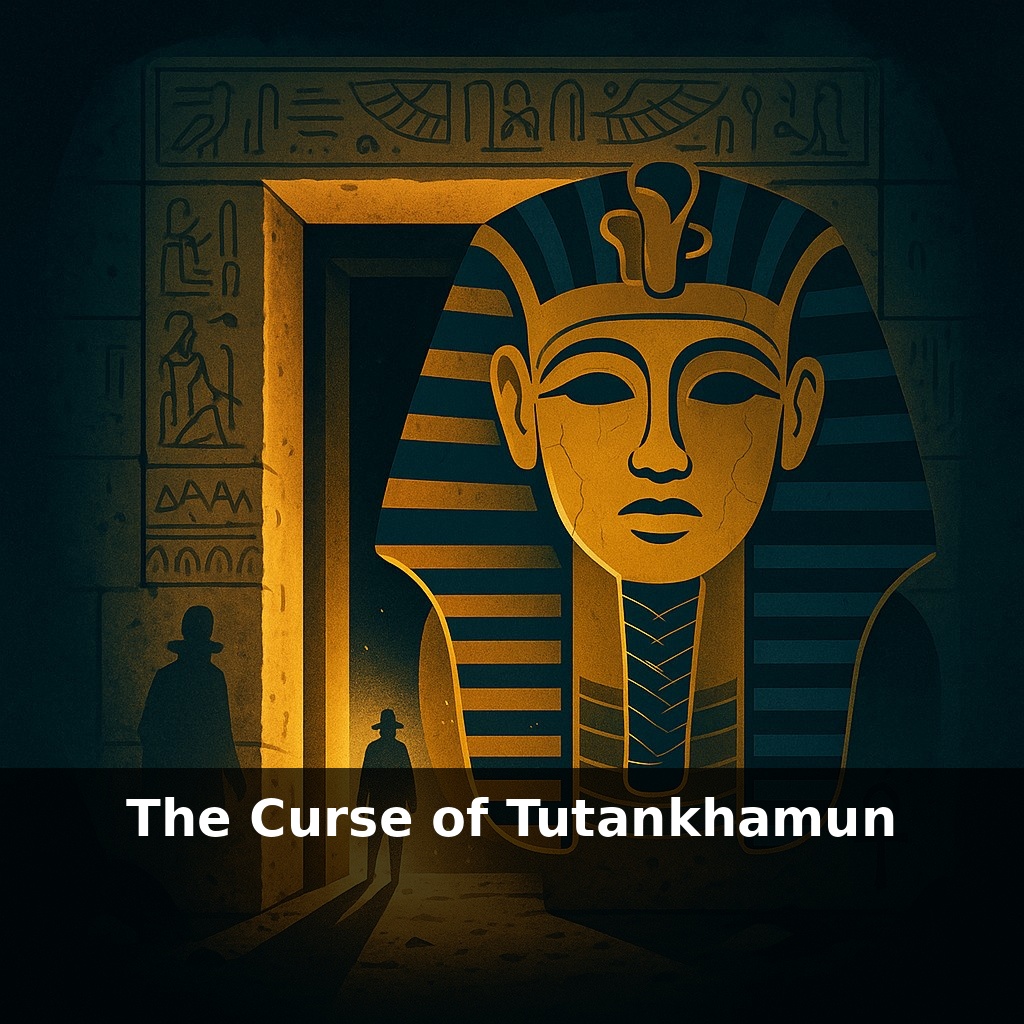
A teenage king, dead for over three thousand years, becomes the most famous corpse on Earth—yet the first thing newspapers ask is not “What did we find?” but “Who will die next?” In this episode, we walk into Tutankhamun’s tomb and straight into a manufactured curse.
Cameras flashed, headlines screamed, and suddenly a careful archaeological dig was being narrated like a horror serial. Reporters tallied every mishap—an infection here, a heart attack there—the way sports fans track goals, each one chalked up to a lurking malediction. The story was too good to check: eccentric aristocrats, ancient gold, unexplained deaths. But behind the melodrama, doctors, statisticians, and Egyptologists were quietly doing something far less theatrical and far more revealing: counting, comparing, and scrutinizing the health records of those involved. Instead of asking, “Who’s next?” they asked, “Is this pattern unusual at all?” Their results pulled the rug out from under the legend, forcing a harder question: why did an ordinary run of human misfortune get upgraded into a cosmic death sentence in the first place?
To untangle that upgrade, we have to leave the desert for a moment and step into the world that received the news in 1922. Spiritualism was fashionable in drawing rooms; séances, tarot readings, and ghost photographs shared column space with reports from the Middle East. Fresh memories of World War I and the flu pandemic had primed people to see death as sudden and uncanny. At the same time, newspapers were locked in a race for attention, rewarding the most lurid angle. When a few early deaths occurred, editors stitched them into a narrative as quickly as a headline writer stitches a scandal into a front page.
Step back to the Valley of the Kings on that November day in 1922. The air is hot, dusty, and—crucially—stale. KV62 had been sealed for centuries. When Carter’s team broke through, they weren’t just unveiling gold and statues; they were disturbing an enclosed micro‑environment that had quietly stabilized over millennia. Inside, organic materials—oils, resins, linens, food offerings—had long since dried, decayed, and, in some places, become a paradise for hardy microbes and fungi that thrive in dark, low‑airflow spaces.
Modern conservators approach such spaces like a controlled laboratory experiment. Masks, airflow management, gradual exposure to outside humidity: all of these are standard today, but they weren’t in the early 1920s. Members of the team went in and out repeatedly, sometimes for hours, breathing in dust and spores. For healthy adults, that likely meant little more than irritation. For anyone with compromised lungs or immunity, it could tip an already‑loaded scale. Some physicians have suggested allergic bronchopulmonary reactions or opportunistic infections as plausible culprits behind a few of the illnesses that were later folded into the curse narrative.
To test whether something truly lethal was at work, researchers did something decidedly un‑mystical: they listed everyone substantially involved, noted how long they lived, and compared that to life expectancies of similar Europeans of the time. One careful analysis, published decades later, showed no statistically meaningful spike in early deaths among those present. A few died young, most did not. Carter himself worked with the material for years and died in his sixties.
The “curse,” in other words, behaves less like a targeted supernatural punishment and more like a press release that got wildly out of hand. Once the pattern was announced—“those who enter will die”—confirmation bias did the rest. Any misfortune touching anyone remotely linked to the excavation, no matter how ordinary, was retrofitted to the script, while hundreds of uneventful, healthy lives simply vanished from public memory.
Your challenge this week: when you encounter a dramatic claim about hidden forces—be they mystical, conspiratorial, or “too perfect” to be random—pause and list the boring, physical explanations first. Microbes, money, miscommunication: walk through them carefully. Then ask yourself which story feels more satisfying, and which is better supported. That tension between emotional appeal and evidence is exactly the gap where curses like Tutankhamun’s are born and kept alive.
Think of the “curse” story as an early version of a viral post: one striking incident, endlessly shared, framed to trigger a specific emotion. A few deaths near in time to the excavation supplied the click‑worthy hook; editors then curated only the details that fit. It’s the same logic that makes people fear flying after a single plane crash while cheerfully driving every day. One vivid example eclipses a thousand quiet counterexamples.
Historians tracing the legend’s growth have found that names were added over time, sometimes with only the thinnest link to the original event—a relative, a distant visitor, someone who merely handled an artifact years later. It resembles a speculative bubble in finance: once a compelling narrative (“this stock only goes up,” “this tomb strikes down intruders”) takes hold, every new data point is interpreted as confirmation. Skeptical voices, whether actuaries or epidemiologists, struggle to compete not because they lack evidence, but because their story lacks drama.
If we treat the “curse” like a stress‑test for our reasoning, it exposes where we overvalue drama and undervalue data. That has stakes far beyond one pharaoh. The same instincts that once blamed desert gods can now amplify viral rumors, health panics, or conspiracy threads. Your challenge this week: whenever a story feels “too spooky to be chance,” jot down three plain‑world levers—biology, incentives, error—that could drive it. Then watch how the narrative shifts once you factor those in.
In the end, Tutankhamun’s “curse” is less a hex and more a mirror, reflecting what we’re ready to believe when coincidence wears a dramatic costume. Superstition slips in like background app processes, quietly draining our mental battery. The real magic trick is learning to spot the narrative sleight of hand—and deciding which stories we’ll let run our lives.
Start with this tiny habit: When you hear or see the name “Tutankhamun” (in the episode, online, or anywhere), pause for 10 seconds and picture one specific object from his tomb, like the golden death mask or the nested coffins. As you do, quietly ask yourself, “Whose story about this am I believing—archaeologists, journalists, or the ‘curse’ legend?” Then, if you have your phone nearby, quickly search just one detail from the story (like Howard Carter’s canary or Lord Carnarvon’s death) and check whether it’s actually supported by evidence.