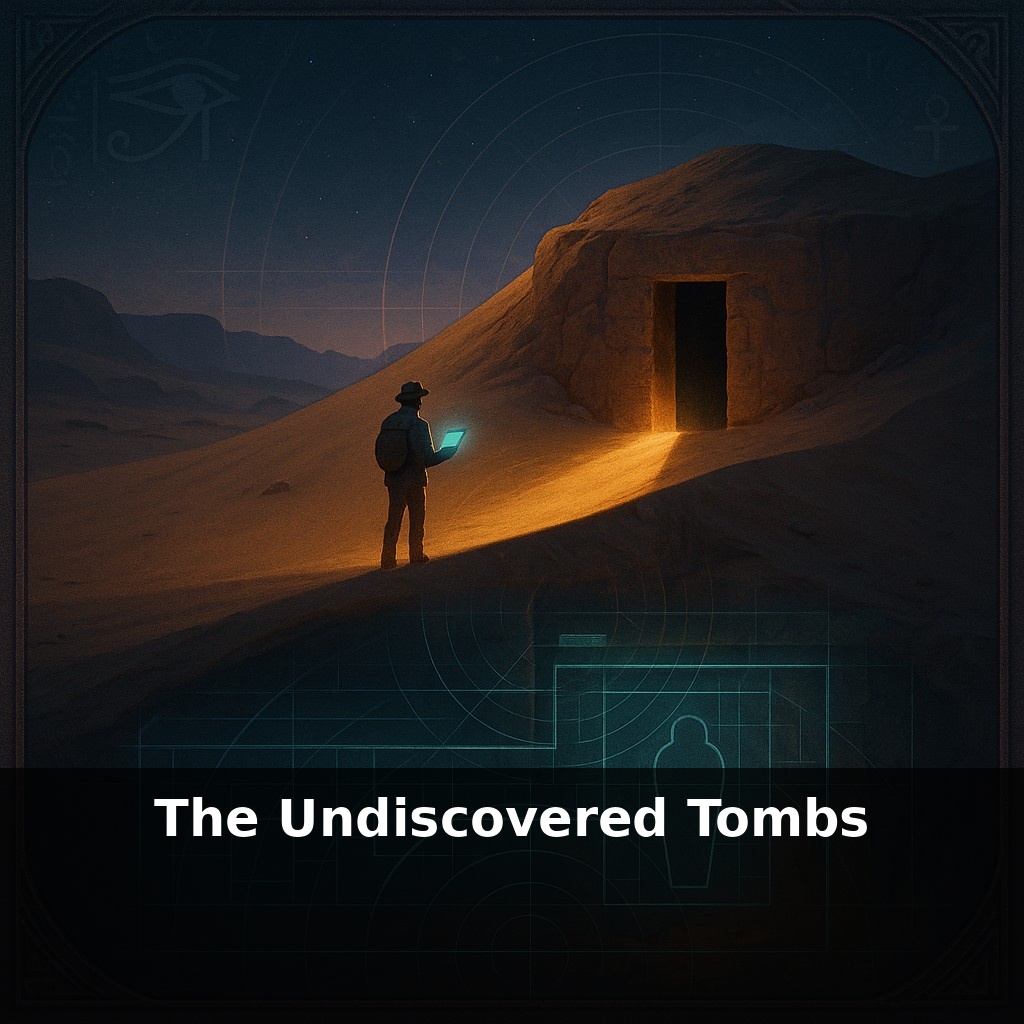
Somewhere under Egypt’s sand, more royal tombs lie hidden than have ever been opened. In one valley, archaeologists stand above the rock, staring at radar scans that hint at empty chambers just a wall away—rooms that could rewrite what we know about power, faith, and betrayal.
Beneath those promising scans lies a quieter revolution: archaeologists are learning to “read” the desert without breaking its surface. Infrared images from orbit can pick up the ghostly outlines of buried walls, roads, even gardens—slight changes in temperature that betray what lies below. On the ground, teams walk precise grids, feeding subtle shifts in density and magnetism into software that turns dunes and cliffs into 3D puzzles. At places like Saqqara, this means entire lost districts of the dead may be mapped before a single spade touches sand. And in the cliffs near Luxor, ultra-sensitive muon detectors sit patiently in chambers, counting subatomic particles from space to reveal voids in the rock. This new toolkit doesn’t just find tombs more safely; it raises an unsettling possibility: our picture of ancient Egypt may be based on only the easiest tombs to stumble upon.
On officials’ maps, much of this landscape is still just blank beige, yet archaeologists now treat those “empty” zones as suspect. They layer old survey notebooks, colonial-era sketches, and recent drone flights, then cross-check them with the new scans to spot gaps where activity should exist but doesn’t—missing tombs, missing temples, missing streets of priests’ houses. At Saqqara, shafts clustered along one ridge hint at a whole administrative quarter for the dead. In the Valley of the Kings, patterns of untouched cliff hint that burial plans were more standardized—and more crowded—than we thought.
When those “blank” zones on the maps finally yield a target, the work changes tempo. The teams move from broad survey to something closer to surgery: drilling pencil-thin test cores, sliding cameras into hairline cracks, sampling dust from natural fissures to see whether it carries traces of paint, resin, or human bone. They might spend a season just proving that one anomaly is artificial, another natural, a third a collapsed shaft from some long-forgotten robbery.
The stakes are high because the next tomb is unlikely to be a neatly sealed time capsule. Many royal and elite burials were reopened in antiquity—sometimes to steal, sometimes to rescue. Priests of the 21st Dynasty systematically gathered scattered royal mummies, rewrapping and hiding them in communal caches like the famous DB320 near Deir el-Bahri. An “undiscovered tomb” today might be a stripped chamber whose walls still whisper political decisions: whose name was chiseled out, whose added later, which gods were emphasized or ignored.
The Valley of the Kings illustrates this ambiguity. Those radar anomalies near Tutankhamun may, if they exist at all, belong not to Nefertiti but to a later reuse of a convenient corridor system. Burial real estate was precious; workmen extended, diverted, and repurposed passageways over generations. What looks like one coherent monument on the tourist path can conceal a patchwork of shifting plans, cancelled projects, and emergency burials squeezed into leftover corners.
Saqqara adds another layer of complexity. Here, deep shafts plunge through older levels, slicing past Old Kingdom tombs to reach New Kingdom and Late Period chambers far below. When archaeologists winch themselves down, they often find stacks of histories: a reused sarcophagus here, intrusive animal burials there, a scribbled ostracon casually recording bread deliveries to funerary priests. A single shaft can compress centuries of changing beliefs about how to care for the dead—and who deserved that care.
Modern teams know that even the debris is data. Broken ushabti figurines, discarded mummy wrappings, and misfired amulets are sifted like forensic evidence, logged with GPS accuracy, and compared across sites. Patterns in cheap, everyday objects can reveal as much about ancient budgets, trade routes, and workshop organization as a golden mask. It is entirely possible that the find which most reshapes our view of Egyptian history will not be a spectacular royal burial at all, but a modest, overlooked tomb whose occupant kept better paperwork.
On the ground, that patient, layered approach produces oddly humble breakthrough moments. A team at Saqqara might spot a slight kink in a line of known shafts—just enough to justify walking a tighter grid, then a focused subsurface survey. Instead of chasing a pharaoh, they follow the “off” geometry and uncover a cluster of mid-level officials whose titles fill gaps in bureaucratic history. In the Valley, a feature first logged as a natural crack can, after re-examination, turn out to be the mouth of a plastered-over stairway. Gains like these rarely make headlines, but they stitch together missing years in king lists, or reveal that a supposedly minor queen controlled estates stretching hundreds of kilometers. In practice, orchestrating these searches is less about heroic discovery than careful resource management: deciding which anomaly earns a season’s budget, which must wait, which gets quietly dropped. The desert is effectively a vast portfolio of leads, and each trench is a calculated investment in one story over another.
New tools won’t just find tombs; they’ll reorder who counts in history. Algorithms might flag a cluster of “minor” burials whose inked tax records rewrite what we know about labor, land, or debt. VR reconstructions could let local schoolchildren walk through a governor’s tomb before foreign tourists arrive, shifting who claims these stories. Your challenge this week: pick a famous artifact, then ask, “Whose quieter evidence around it have we never been shown—and why?”
The next “big discovery” may not be a golden mask but a scribble: a docket of grain, a half-finished tally of workers, a note about a delayed delivery. Like overlooked footnotes in a dense book, such scraps can flip the meaning of whole chapters. As silent zones on the map shrink, the risk isn’t finding too little—but realizing how partial our story still is.
Start with this tiny habit: When you see or touch your house keys, pause for 10 seconds and picture one “undiscovered tomb” in your own life—a drawer, box, or folder where you’ve stashed old photos, letters, or mementos you never look at. Then simply open that one drawer or box and gently pull out just a single item, like an old ticket stub or postcard. Spend 30 seconds looking at it and silently ask yourself, “What forgotten story is buried in this?” That’s it—no organizing, no journaling, just a quick daily excavation of one tiny artifact.