The most important date in ancient Egypt wasn’t a royal birthday or a battle—but the day the Nile began to rise. Farmers rushed to the riverbank, priests watched the water like astronomers tracking stars, and the entire kingdom held its breath for a flood they worshipped as a god.
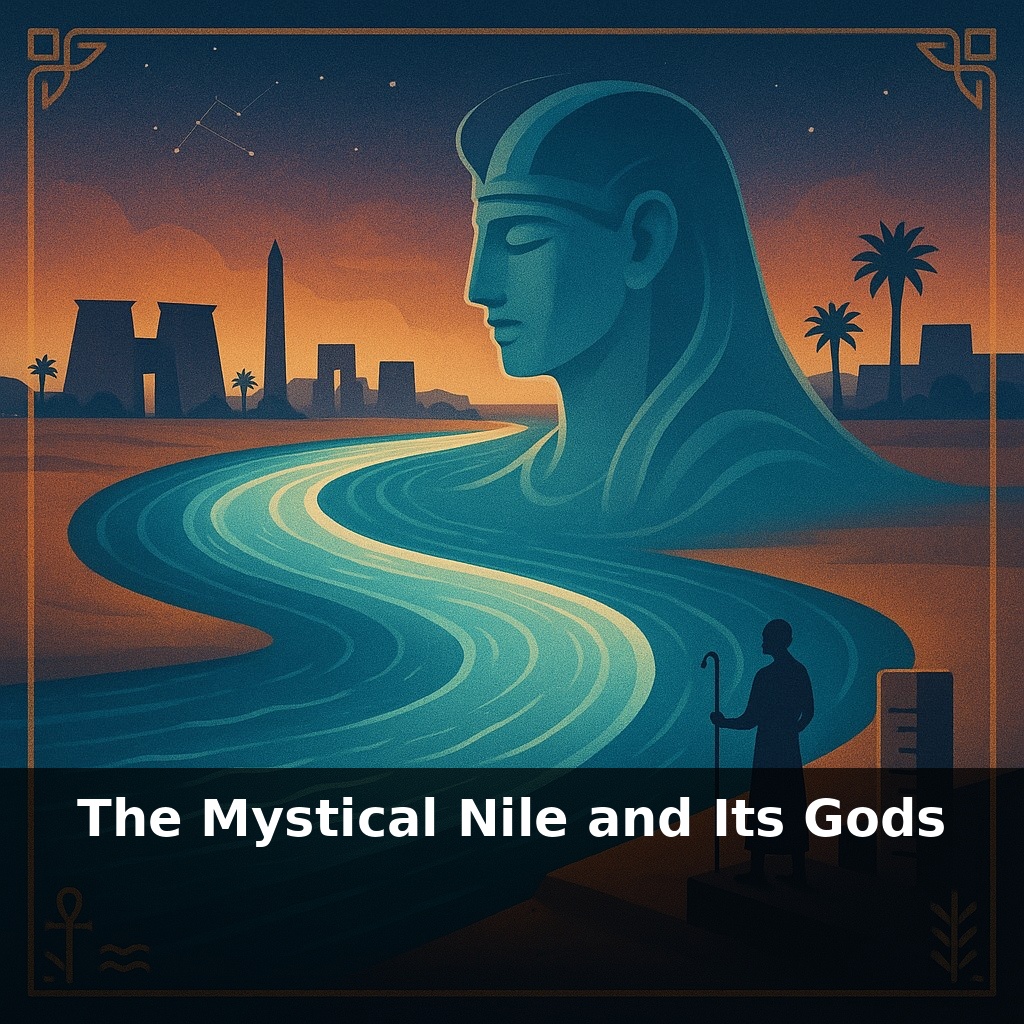
To the Egyptians, water wasn’t just “wet”—it had personality, mood, and even a legal status in the cosmic order. They mapped these qualities onto a small pantheon of river-gods, each handling a different “department” of the Nile’s behavior. Hapy presided over the life-giving rise of the waters, but he didn’t act alone. At the mysterious southern sources, Khnum shaped destinies from Nile clay, while in the lush fields Osiris absorbed the river’s gift into reborn grain. In the darker channels and reed-choked backwaters, Sobek’s crocodile gaze signaled risk, fear, and royal ferocity. These weren’t abstract symbols; they were how Egyptians negotiated uncertainty. Just as a modern engineer might model a complex system with several interacting modules, priests and farmers “modeled” their river as a network of cooperating—and sometimes competing—divine specialists.
Priests didn’t just pray; they measured. At temples from Elephantine to Memphis, officials tracked flood levels with stone nilometers—carved stairways where each step was a data point. Taxes, grain rations, even festival dates could hinge on those readings. A few cubits too low: warnings, processions, pleas to restore balance. Too high: extra offerings to avert destruction. Over centuries, patterns in these records quietly shaped myth and ritual. When a “normal” year was later praised as a gift from the gods, it rested on generations of careful observation, like a scribe’s ledger swollen with annual experiments.
At Karnak and Philae, inscriptions speak almost like policy documents: Egypt “lives on water and writing.” The water was obvious; the writing was how they turned erratic nature into something negotiable. Temple archives linked specific water levels to precise ritual responses. If a certain mark was reached, a particular hymn to Hapy was chanted at dawn, another to Khnum at dusk, and storage granaries were sealed under the authority of Osiris. Theology, logistics, and crisis management were variations of the same script.
This is where the gods stop being distant artwork and become tools for decision-making. Instead of saying, “rainfall upstream was low,” priests announced, “Hapy is weak this year; Khnum must be petitioned.” The language shifted responsibility from chaotic climate to a relationship with knowable personalities. You don’t bargain with random weather; you can bargain with a god—through offerings, promises, and reforms proclaimed as acts of piety rather than politics.
Royal power plugged straight into this system. Pharaohs styled themselves as those who “control the flood,” not because they actually adjusted river height, but because they mediated between these divine specialists. In reliefs, the king pours water before Amun while tiny Nile-figures carry heaps of grain at his feet. The image says: cosmic order flows through the palace before it reaches the fields. When inundations failed, texts rarely criticized the river; they questioned whether rulers still upheld maʿat, the fragile equilibrium that made reliable seasons possible.
Local communities customized this divine network. In Fayum, Sobek’s cult blended menace with abundance; crocodile hatcheries stood beside fertile orchards. Farther south, island temples emphasized Khnum’s role in “opening the year,” aligning southern ceremonies with the first visible changes in current and clarity. A fisherman on one bend of the river might feel watched by Sobek, while a potter upstream thanked Khnum with the same clay he used for everyday jars.
Over time, this patchwork produced a subtle but powerful idea: you can’t control the Nile, but you can learn its habits and respond in the right language—mythic, ritual, and administrative at once.
In one village archive from the Late Period, scribes jotted tiny notes beside annual water readings: “fields north of the dike sown late,” “granary three sealed early,” “procession delayed by one day.” It reads less like pious poetry and more like a series of lab notes—small tweaks, watching for outcomes. Some plots were intentionally planted at different times, then linked in the margins to particular hymns or extra offerings made that season. Over decades, a quiet feedback loop emerged: which combinations of timing, ritual, and storage left the fewest complaints on tax records or petitions from hungry farmers?
One way to picture this is like a careful programmer iterating on a complex piece of code: adjust a single parameter, run the system for a year, then inspect every “bug report” carved in ostraca and ledgers. If a certain chant at a certain shrine “coincided” with fewer ruined fields, that practice tended to persist. Theology evolved not just in temples, but in these accumulated, practical experiments with risk, scarcity, and trust.
Drought forecasts, dam releases, satellite imagery—our tools have changed, but we still translate shifting water into stories we can act on. Governments publish “resilience plans”; activists brand rivers as legal persons; artists stage light-shows on bridges that pulse with flow data. Your challenge this week: treat one glass of water a day as if it had a name and history. Ask: who depended on it before you, and who will need it after you?
Even now, traces of those river-side prayers survive in border treaties, irrigation quotas, and apps that track rainfall like stock prices. Your challenge this week: treat every weather update as a tiny oracle, not just a forecast. Note what decisions—bike, bus, plant, postpone—silently hinge on it. You’re closer to the old Nile-priests than you think.