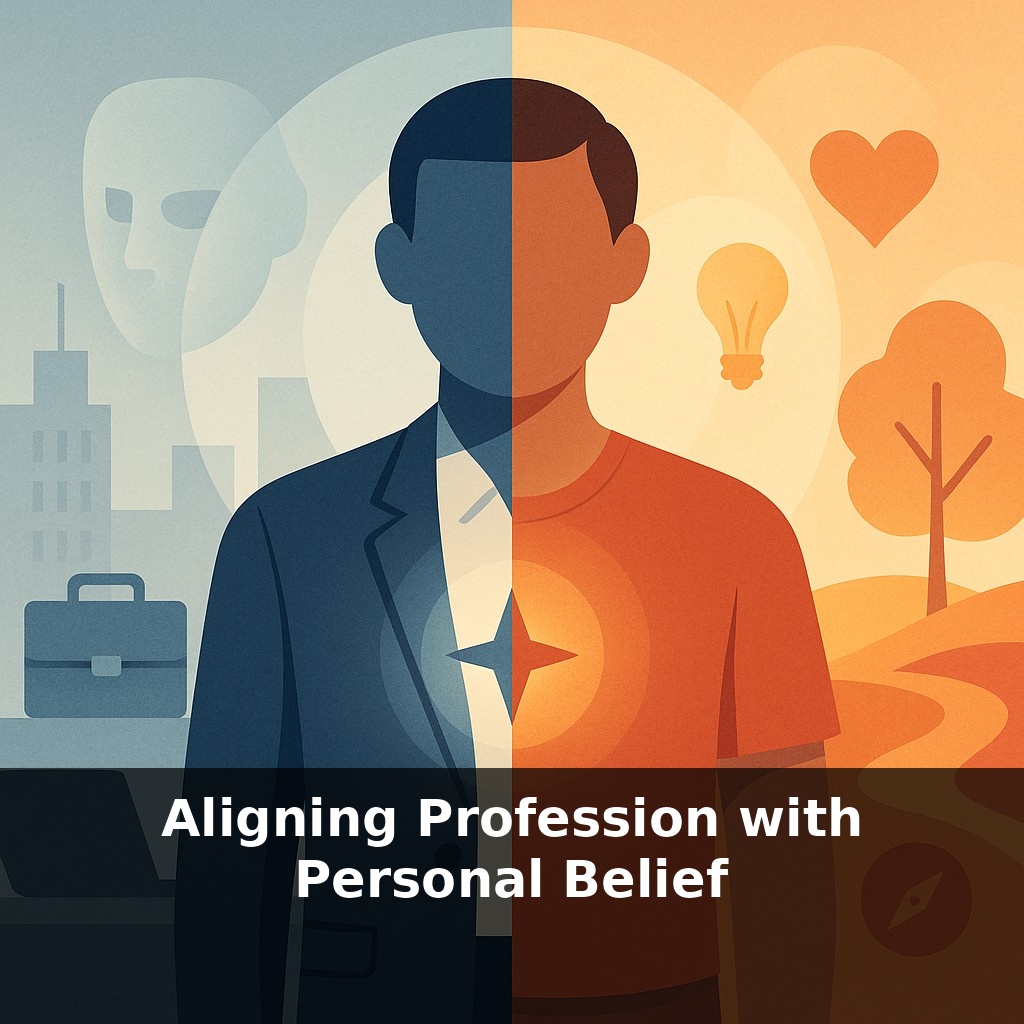
About half of workers say their job clashes with their personal values—yet many still perform well on paper. Success on the outside, quiet conflict on the inside. In today’s episode, we’ll step into that tension and ask: what happens when your paycheck disagrees with your principles?
Fewer people leave their jobs because of salary than because of something quieter: a sense that “this isn’t who I am.” Research now backs up that intuition. When your daily tasks line up with what you believe matters, your brain literally works differently—stress hormones drop, motivation systems light up, and you’re more likely to enter that absorbed, almost effortless focus state. This isn’t mystical; it’s mechanical.
Today we’ll explore how to use that to your advantage. Not by blowing up your career overnight, but by running small, low‑risk experiments inside your current reality. Think of tiny shifts—choosing which projects to volunteer for, how you approach a meeting, which skills you develop—as dials you can tune.
We’ll also look at how people in “imperfect” jobs quietly reshape them, turning role descriptions into something closer to a personal manifesto in action.
So how do you know what really needs tuning? Many people jump straight to “I need a new job” without first checking *which* part of the current setup is actually grinding against them. Is it the industry’s impact, how decisions get made, who you serve, or the way time is used? Alignment isn’t one big switch; it’s more like sound mixing. Purpose, ethics, growth, relationships, and lifestyle each have their own volume knob. In this episode, we’ll map those channels, then show how small, precise adjustments can change the whole track you’re working to.
Most people never run a clear “alignment diagnosis.” They feel a vague drag, then globalize it: “I hate my job.” That’s like tossing an entire sound system because one cable is loose. Instead, you can zoom in on *where* the friction actually lives.
Researchers often break value alignment into a few clusters: impact (what your work does in the world), ethics (how things get done), growth (who you’re becoming), relationships (who you’re with), and rhythm (how your time and energy are used). Your workday touches all five, but not equally—and misalignment in *one* channel can contaminate your experience of the rest.
Consider impact. Two software engineers write similar code. One builds tools that help clinics schedule low‑income patients; the other optimizes ad clicks for products they’d never buy. Same skills, different meaning. In studies, people in roles they see as contributing to something larger are markedly more resilient when things get hard—late nights feel like investment, not extraction.
Then there’s ethics and culture. You might love the craft of selling but feel sick when pressured into manipulative tactics. Or you enjoy finance yet flinch at aggressive tax games. Data from organizational behavior shows that when people feel pushed to cross their own lines, disengagement isn’t a mood—it’s a defense mechanism.
Growth is quieter but just as critical. A job can seem “fine” yet slowly flatten you if you’re not stretching in directions that matter to you. Are you becoming more courageous, more skilled, more able to contribute the way you want—or just more efficient at something you don’t respect?
Relationships and rhythm shape the daily texture. Even noble missions can hollow you out if every day is chaos, or if your team dynamics run counter to how you believe people should treat each other. Notice whether your environment amplifies your better instincts or constantly triggers your worst.
The goal isn’t to score each category and pronounce a verdict. It’s to see patterns: *Where* is the signal strong? *Where* is the static loudest? Once you know that, you can stop fantasizing about a magical “perfect job” and instead start designing concrete adjustments—within your role or beyond it—that move specific dials toward a truer version of you.
A practical way to spot alignment is to notice where you *instinctively over-deliver*. One consultant realized she stayed late only on projects where the client’s mission inspired her; on others, she did competent but minimal work. That contrast became data: impact and ethics were non‑negotiable dials for her.
Another example: two nurses in the same ward. One lights up during patient education, the other during emergency procedures. Neither needs a new profession; they quietly trade shifts and responsibilities so each spends more time in situations that match their instincts. Same job title, very different internal experience.
You can also watch for where you feel oddly energized after hard days. A product manager might leave drained from roadmap battles but buzzing after mentoring junior colleagues—that’s a clue that growth and relationships deserve more space.
Like refactoring old code without rewriting the whole system, you’re looking for parts of your current work that can be reorganized so your best motivations run through the core functions, not just the side projects.
Alignment doesn’t freeze you in one “perfect” role; it’s more like version updates to your operating system. As your beliefs evolve, your work can, too—through shifting projects, industries, or even how you show up in the same job. Watch for moments when small, values-based tweaks produce outsize relief; those are prototypes for your future. Over time, your résumé starts to read less like random apps and more like a coherent product roadmap for who you’re becoming.
Alignment isn’t a finish line; it’s a series of course corrections, like nudging a GPS as traffic shifts. Some seasons call for patience, others for bold turns. Over time, even small, steady adjustments can move you from “I can tolerate this” toward “this fits me.” In the next episode, we’ll explore how money and meaning can coexist without one quietly erasing the other.
Try this experiment: Tomorrow, for one full workday, keep a running “belief alignment log” by tagging each task you do with one of three labels right after you finish it: “Aligned with my values,” “Neutral,” or “Contradicts my values,” and add a 1–10 energy score for how you feel immediately afterward. At the end of the day, total how much time you spent in each category and notice where your energy was highest and lowest. Then, choose one “Contradicts my values” task and, for the next week, either (a) delegate it, (b) change how you do it so it better reflects your beliefs, or (c) have one honest conversation with your manager or client about reshaping it—and see what actually happens.