You make tens of thousands of choices every day, but here’s the twist: most of them never move you one step closer to what matters most. In this episode, we’ll zoom in on a single ordinary day and quietly rebuild it into a life you’d actually be proud to be living.
Most people treat “today” like a disposable draft—something to survive, not something that quietly shapes the next decade. But research says otherwise: your sense of purpose *today* predicts not just mood, but health markers and even long‑term mortality. A clear daily purpose doesn’t have to mean quitting your job or discovering a grand mission; it can start with how you structure the next 24 hours.
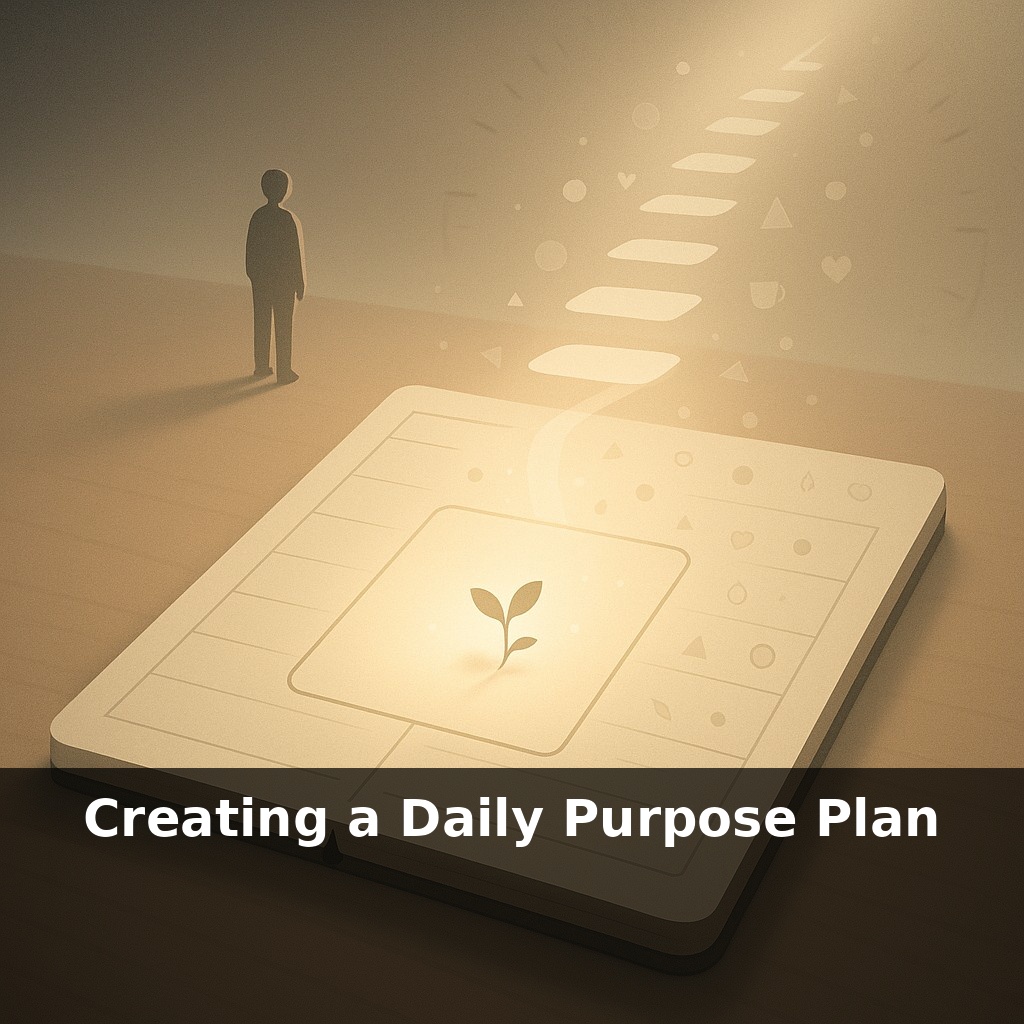
In this episode, we’ll turn purpose from a vague feeling into a practical, testable plan: a Daily Purpose Plan. Think of it less like a strict schedule and more like arranging furniture in a small apartment—same space, completely different experience of being in it. We’ll connect your long‑range “why” to tiny decisions about when you check your phone, how you start your mornings, and what you do in the quiet five minutes before bed. Step by step, we’ll design a day that quietly pulls you toward who you want to become.
Most people wait for motivation to strike, then try to organize their day around it. But motivation is unreliable; structure isn’t. Neuroscience shows that when your brain sees a clear, doable next step tied to something that matters, it quietly releases more energy to tackle it. That means the way you sequence your day—what comes first, what’s protected, what’s optional—can either amplify your deeper values or slowly mute them. In this episode, we’ll treat your next 24 hours like a prototype: a low‑risk experiment where you can adjust timing, environment, and tiny rituals to see what actually helps your purpose show up.
Here’s the quiet power move most people miss: your day doesn’t begin when your alarm goes off; it begins when *you decide what today is for*. Not in a grand, poetic way— in three or four specific directions that are allowed to matter more than everything else.
To build that, we’ll zoom your 24 hours into three layers:
1. **Anchor moments** These are 3–5 fixed points that happen almost every day no matter what: waking up, starting work, eating, commuting, winding down. Instead of adding new tasks, you “piggyback” purpose onto what already happens. At wake‑up, you might ask: “What kind of person am I practicing being today?” Before opening your laptop: “What’s the one result that would make today feel well‑used?” Before bed: “Where did I act in line with my values?” Tiny prompts, same anchors, different day.
2. **Purpose blocks** Next, you claim 1–3 blocks of protected time where you do work that clearly serves something bigger than short‑term comfort. These don’t have to be long; 25–50 minutes is enough. The key is labeling each block with a *purpose tag*, not just an activity: - “Learn: becoming a more trusted expert” (reading or practice) - “Create: making something that might help someone” - “Connect: strengthening a relationship that matters”
Notice we’re naming *why* the block exists, not just *what* fills it. That’s what your brain locks onto.
3. **Micro-adjustments** Now you make your day slightly more “purpose‑friendly” without blowing it up. You keep your job, responsibilities, and constraints—but tilt them. Examples: - If “growth” is part of your Ikigai, you might turn one routine task into a learning rep: document what you’d improve next time. - If “care” is core, you might add a 60‑second check‑in message to one person you value during an existing break. - If “craft” matters, you might choose one task to do with 10% more attention to quality than usual.
Think of it like updating the operating system on your phone: the hardware of your life looks the same, but everything runs with a different set of priorities in the background.
The research you heard about purpose and health doesn’t require a dramatic life overhaul; it leans on repeated, modest alignments. That’s why a Daily Purpose Plan works best as a *prototype mindset* rather than a strict template. You’re not judging yourself for “failing the plan”; you’re running small experiments in meaning: “When I shift this 15‑minute window, do I feel more on track or less?” Over days, those data points become your personal blueprint for a day that quietly feels like it belongs to you.
A useful way to explore this is to treat today like a low‑stakes lab test. Instead of asking “Is my whole life aligned?” you ask, “What happens if I tilt just one ordinary moment?” For example, say your long‑term aim is to be a kinder, calmer parent. Your morning anchor might simply become: “No phone until I’ve made eye contact with my kids and said one specific, genuine compliment.” Same commute, same breakfast chaos, but you’ve quietly rewritten the script.
Or imagine your purpose includes craftsmanship. You still send the same report at work—but you choose one paragraph to polish as if your name will be studied on it later. That tiny upgrade is your “craft rep” for the day. Over time, you can even assign “themes” to days—Monday as “learning,” Wednesday as “relationships”—so when interruptions hit, you’ve got a bias for which kind of action wins. None of this requires more hours, just different defaults when you hit those repeatable moments.
A quiet shift is coming: as calendars, wearables, and AI tools merge, your day may start to “negotiate” with you. A planner could notice you slept badly, then nudge you to shrink one ambition block and deepen a reflection block instead—like a coach adjusting training loads after a tough game. Cities and companies might follow, designing schedules with protected “meaning windows,” the way buildings now include fire exits—small structural guarantees that some part of your day stays non‑negotiably yours.
Let today be a small rehearsal, not a final performance. You don’t need to fix your whole future; you only need to aim the next 24 hours a few degrees truer. Over weeks, those tiny course shifts add up like compound interest. Your challenge this week: each night, adjust *one* moment for tomorrow—like tuning a single instrument—and see how the whole song of your day changes.