A global survey found that people with a strong sense of purpose are about three times more engaged at work—yet most of us still feel strangely “off” about our day-to-day lives. You’re rushing to meetings, answering messages, hitting goals… and quietly asking, “Is this it?”
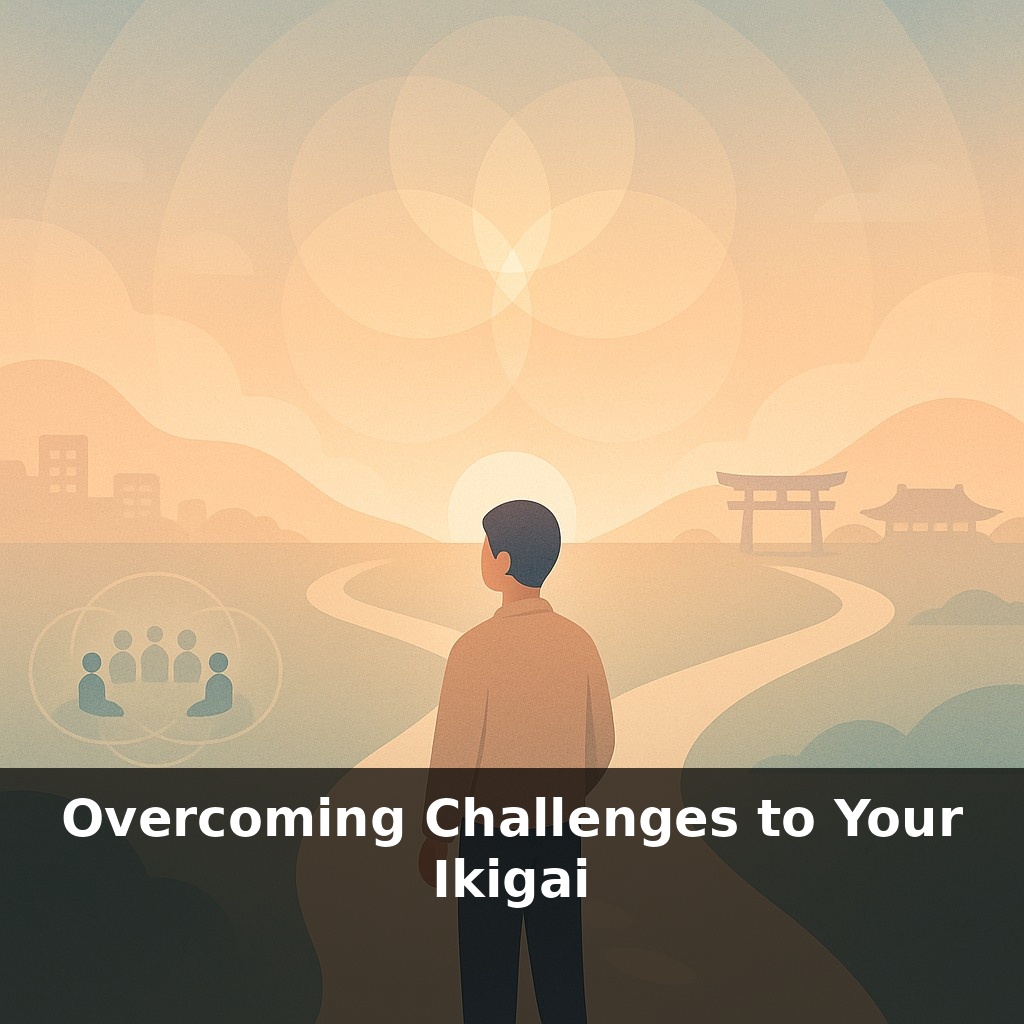
“Moai”—the lifelong social circles of Okinawa’s elders—aren’t just for sharing tea; they’re quiet protection against giving up on what matters. Even with a clear Ikigai, most people hit the same walls: inner doubt, outer pressure, and the slow fade of initial motivation. It’s not that your Ikigai disappears; it gets buried under deadlines, expectations, and your own self-criticism.
You might recognize the pattern: you start a new direction energized, then a critical comment, an unexpected bill, or sheer exhaustion nudges your plans to “later.” Weeks pass. Your Ikigai drifts to the background like a tab you keep meaning to click.
This episode is about facing those interruptions head-on. We’ll treat obstacles not as verdicts, but as data. And we’ll explore how tiny, well-designed experiments—and the people around you—can keep your Ikigai active, even on the messiest days.
You’re not “bad at consistency”; you’re running into patterns that almost everyone on this path faces. Psychology research shows that most people don’t quit because their goal is wrong—they quit because their *system* for pursuing it was never built for real life. Deadlines spike, kids get sick, your energy dips, and the first thing sacrificed is whatever doesn’t scream for attention. In this episode, we’ll zoom in on three predictable friction points and treat them like debug logs in your week. Instead of asking, “What’s wrong with me?” we’ll ask, “What broke in the system, and how do I redesign it?”
Gallup’s latest data shows that people with a strong purpose are *far* less likely to burn out—yet purpose-seeking itself often feels exhausting. That’s the paradox: the thing that should give you energy can start to drain you if you bump into the same walls without knowing how to move through them.
Let’s zoom in on those walls.
**1. Internal barriers: the “voice in your head” layer**
Psychologists talk about *cognitive distortions*—mental shortcuts that quietly sabotage you. On an Ikigai path, they sound like:
- “If I can’t do this perfectly, it’s not worth doing.” - “If this really mattered, it wouldn’t feel this hard.” - “Other people are already ahead, so why bother?”
Instead of arguing with that voice, label it. When you catch “all-or-nothing” thinking, say it out loud or jot it down. Naming the pattern creates just enough distance to choose a different move—like doing 10% of the task instead of abandoning it.
**2. External pressures: the “constraints we never chose” layer**
Family, culture, money, and time don’t disappear because you care about something. But research on *implementation intentions* shows that *how* you phrase your plans changes your follow-through.
Compare: - “I’ll work on my writing more.” - “On Tuesdays and Thursdays, I’ll draft from 7:10–7:30 a.m. at the kitchen table.”
Same desire, different architecture. You’re turning a wish into something that can survive a busy week.
You can also negotiate constraints. That might mean a micro “contract” with a partner (“I’ll cover bedtime Mondays, you take Wednesdays so I can practice”) or asking a manager for a small role shift that lets you test a strength on real work.
**3. Structural drift: the “week 5 problem”**
Neuroscience findings on motivation show that our brains respond strongly to *progress cues*, not just big outcomes. When your Ikigai work becomes invisible—no checkmarks, no feedback—your brain quietly deprioritizes it.
You can counter this by making progress *seeable*:
- Track “streaks” (days you touched your craft, even for 5 minutes). - Use tiny, binary goals: “Did I ship *something* today?” yes/no. - Build in reflection points where you quickly scan: What did I love? What did I do well? Where did someone benefit? Did any of this earn (or potentially earn) money?
Think of it like refactoring legacy code in an old system: you’re not rewriting your life overnight; you’re updating one function at a time so the whole thing runs more in line with what matters to you.
Think of a goalkeeper in football. They don’t wait for a perfect game; they train for edge cases—penalties in the rain, weird bounces, last‑minute scrambles. Treat your week the same way: design for “bad conditions” instead of hoping for ideal ones.
For internal pushback, create a pre-set “Plan B” version of your practice: the 5‑minute sketch when you’re tired, the 10‑line journal when you’re drained, the single email to a potential collaborator when you feel behind. You’re lowering the threshold, not the standard.
For outside demands, borrow from project sprints in tech. Choose one 7‑day “mini‑sprint” with a clearly defined outcome: a test lesson, a rough prototype, a trial conversation with someone in a field you’re curious about. At the end, you run a quick retro: What energized me? What dragged? What’s one constraint I can tweak, not topple?
Over time, these micro‑sprints stack like architectural layers in a building—each floor sturdy enough to hold the next experiment without collapsing your life underneath.
A decade from now, “following your Ikigai” may be less about grand career moves and more about real‑time course corrections. Mood‑aware wearables could flag when your days drift from what energizes you, like a smart thermostat nudging your home back to a set temperature. Schools and companies might treat purpose like a skill: something you iterate on through projects, reflection, and feedback, updating your “meaning profile” the way you now refine a playlist or a fitness plan.
Your Ikigai won’t arrive like a finished novel; it’ll show up more like a rough draft you keep editing. Some days you’ll cut whole chapters—jobs, projects, even identities. Other days you’ll add a single sentence: one email, one risk, one honest “no.” Progress is less a straight road and more a playlist you refine, track by track, toward what feels deeply yours.
To go deeper, here are 3 next steps:
1. Re-listen to the segment where the guest talks about “micro-ikigai moments” and then use the free Ikigai-9 questionnaire (available at ikigai.pl or by searching “Ikigai-9 scale PDF”) to quickly score where you feel most and least aligned, so you know exactly which dimension of ikigai is being blocked. 2. Grab Ken Mogi’s *The Little Book of Ikigai* or Hector Garcia & Francesc Miralles’ *Ikigai: The Japanese Secret to a Long and Happy Life* and read just one chapter that relates to what you’re struggling with most (e.g., perfectionism, burnout, or fear of change), then try one practice they suggest exactly as written for the next 24 hours. 3. Join a free online community aligned with your “reason for being” (for example, a volunteering platform like VolunteerMatch if contribution lit you up in the episode, or a Meetup group focused on your craft), and commit to attending the very next available event to put your ikigai into motion with real people, not just in your head.