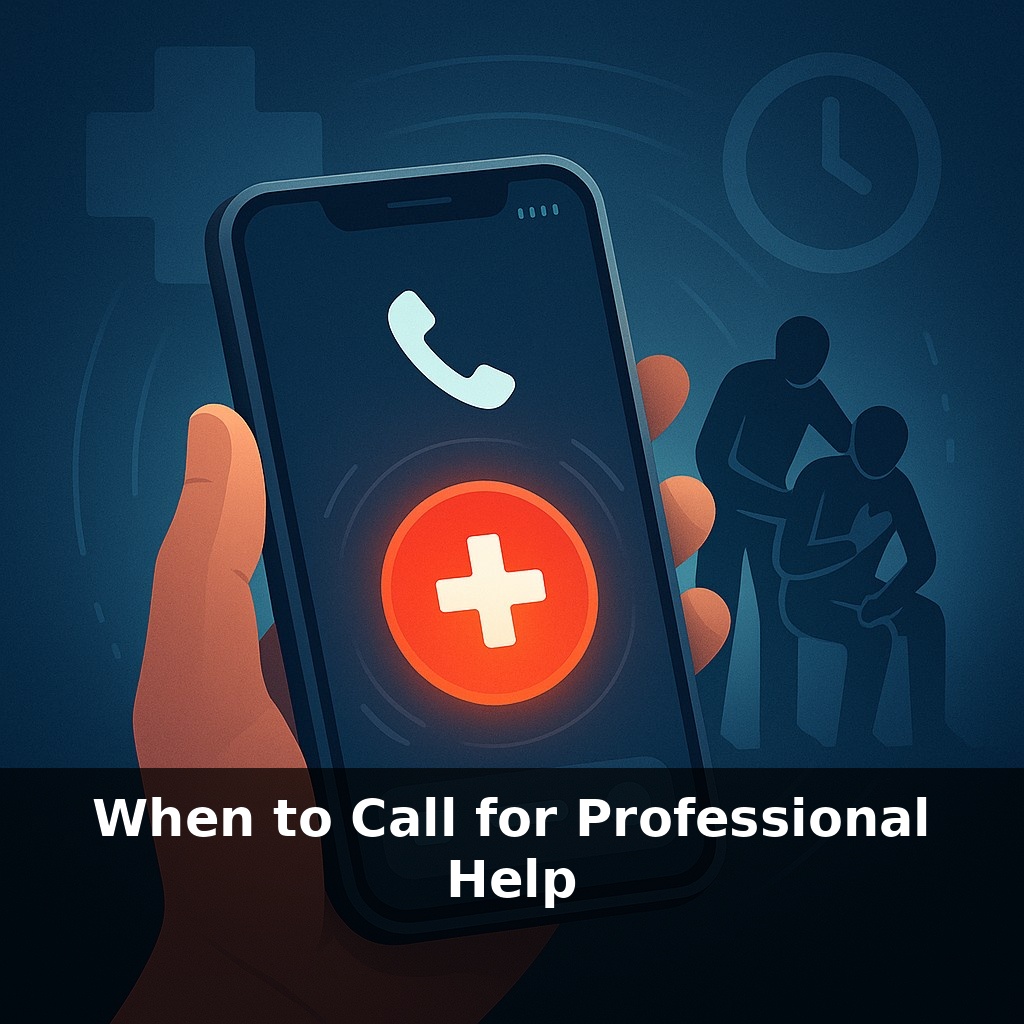
An ambulance can arrive faster than most food deliveries—yet many people hesitate before calling. In one moment, you’re arguing with a friend who “doesn’t want to bother 911,” and in the next, they’re slurring their words and gripping their chest in silence.
One of the quietest skills in first aid is knowing when to hand the problem over. In real emergencies, people don’t just freeze around bleeding or breathing—they freeze around the phone. They argue about “waiting a minute,” negotiate with the person in distress, or poll the room for opinions like it’s a group project. Meanwhile, the clock for the brain, heart, and lungs is ticking down in seconds, not feelings.
In this episode, we’ll turn that hesitation into a simple rule set you can trust under pressure. You’ll learn how to spot situations where your job is not to fix, but to *activate* help—fast. We’ll look at how technology can help you cut through doubt, how to handle pushback from the person who’s sick or injured, and what to say when you do call so the right help finds you as quickly as possible.
In this part, we’ll zoom out from individual crises and look at your *environment* as part of your first-aid toolkit. Think of it like walking onto a stage: the exits, spotlights, and backstage crew are already there—you just need to know how to use them when the script suddenly changes. We’ll map out who, besides 911, can be “cast” in your emergency plan: security staff, onsite medical teams, nearby clinics, even neighbors with key skills. We’ll also connect this to your daily routines—commutes, workouts, events—so that calling for help becomes a prepared move, not a panicked guess.
When you zoom in from “who can help” to “when do I *pull the trigger* and call,” the data draw a hard line: early calls change biology, not just logistics. Each minute shaved off before EMS engagement buys brain cells, heart muscle, and sometimes an entire lifetime of independence.
Think of three overlapping circles that tell you it’s time to escalate:
**1. Threat to vital functions (A–B–C–brain).** You’re not reassessing the whole person—just scanning for any serious hit to: - Airway: noisy, gurgling, or clearly blocked - Breathing: very fast, very slow, or obviously labored - Circulation: skin gray/blue, pulse weak or racing, heavy bleeding - Brain: suddenly “not themselves,” confused, or unresponsive
If any of these are clearly off and not resolving in seconds, that circle lights up.
**2. Sudden *change* from baseline.** A quiet, pale person might be normal; a loud, joking person who suddenly can’t finish a sentence is not. You’re looking for abrupt shifts: - Walking → can’t stand - Talking → can’t form words properly - Normal color → ghost-pale and sweaty - Mild pain → “worst of my life”
Even when vital signs look okay to you, a sharp, unexplained change is a major escalation trigger.
**3. Time-sensitive diagnoses.** Some conditions have a “treatment window” that closes fast. You’re not expected to diagnose, but you *are* expected to respect the clock. Cluster these in your head as “don’t wait and see” problems: - Stroke signs (face, arm, speech changes) - Chest pain/pressure that’s new or unusual - Major trauma, including high-speed crashes or big falls - Signs of sepsis (fever or suspected infection plus confusion, extreme shivering, or fast breathing)
If a situation lands in even **one** of these circles, calling formal help is strongly justified. If it hits **two or more**, calling is no longer a debate—it’s your primary intervention.
Technology sits on top of these circles as an amplifier, not a referee. A smartwatch alert about a wildly abnormal heart rate, a fall detection ping, or an app yelling “possible stroke” doesn’t replace your judgment; it shifts the burden of proof. Once a device throws a serious flag *and* your eyes see something off, you act and let professionals sort out over-calls from under-calls later.
Your goal isn’t to be right about *what* is happening. Your goal is to be fast about *who* needs to know.
A sprinter doesn’t wait to see if the starting gun was “really loud enough” before leaving the blocks—they train until moving on that sound is automatic. You can treat certain everyday scenes the same way. You’re at a rec-league game and a player collapses after a collision, staring but not answering; that’s your gunshot—call, then move into whatever first aid you know. Or you’re on a video call and a coworker suddenly can’t get words out clearly; you’re not there in person, but you *still* become the one who messages a nearby teammate to knock on their door and dial locally.
Think of it as building a personal “instant call” list: specific patterns where you pre-decide, *I don’t argue here, I act.* For one person, that might be any head hit followed by vomiting. For another, any pain that stops them mid-sport. Over time, this list becomes like a coach’s playbook—you flip to the right page under stress instead of inventing a strategy while the clock’s already running.
AI will soon sit in the background like a quiet second referee, flagging borderline calls you might miss: a pattern of odd symptoms in your family, a neighborhood spike in heat illness, a smartwatch trend that’s easy to ignore day to day but matters in an emergency. As these tools learn from millions of past crises, your single decision to dial for help plugs into a much larger “team,” turning one scared bystander into the first link in an increasingly intelligent chain.
Treat this as a skill you can practice, not a switch you magically flip in a crisis. Like learning a new instrument, the awkward first notes—calling, describing what you see, staying on the line—eventually become muscle memory. Your challenge this week: rehearse one “instant call” scenario in your head daily, so action feels like the default, not the exception.