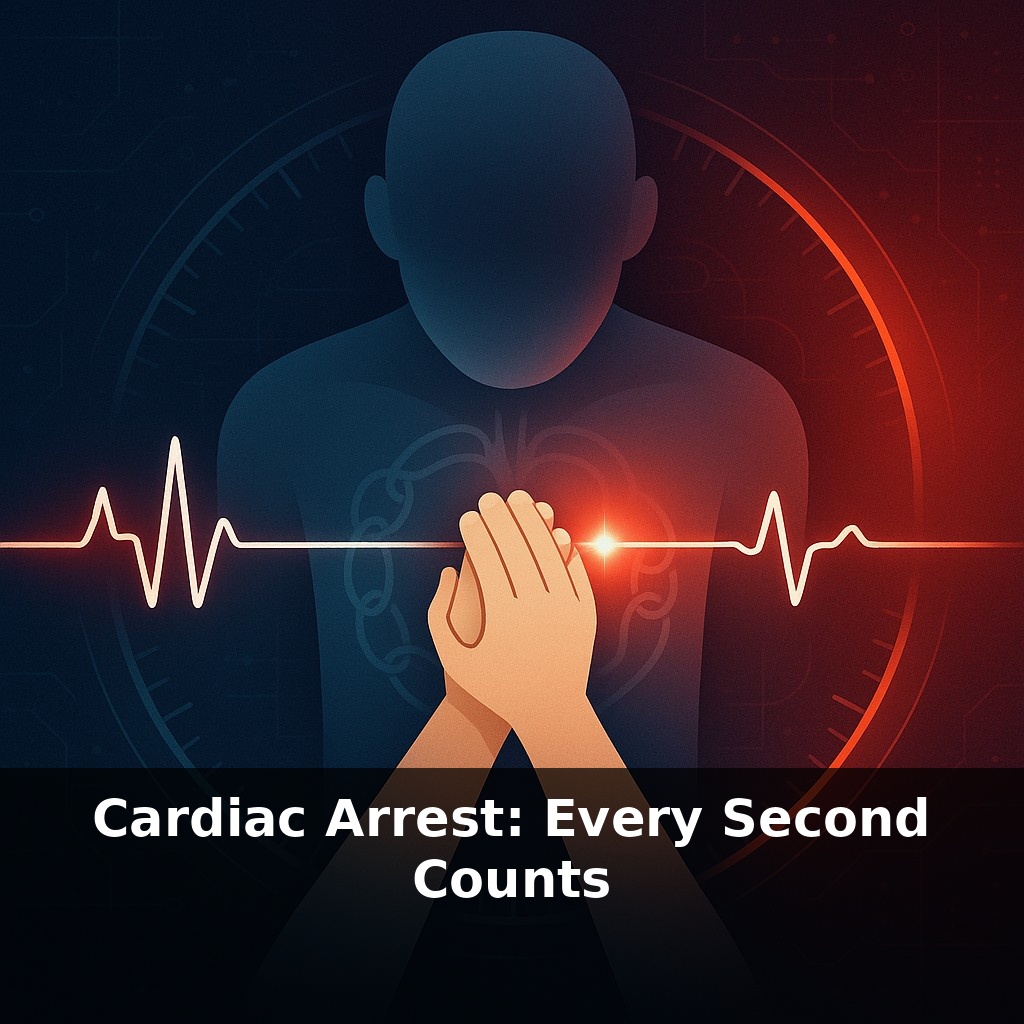
A heart can go from beating to silent between two breaths—and the person next to them often decides what happens next. A coworker at lunch, a parent at a game, a stranger in an airport: one collapses, the other has seconds to notice, act, and either freeze…or start the chain that saves a life.
Most cardiac arrests outside hospitals don’t look dramatic at first—they look confusing. Someone “slumps,” makes a strange snoring sound, or seems like they’re having a fainting spell. Those first few seconds are when most bystanders lose time simply trying to decide what they’re seeing. The hard truth: in a sudden collapse, it’s usually safer to assume “this is cardiac arrest” and be wrong, than to hesitate and be right too late. Modern CPR and AED use are designed for non‑experts; you’re not performing delicate surgery, you’re buying the brain and heart a little more time. Think of it like hitting “pause” on the damage while help races toward you. In this episode, we’ll move from theory to practice: how to recognize trouble fast, what to do in the first 60 seconds, and how to work with, not against, your own adrenaline.
In real life, those “first 60 seconds” rarely feel clean or obvious. People around you may argue it’s just a faint, insist “give them space,” or start filming. Background noise, crowded spaces, and social pressure all steal seconds you don’t realize you’re losing. This is where a simple mental script helps: a pre‑decided set of words and actions you default to when someone drops. Like a pilot’s checklist, it isn’t about saying everything perfectly; it’s about having a backbone of “do this next” when your mind wants to spin, doubt itself, or look to someone “more qualified.”
“No response. No normal breathing. I’m starting CPR.” That one sentence is a powerful start to your mental script—and it does three things at once: it forces you to decide, it tells the people around you what’s happening, and it invites help without waiting for permission.
From there, think in simple “headline” steps you can actually say out loud, in order. For example:
1. “You—call 911 and put me on speaker.” 2. “You—find an AED; check the lobby, reception, or wall cabinets.” 3. “I’m pressing hard and fast in the center of the chest.”
The exact words don’t matter; the structure does. You’re assigning jobs, not making suggestions. Most people want to help but don’t know how—giving them a clear, single task cuts through that frozen moment where everyone’s looking around.
Next, expect the noise. Someone may say, “I think he just fainted,” or “Shouldn’t we wait?” Build a stock phrase you can lean on: “They’re not waking up and not breathing normally—we treat this like arrest until medics say otherwise.” You’re not arguing; you’re anchoring the group to action.
Now layer in your own physical reality. Your arms will tire faster than you think. Plan for rotation: “We’ll switch every 2 minutes when the song ends / when I say ‘switch.’” Even if nobody is there yet, saying it prepares your mind to look for a replacement instead of silently struggling until you fail.
Consider your environment before you ever face an emergency. At work or school, quietly note: Where are exits? Where might an AED be? About how long would it take to run there and back? This isn’t paranoia; it’s like knowing where the fire extinguishers are. The first time you scan a building for an AED is not when someone is already on the ground.
When an AED appears, fold it into your script smoothly: “Open the AED and turn it on; follow its voice. I’ll keep compressions until it tells us to stop.” Clear, shared expectations prevent last‑second confusion when the device starts talking and beeping.
Finally, accept that you won’t feel calm. Your goal isn’t to be fearless; it’s to be effective while scared. A short, practiced script turns that fear into motion—step by step, voice by voice, second by second.
A professional rescuer once described their approach as “running a tiny team on a chaotic stage.” That’s close to what you’re doing as a bystander: not becoming the hero, but becoming the director. One useful mental experiment: replay places you visit often and cast people around you into roles. In your gym, who’s likely to be fastest to the front desk? In your office, who usually takes charge under pressure? On a plane, who’s already standing in the aisle and can run for help? You’re not judging; you’re pre‑assigning “future teammates.”
You can also rehearse tiny “scene changes.” In a crowded restaurant, how would you clear enough floor space without shouting “Move!” at everyone? Try: “We need room here—please take two big steps back.” In a noisy stadium, what hand signals would you use if your voice disappears? Point firmly, beckon, pat the ground where you need space. The more specific your imagined moves, the less alien they will feel when reality suddenly hands you the script.
Every minute that passes without effective help means 7–10% less chance of survival—so the future is all about shrinking those minutes. Think of the scene widening from just you and a collapsed person to an invisible “support net” flicking on around you. Buildings may quietly ping nearby responders when 911 is dialed. Phones could auto‑flag likely arrest, guiding compressions with haptics while drones race over with gear. Your role doesn’t vanish; it upgrades—from lone rescuer to the on‑scene lead for a growing digital team.
Your challenge this week: treat “readiness” like a muscle. Once a day, in whatever space you’re in, quietly spot at least one tool or person that could help in a collapse—a security guard, a phone, a posted map, an emergency button. Over time, that habit turns chaos into a layout you already know, like a familiar room you can navigate even in the dark.