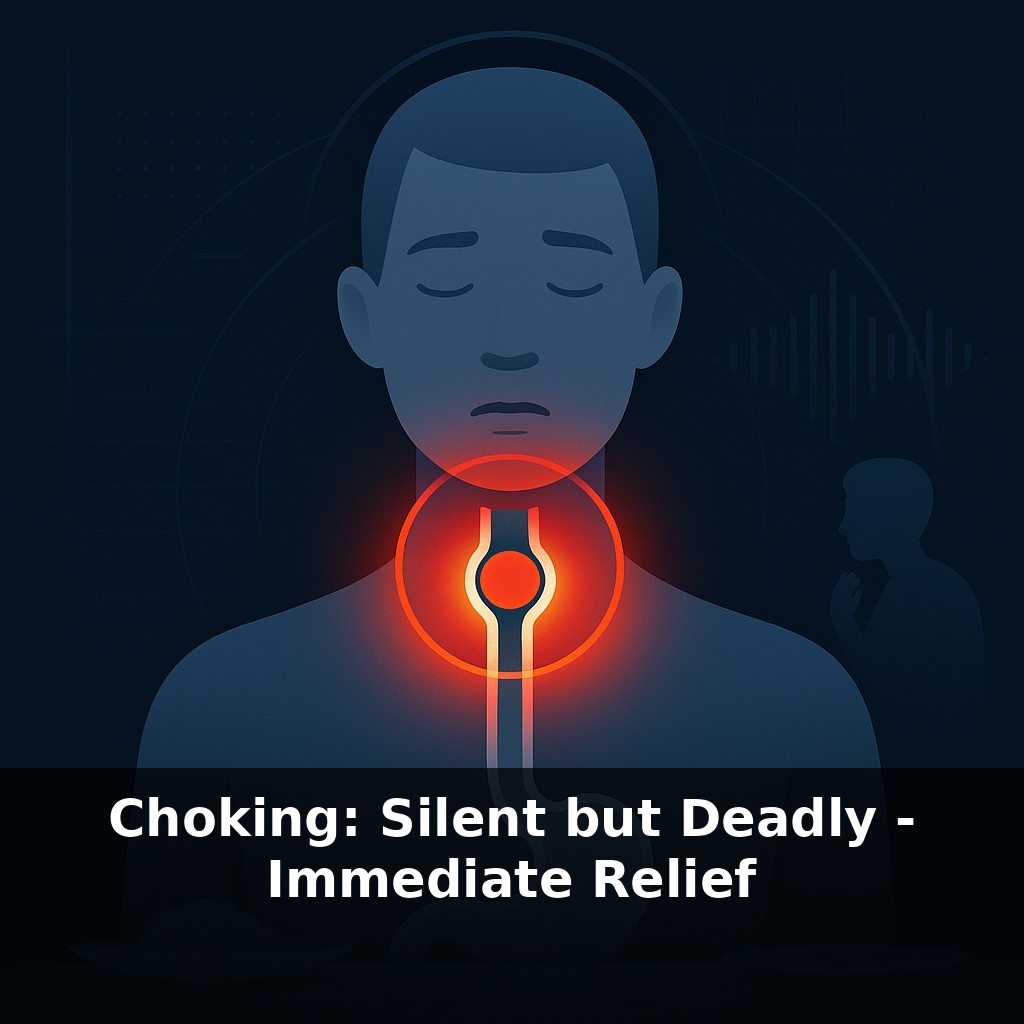
A blocked airway can knock someone unconscious in under two minutes—far faster than most people realize. At a family dinner, a guest suddenly goes silent, clutching their throat. No coughing, no sound, just wide eyes. In that frozen moment, who actually knows what to do?
Most people think of choking as a loud, dramatic event—gasping, coughing, panicked shouting for help. In reality, the most dangerous episodes are often quiet. The person may stand up from the table, push their chair back a little too hard, grasp at their neck, and make no sound at all. Others might hesitate, assuming it’s a joke or a mild “went down the wrong pipe” moment. Those lost seconds are exactly where outcomes are decided. Modern first-aid guidelines don’t just say “do the Heimlich”; they ask you to quickly sort the situation: toddler or adult, frail grandparent or athletic teen, pregnant belly or flat abdomen, wheelchair user or standing coworker. Each detail slightly shifts what your hands should do, and where. Knowing that decision tree ahead of time is what turns fear into action.
You don’t need a medical degree to act; you need a mental script you can run under pressure. Start by widening your awareness of who’s most at risk around you: the toddler who loves putting everything in their mouth, the grandparent with dentures, the teen who wolfs down food while scrolling. Notice how each setting changes your options—crowded restaurant, moving car, playground, office lunch. Think of it like walking onto a sports field: before the play starts, good players quietly scan the layout so they’re ready to move the second the ball is in motion.
Silent choking looks deceptively calm from the outside, so your brain will want to downplay it. Fight that impulse by watching for one simple cluster: sudden quiet + hands to throat + clear panic in the eyes. If they can’t speak, can’t cough, and can’t make any sound, you act. Don’t wait for “proof” you’re right.
Your first move is always communication and consent, even if it’s just a rapid, “You’re choking? I’m going to help.” That brief sentence does two things: it reassures them and forces you to commit. Hesitation is the real enemy here, not “doing it wrong” in some perfect-world sense.
Next comes positioning. Get yourself slightly behind and to the side so you’re stable, especially on slick floors or crowded spaces. One hand supports their chest or upper body; the other delivers firm, targeted impacts between the shoulder blades. Think of it like a boxer’s short, controlled body shots, not wild swings—small, precise force where it counts. After each blow, you reassess: did the object move, did they start coughing, can they speak? You’re not just hammering away; you’re running a fast feedback loop.
If that doesn’t work and you’re trained for thrusts, your hands shift to the appropriate technique for that person’s body—standard abdominal for most adults, chest-level alternatives for those with a prominent abdomen, late pregnancy, or frailty. The principle is consistent: create a sharp upward burst of air using the person’s own lungs. You work in cycles: a sequence of blows, a sequence of thrusts, then repeat, each time scanning for any change in sound or behavior.
Modern devices—suction masks, app-based coaching tools, smart speakers that talk you through steps—can be useful if they’re literally within reach and you know how to use them. But they are add-ons, not anchors. Your hands and your judgment are always first-line.
Throughout, you’re multitasking: someone calls emergency services, someone else clears space, maybe another person comforts nearby kids. You’re the one focused on airflow, ready to smoothly pivot from these maneuvers to CPR if they collapse. The more you’ve walked through this sequence in your mind ahead of time, the more automatic it feels when seconds actually matter.
Your brain learns these moves the way it learns a new sport: clumsy the first time, smoother with each run‑through. One way to practice without pressure is to walk through “micro‑drills” in ordinary moments. Waiting for a kettle to boil, glance around your kitchen and quietly assign roles: who would call for help, who could move chairs, where would you stand if someone suddenly went silent? In a restaurant, notice clear floor patches where you’d guide a struggling guest; on a playground, picture how you’d stabilize yourself in sand or on rubber matting.
You can also rehearse with a friend the way musicians run scales—no drama, just repetition. Stand behind a chair and mark your hypothetical hand positions for different body types; swap roles and have them “coach” you from a printed guideline or reputable app. This kind of low‑stakes rehearsal builds a tactile memory: your hands start to “know” where to go even before your thoughts fully catch up, buying back precious seconds when they matter most.
One person in the U.S. dies roughly every two hours from something most people think they’d “just handle.” Now picture how quickly that might change once tech stops being a bystander.
Soon, an AR overlay on your phone could trace hand placement on a real body while you work, like a live “ghost instructor.” Smartwatches may flag abrupt, silent distress the way they already catch irregular heart rhythms. And the next generation of training manikins could feel more like sparring with a responsive partner than memorizing a flowchart on paper.
Your challenge this week: open the camera on your phone in three places you spend time (home, work, favorite café) and ask, “If an AR app tried to guide me here, what would get in the way?” Notice glare, noise, Wi‑Fi dead zones, cramped corners. Jot down the worst obstacle in each place. You’re not just daydreaming about gadgets—you’re stress‑testing the spaces you already live in for the tools that are coming.
Treat this like learning a short piece of choreography: at first you count every step, later your body just moves. The more often you rehearse calmly—watch a short training video, quiz a friend, bookmark local classes—the less alien an emergency will feel. Skills you stack now can turn a random bystander into the one person everyone silently depends on.
Try this experiment: The next time you eat a meal (ideally something you normally eat quickly, like a sandwich or pasta), set a timer for 10 minutes and deliberately take smaller bites, chew each bite 15–20 times, and put your fork down between bites. While you’re doing this, pay close attention to how your throat feels—notice any urge to gulp, rush, or “push” food down, and instead pause and take a calm breath before swallowing. After the meal, quickly test your ability to cough forcefully by doing three strong coughs in a row and notice whether your throat feels clearer and more responsive than usual.