Identifying Triggers of Social Anxiety
📝 Transcript
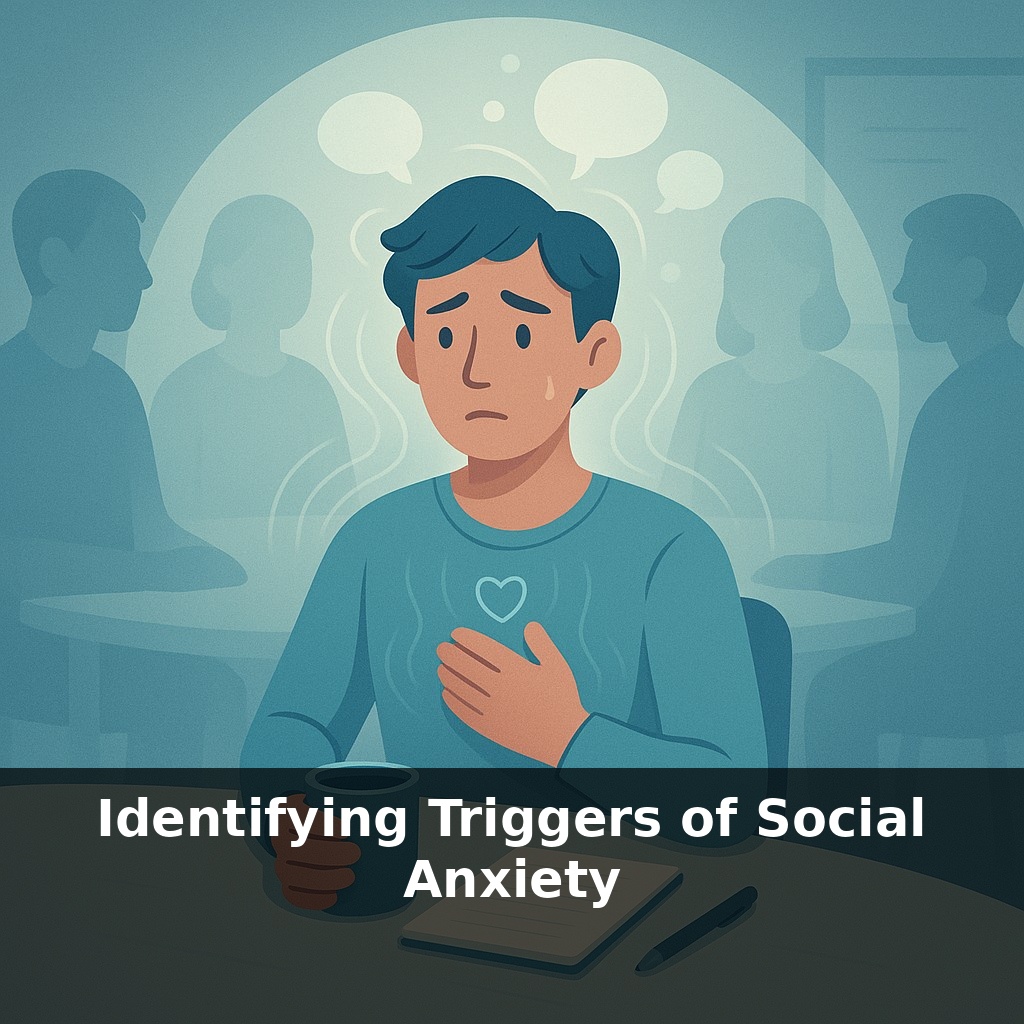
Your heart’s racing, palms sweating—but you’re just saying your name in a meeting. Here’s the twist: for many people, that tiny moment feels more threatening than real physical danger. In this episode, we’ll explore why such ordinary interactions can trigger such intense fear.
Now zoom in on the moments *before* things feel overwhelming. Maybe you’re fine chatting one-on-one, but the second someone turns toward you in a group, your mind starts scanning for escape routes. Or you’re okay in class until the teacher says, “Let’s go around and share,” and your body reacts as if a spotlight just snapped on above your head.
Those “micro‑moments” are often where triggers hide: a certain tone of voice, a notification that a meeting is now “in person,” a pause in conversation when all eyes drift your way. They can be subtle, fast, and easy to miss—especially when you’re focused on just getting through the situation. In this episode, we’ll slow things down, tease apart the chain of events, and show you how to spot the earliest signals that flip your system into high alert—so you can respond with intention instead of getting swept away.
Sometimes those tiny shifts are so quick they blur into one big “I just freaked out.” That’s why we’ll zoom out, too—not just the second your name is called, but the whole scene around it. Who’s in the room? What were you already carrying from your day? How did your body feel *five minutes* earlier? Think of it like checking a photo’s “behind the scenes”: the lighting, angle, and timing all change how it looks. In the same way, certain people, places, or topics quietly raise the baseline tension, so when a micro‑moment hits, your system is already closer to its tipping point.
Think of this part as detective work, not self-criticism. Instead of asking, “What’s wrong with me?”, we’re asking, “What *exactly* is setting this off, and when?” The more precise you get, the more options you have.
Start by separating three layers:
1. **The situation** 2. **The meaning your brain gives it** 3. **What your body does next**
Many people only notice the third layer (“My heart exploded when I had to speak”), and skip the rest. But two people can be in the same situation and have totally different meanings fire off in their mind.
Take three common social setups:
- **Performance situations** – giving an update in a meeting, being the one talking in a group chat, posting something where others can “like” or ignore it. Often-hidden meanings: “If I’m not impressive, I’m irrelevant,” “Silence means they secretly think I’m stupid.”
- **Being observed** – eating while others talk, walking into a classroom after it’s started, working while someone stands behind you. Often-hidden meanings: “They’re scanning for flaws,” “Any awkward move will expose me.”
- **Unstructured interactions** – small talk at a party, group lunches, breakout rooms. Often-hidden meanings: “It’s my job to keep this smooth,” “If there’s a lull, it’s my fault.”
Notice how the situation alone isn’t the problem; it’s the *prediction* about what it reveals about you. Those predictions usually show up as quick, almost subtitle-like thoughts. You might barely catch them: “Don’t mess this up,” “Say something smart,” “They’re bored,” “You’re weird.” Each one acts like a volume knob for your body’s reaction.
Next, look for **patterns across contexts**, not just single moments:
- Is it worse with peers, authority figures, or people you’re attracted to? - Is it stronger when you feel judged on *appearance*, *competence*, or *personality*? - Does it spike more in unfamiliar places, or oddly, in familiar ones where you feel you “should” be comfortable?
You can also track specific **sensations** that reliably show up early for you: a sudden jolt in your stomach, heat in your face, a freeze in your shoulders, a mental urge to rehearse what you’ll say. These aren’t failures; they’re early warning lights.
The goal isn’t to avoid every situation that stirs these up. It’s to build a clear “map” of which combinations of situation + meaning + body reaction tend to flare, so you can plan experiments and coping strategies with precision instead of guessing.
Notice how triggers can stack, like tabs in a browser. One tab is the situation (“team lunch”), another is the specific element (“when someone asks about my weekend”), another is an inner rule (“I must sound interesting”), and another is a body cue (“my voice sounds shaky”). On their own, each tab is manageable; together, they overload your system.
To get specific, think in terms of “micro‑scenes” instead of general labels:
- Not just “meetings,” but: when it’s your turn after a very confident coworker. - Not just “texting,” but: seeing “typing…” and feeling pressure to respond perfectly. - Not just “parties,” but: standing alone while others are already in clusters.
One sports-style way to look at this: elite athletes review game footage to spot exactly when momentum shifted, not just “we lost.” You’re doing the same with your social “plays.” You’re not judging the performance; you’re marking: *right there—that comment, that glance, that silence—that’s when my system flipped.*
As your personal “footage” gets clearer, interventions can become small and targeted, rather than vague and exhausting.
Noticing these patterns now also prepares you for what’s coming. As tools evolve, you might soon pair your internal “map” with external feedback—like a smart watch showing subtle shifts in your pulse during specific parts of a meeting, or VR scenes that let you rehearse the exact With that foundation, consider the Building on this understanding, notice the moments that usually throw you. Instead of bracing for every social plan, you’ll be able to fine‑tune them, the way a sound engineer adjusts individual dials instead of blasting the whole system.
As you keep mapping this, notice how some situations shift from “red zone” to “yellow,” like a dimmer switch instead of an on/off button. That change is data: your brain updating its predictions. Over time, your notes become less like a symptom log and more like a user manual—specific settings you can tweak instead of a mystery you just endure.
To go deeper, here are 3 next steps: (1) Download a CBT-based social anxiety workbook like “The Shyness & Social Anxiety Workbook” by Antony & Swinson and complete the specific “Anxiety Triggers Log” pages for three situations you know spike your anxiety (e.g., staff meetings, group texts, or meeting new people). (2) Install the free app “MindShift CBT” and use the “Social Anxiety” section to run through one real scenario you’re dreading this week, using its Thought Journal and Coping Cards tools to challenge the exact beliefs you heard discussed in the episode (like “Everyone is judging me”). (3) Watch Dr. Ellen Hendriksen’s TEDx talk “How to Be Yourself” on YouTube and, while you listen, pause twice to bookmark one concrete strategy she mentions (like “act like a regular” or “focus on the goal, not yourself”) and then apply that strategy in your very next social interaction today, even if it’s just a quick chat with a barista or coworker.
Unlock all episodes
Full access to 5 episodes and everything on OwlUp.
Subscribe — $1.99/monthLess than a coffee ☕ · Cancel anytime