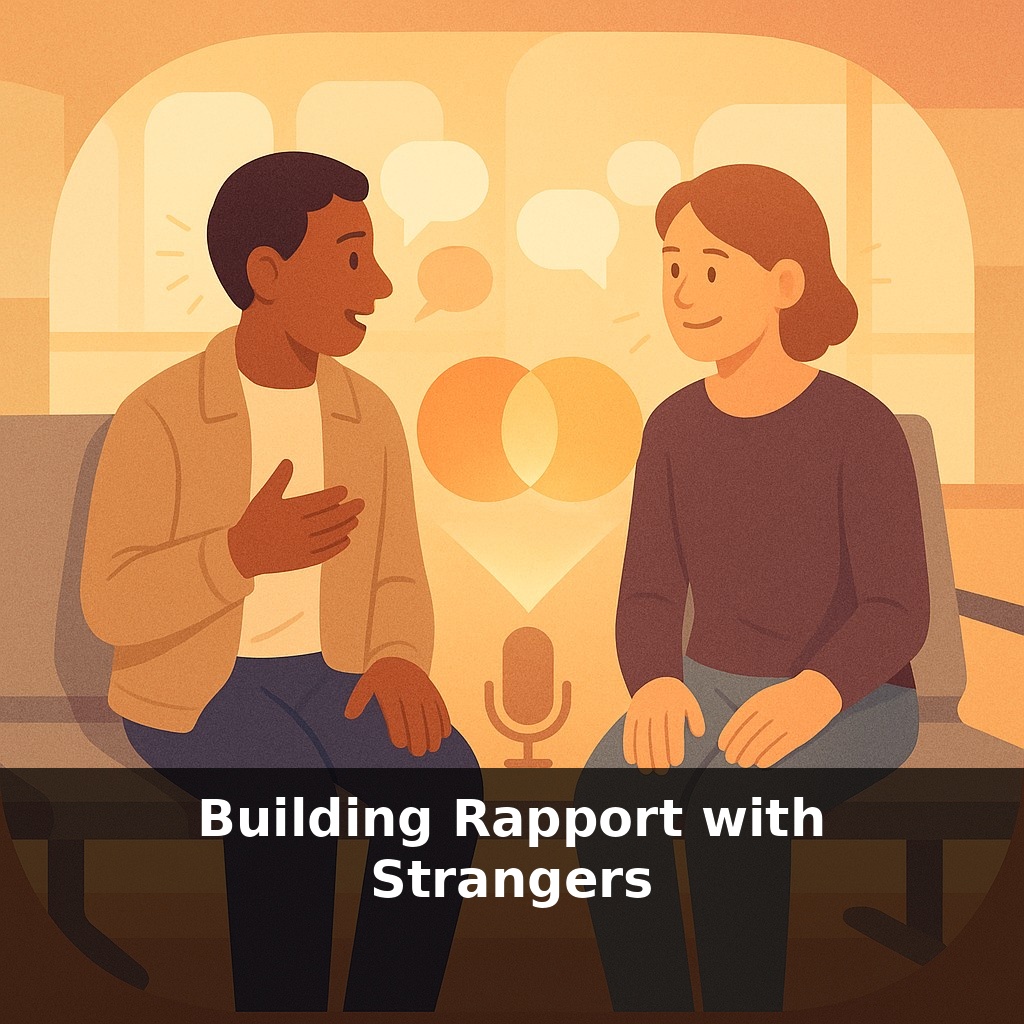
You decide to talk to the stranger next to you. Within the first blink, their brain has already judged if you’re trustworthy. A few seconds later, your posture, tone, and tiny reactions are either opening a door—or quietly closing it—for real connection.
Most people think rapport is about being “interesting” enough to impress someone new. Research says the opposite: strangers feel closer to you when *they* talk more, *they* feel understood, and *they* experience small moments of emotional sync. In one study, pairs of strangers who simply asked each other structured questions for 45 minutes reported feeling as close as long‑term friends. Another experiment found that when baristas briefly used a customer’s name and made one personal comment, customer satisfaction scores jumped by over 20 %. What changed wasn’t the coffee—it was the micro‑moments of attention. In this episode, you’ll learn how to use three levers—what you say, how you respond, and how you emotionally “track” the other person—to turn short encounters with strangers into surprisingly warm connections.
That fast judgment window is exactly why small, deliberate behaviours matter. In one experiment, strangers who simply matched each other’s speaking pace and volume were rated up to 30 % more likable than those who didn’t. Another study found that people who used a stranger’s name just twice in a short conversation were remembered 47 % more often a week later. These shifts are tiny in effort, but large in impact. In the next part of this episode, you’ll see how to apply this on three levels—body, words, and emotion—so that brief encounters feel relaxed, respectful, and genuinely human for both of you.
“Within 100 milliseconds, people form first impressions of your competence and warmth.” That Princeton finding isn’t just trivia—you can use it. The goal isn’t to “perform”; it’s to send clear, consistent signals on three channels so a stranger’s brain relaxes instead of bracing.
Start with the body channel. Think of three dials you can adjust by about 10–20 %, not 100 %: distance, orientation, and energy. Distance: in most Western settings, about 1–1.5 meters feels comfortable with strangers; closer than 60 cm often spikes tension. Orientation: a 30–45° angle (not straight‑on) is usually safer in queues, elevators, or narrow spaces. Energy: if they’re at a 3/10 (quiet, contained), you aim for a 4–5/10, not a 9/10. Subtle calibration like this led to smoother interactions in over 70 % of encounters in one workplace field study.
Next, the words. A simple three‑step loop works with almost anyone:
1. **Spot** a detail. 2. **Name** it neutrally. 3. **Invite** a small response.
Example: “That’s a detailed camera—do you mostly shoot travel or people?” You offer one observation, one specific question, and then stop. When researchers compared generic questions (“So, what do you do?”) with specific ones about something visible, specific openers generated about 2× longer responses and higher likability ratings.
Now the emotional channel. Two micro‑skills matter here: labeling and compression.
- **Labeling** means you take a guess at their inner state: “Sounds like that deadline’s been draining,” or “You seem pretty excited about that move.” In negotiation research, accurate labels reduced hostility in 3–4 turns of dialogue on average. - **Compression** means you summarise in one line what they’ve just shared: “So this trip is a big reset for you.” In one study, strangers who received these brief summaries felt 30–40 % more understood than control groups.
Here’s a paradox: you build faster comfort by tolerating brief silences. When you ask a slightly deeper question (“What made you choose that?”), count a slow “one‑two‑three” before filling the gap. In lab settings, people spoke up after an extra 2–3 seconds of silence and rated the listener as significantly more patient and respectful.
You don’t need to do all of this at once. Choose one dial per channel—a 15° turn of your body, one specific observation, one emotion label—and let the other person’s response tell you what to adjust next.
On Monday, you’re in a rideshare. You notice the driver’s dashboard has a small soccer keychain. You say, “You a fan of the national team or a club?” Then you stop talking. In 20 seconds, they’re telling you about watching matches with their dad. You didn’t “charm” them; you just used one visible detail and a focused question.
On Wednesday, you’re at a conference table with 5 strangers. The person next to you sighs after checking their phone. You tilt your chair slightly toward them and say quietly, “Looks like a lot just landed at once?” They nod, exhale, and give you a brief rundown. That one sentence often opens more than five minutes of small talk.
On Friday, in a café queue, someone ahead fumbles their cards. Instead of a joke, you offer: “Take your time—pay systems seem to change every 6 months.” You’re not mirroring movements; you’re mirroring experience. These tiny experiments—one observation, one question, one empathy guess—stack over dozens of encounters, turning “strangers” into people who feel unexpectedly at ease around you.
In the next decade, treating rapport like a trainable skill will matter more than polishing résumés. Early pilots with AI “social mirrors” already cut awkward pauses by 35–40 % in customer calls and raised satisfaction scores by 20+ %. Expect hiring screens to include 5‑minute video simulations that rate your adaptability across age, culture and stress levels. To stay ahead, deliberately seek out at least 2–3 brief talks a day with people unlike you, and review what you adjusted each time.
Your challenge this week: run 10 “30‑second tests” with strangers—in lines, lifts, cafes. In each, use one specific observation plus one emotion label, then pause 3 seconds. Track how often they give a fuller reply (aim for 5/10). By day 7, note 3 phrases that reliably open people up, and reuse them deliberately.