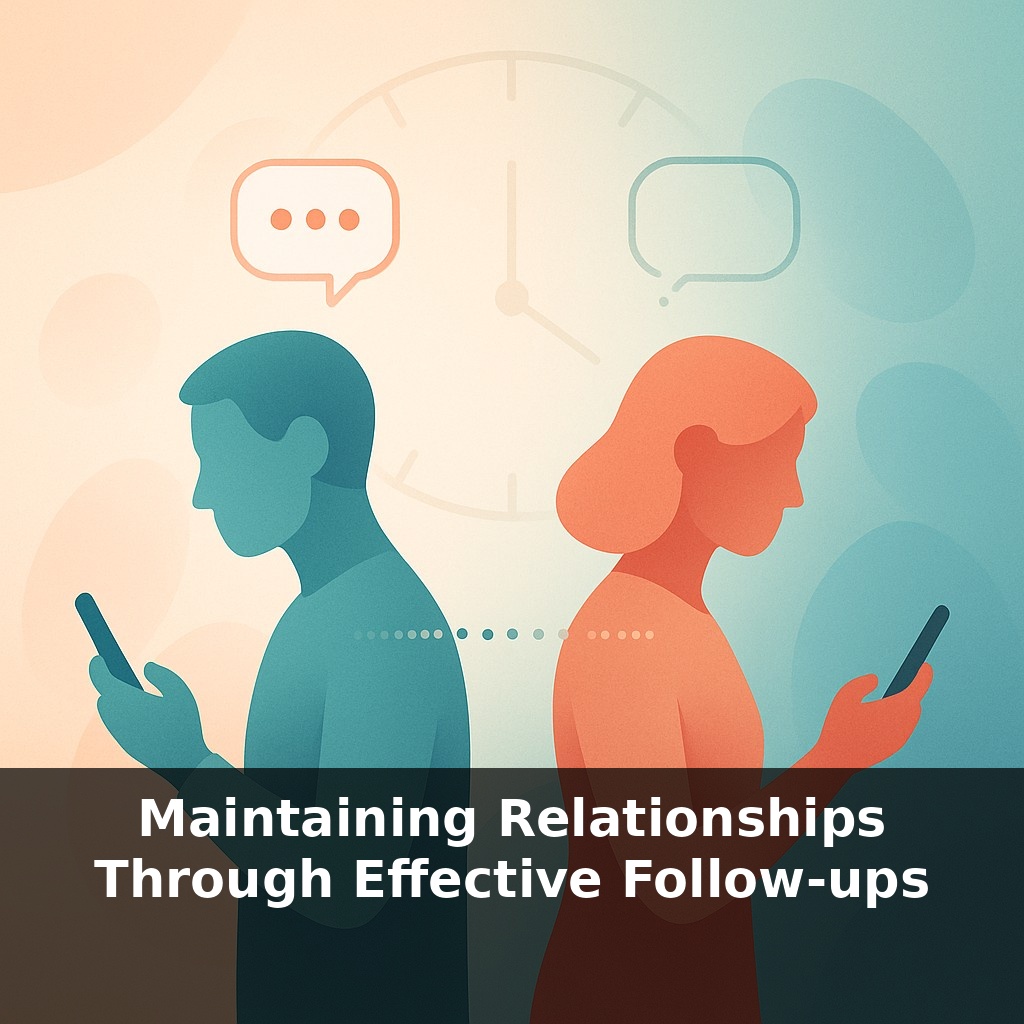
“Most lost opportunities don’t end with a ‘no’—they fade into silence.”
A week after a great conversation, one person thinks, “They must be too busy.” The other quietly assumes, “Guess they weren’t that interested.”
The relationship doesn’t break. It just quietly… stops.
“Eighty percent of non‑routine sales need at least five follow‑ups, yet nearly half of professionals quit after the first message.” That gap isn’t just about revenue—it’s about how quickly potential connections slip back into the anonymous crowd.
Follow-ups are the small, visible signals that say, “I still remember you,” long after the first conversation ends. Neuroscience calls this memory reinforcement; your name doesn’t just vanish from the other person’s mental shelf. Social psychology adds another layer: when you thoughtfully circle back, you invite reciprocity rather than pressure.
But here’s the twist: more touches don’t automatically mean better relationships. Timing, relevance, and tone decide whether a follow-up feels like genuine care or digital noise. Tools can remind you *when* to reach out; only intention can determine *how*.
Think of what happens in your own inbox. You reply to the friend who sends a quick article that made them think of you—but ignore the generic “just circling back” thread that could have gone to anyone. That tiny difference is the real leverage: not *whether* you follow up, but *what* you bring back with you. A relevant link, a short update, a specific question—these act like proof that you were actually listening. Digital tools can track dates and reminders, but only you can remember the detail about their new role, their marathon training, or the project they were secretly excited about.
A lot of hesitation around following up comes from a simple fear: “Am I bothering them?” Our brains are wired to overestimate how annoyed others will be and underestimate how appreciated we’ll be when we show sustained interest. In experiments where people were asked to reconnect with “dormant ties,” participants expected awkwardness; instead, most contacts reported feeling pleasantly surprised and more supported. That gap between expectation and reality is where many relationships quietly stall.
So how do you move from “I should reach out” to actually doing it in a way that feels natural?
First, narrow your focus. Not everyone needs the same type of follow-up. A new collaborator might benefit from a clear next step within 24–48 hours (“Here’s the doc we discussed; does this timeline still work for you?”). A loose acquaintance who shared something personal—like caring for a parent or changing careers—might appreciate a check‑in a few weeks later that references that specific detail. You’re not “keeping in touch” in the abstract; you’re continuing a particular thread of the relationship.
Second, vary your channels. An email after a meeting may be ideal, but a quick voice note, LinkedIn message, or even a short handwritten card can stand out in an environment saturated with text. The key is congruence: a casual coffee chat can be followed with a light, conversational message; a formal pitch deserves a more structured summary and question.
Third, design your own “minimum follow-up system.” Think in terms of small, repeatable behaviours instead of heroic bursts of outreach. For example: - Tag people in your notes app with themes (“design,” “wellness,” “early-stage founder”) so that when you see something relevant, you know who might care. - Set gentle reminders tied to natural milestones: product launches, conferences, seasonal breaks, or anniversaries of when you met. - Use templates as scaffolding, not scripts—leave deliberate blanks you must customize (“reference something they said,” “acknowledge their constraint,” “offer one concrete win for them”).
Done this way, follow-ups become less like chasing people and more like good version control in software: you’re keeping the relationship’s “file” updated, so it’s easy for both of you to pick up exactly where you left off.
Not all follow-ups need to be “messages with an agenda.” Sometimes the lightest touches travel the farthest. A designer keeps a simple note in her phone labeled “People who’d enjoy this,” and when she stumbles on an obscure font library or a niche podcast, she forwards it to one or two names with a one‑line note: “This felt like your kind of rabbit hole.” Over time, those tiny pings turn casual contacts into collaborators.
Or take a manager who treats check‑ins like a running scoreboard. After each 1:1, he jots down one “next human thing” next to the action items—kid’s exam next month, first improv show, visa interview date. His calendar nudges him a day after each event, and he sends a short, specific line asking how it went. Team members start mirroring the habit with each other, creating a culture where circling back is normal, not needy.
On a larger scale, some founders schedule a monthly “weak ties hour,” scanning conference badges, old email threads, or attendee lists to re‑surface one or two people whose names still spark curiosity.
As AI quietly drafts more of your outreach, your role shifts from writer to editor. The real advantage won’t be who sends the most messages, but who curates like a skilled DJ—selecting the right “tracks” for each person and knowing when to leave silence. Teams that treat consent and cadence as design constraints will likely gain trust, while blast-style automation may start to feel like spam pollution in people’s mental inboxes, pushing them to filter more aggressively.
Treat your outreach like tuning a playlist: you’re not blasting noise, you’re queuing the right track for the right moment. As you experiment, notice who lights up, who stays neutral, and who drifts. That response pattern is quiet feedback. Over time, it teaches you their preferred rhythm—and protects your own energy, too.
Here’s your challenge this week: Pick three people from your “warm circle” (recent clients, collaborators, or colleagues you actually like) and send each of them a tailored follow-up within the next 24 hours—one value-add link or resource, one genuine check-in, and one specific invitation (coffee, Zoom, or quick call). Use the subject line pattern from the episode (“Quick follow-up on [X]” or “Thought of you when I saw this”) and reference your last interaction so it doesn’t feel random. Before you log off each day this week, spend 10 minutes updating a simple follow-up tracker (name, date, context, next touchpoint) and schedule the next touch in your calendar so no relationship goes “cold by accident.”