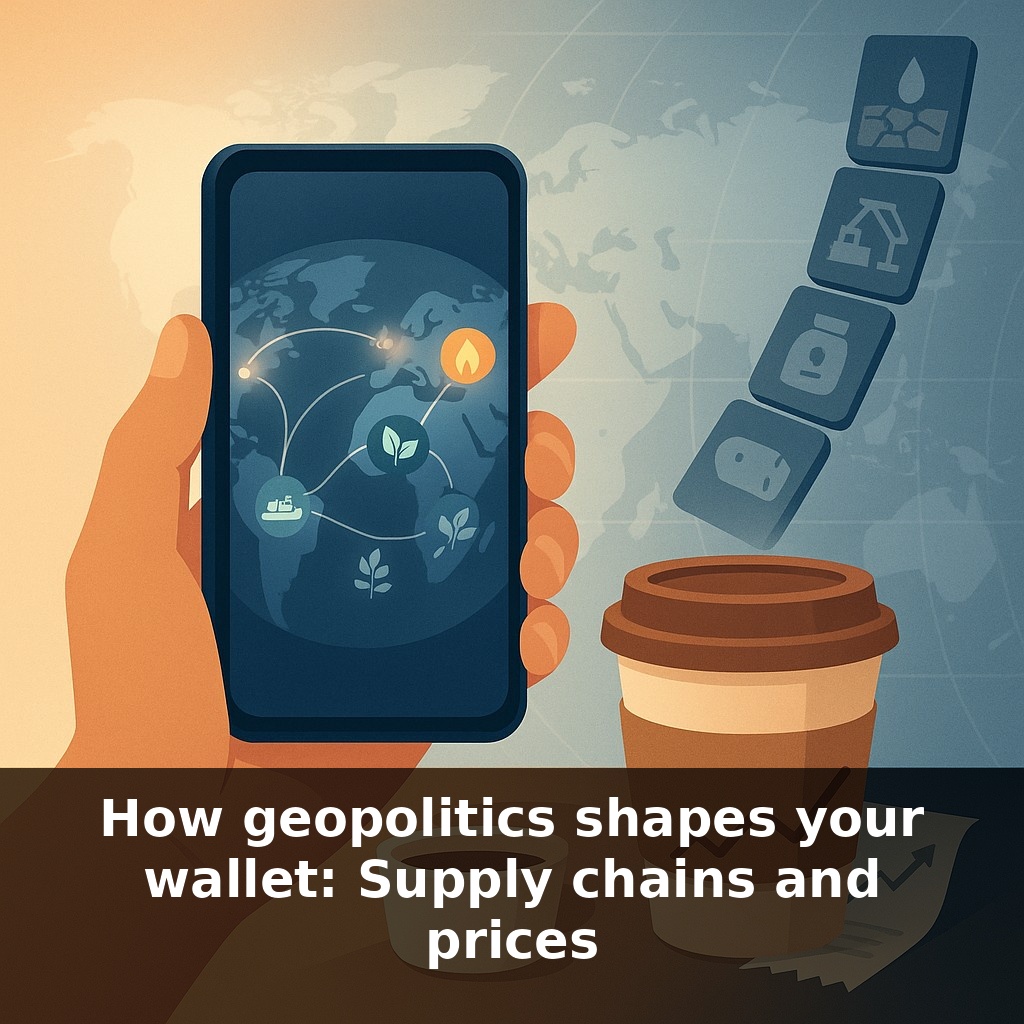
You’re holding your phone, sipping coffee, scrolling news—and three continents quietly decide how much that moment costs you. A ship stuck in a canal, a sanction on gas, a trade spat over chips. None of that feels local, yet it’s already sitting on your receipt.
That coffee price jump on the chalkboard? It might trace back to a drought in Brazil, a fertilizer export ban, and a port strike—stacked like dominoes you never saw fall. Geopolitics shows up in your life not as headlines, but as quiet numbers: the “service fee” on a delivery app, the new “energy surcharge” on your bill, the missing discount on a gadget that used to be on sale every Black Friday.
What’s changed is how tightly stitched everything is. A phone assembled in China may depend on metals from Africa, chips from Taiwan, design from California, and shipping rules set in Brussels. When a government rewrites a tariff schedule or blocks a shipping lane, it’s like pulling one instrument out of an orchestra mid-song: the melody continues, but notes go off-key—and you pay for the dissonance at checkout.
Zoom in further and the map looks even stranger. That loaf of bread isn’t just flour and yeast; it’s tied to Black Sea export corridors, fertilizer quotas, and insurance rules written in London boardrooms. A budget airline ticket bakes in jet fuel hedging, security levies after distant conflicts, and airport fees shaped by diplomatic spats. Your phone upgrade cycle now depends on who’s allowed to sell advanced chips to whom, and which ports stay off‑limits. These aren’t abstract shifts; they’re quiet edits to the menu of choices you thought were purely “market driven.”
Start with the routes. Around 80% of what the world trades by volume travels on ships, not planes or trucks. That makes narrow points on the map—canals, straits, chokepoints—feel a lot like dimmer switches for your cost of living. When a major passage becomes risky or blocked, ships detour thousands of extra kilometres. That means more fuel, more crew time, higher insurance, and fewer journeys per month. Those extra costs don’t stay at sea; they climb the ladder from freight companies to importers to retailers, and finally to your receipt.
Then there’s concentration: who controls what. Before the full‑scale invasion, Russia and Ukraine together moved nearly a third of the world’s exported wheat. When conflict hit ports and fields there, it didn’t just affect people in the region. Buyers in North Africa, the Middle East, and parts of Asia suddenly found themselves competing for alternative grain. The same happened with fertilizers and sunflower oil. Even if you never buy those directly, they’re inputs into things you do buy—bread, snacks, restaurant meals—so the shock sneaks into your budget sideways.
Energy is another pressure point. Europe learned in 2022 how much depends on a few pipelines and political decisions about them. When Russian gas deliveries were cut, the scramble for replacement cargoes drove benchmark prices up several‑fold. Power producers passed the hit to utilities, utilities to households and firms. A few hundred euros more on the average electricity bill isn’t just a line on a statement; it also raises the cost of running ovens, servers, warehouses, and data centres, so prices on unrelated products quietly ratchet upward.
High‑tech goods add a different twist: complexity. An iPhone’s roughly 43‑country footprint means export controls on advanced chips, sanctions on specific firms, or new data‑security rules in one jurisdiction can force redesigns, factory shifts, or backup suppliers. Those moves are expensive and slow. Companies often respond with “shrinkflation” (same price, slightly worse deal) or delayed discounts rather than obvious hikes.
Your challenge this week: pick three everyday items you buy regularly—say, bread, a streaming subscription, and a household product like detergent. For each one, spend 10 minutes tracing one geopolitical factor that could touch its price. Use news searches like “[item] export ban”, “[item] shipping rates”, or “[item] sanctions supplier”. Don’t try to map everything; look for a single clear link, like a key producing region, a raw material, or a transportation route.
By the end of the week you’ll likely see that your “local” budget is quietly negotiated in foreign capitals, shipping conferences, and diplomatic talks you’ll never attend. The aim isn’t to become an expert, but to train a new reflex: when a headline names a port, pipeline, or export restriction, you can immediately guess one or two budget lines it might touch.
Next, we’ll flip the lens: not just how these shocks hit you, but how companies and governments try to defend against them—and why their protective moves can sometimes raise your costs anyway.
Think about supermarket eggs. You see a shell, a label, a price. Behind that box might be feed imports subject to export quotas, veterinary rules rewritten after an outbreak abroad, and shipping insurance that jumped because a distant sea lane got risky. None of that is printed on the carton, but it’s baked into the final number.
Or take a streaming device you plug into your TV. Its metal casing may rely on bauxite from one region, smelted using electricity whose cost depends on gas contracts, then shaped in a factory adjusting schedules around labour rules and pandemic policies. If any country on that chain tightens regulations or faces unrest, your “one‑click” replacement gets pricier or simply disappears from stock.
Even fast fashion carries these hidden routes. A shirt tag might say “Made in Country X,” but the dye, buttons, and fabric can each answer to different export permits and safety standards. A small rule change on chemicals or port security somewhere else can quietly decide which colours and sizes end up on your local rack—and what they cost.
Tomorrow’s “normal price” may quietly bake in a premium for resilience. Friend‑shoring and dual sourcing act like musicians hiring backup instruments: fewer spectacular failures, but every ticket costs a bit more. As climate politics reshapes access to lithium, cobalt and rare earths, the most geopolitically exposed parts of your budget may be EVs, batteries and data‑heavy gadgets. The puzzle for households and policymakers alike: how much security are we willing to buy, and where?
The next step is noticing how often “policy” hides inside everyday labels. A discount vanishes after a new rule on packaging; a favourite snack shrinks after a subsidy ends; a budget airline fare jumps when overflight rights change. Follow those tiny clues like breadcrumbs and you’ll start seeing receipts as maps—not just of where things came from, but of who decided the rules.
Before next week, ask yourself: 1) “Looking at 3–5 everyday items I buy that depend on global supply chains (like smartphones, medicine, or coffee), which ones would hurt my budget most if a geopolitical shock doubled their price, and what specific cheaper substitutes or backup options could I switch to right now?” 2) “If tensions with a major supplier country (like China for electronics or Russia for energy) suddenly disrupted access, which bill or expense in my life would spike first, and what concrete step can I take today—such as changing a provider, adjusting my commute, or shifting how I heat/cool my home—to soften that blow?” 3) “When I look at my savings and investments, how exposed am I to just one region or industry that’s geopolitically fragile (e.g., only US tech or only European energy), and what is one realistic move I could make this week—like reallocating part of a fund or adding a different region/sector—to spread that risk?”