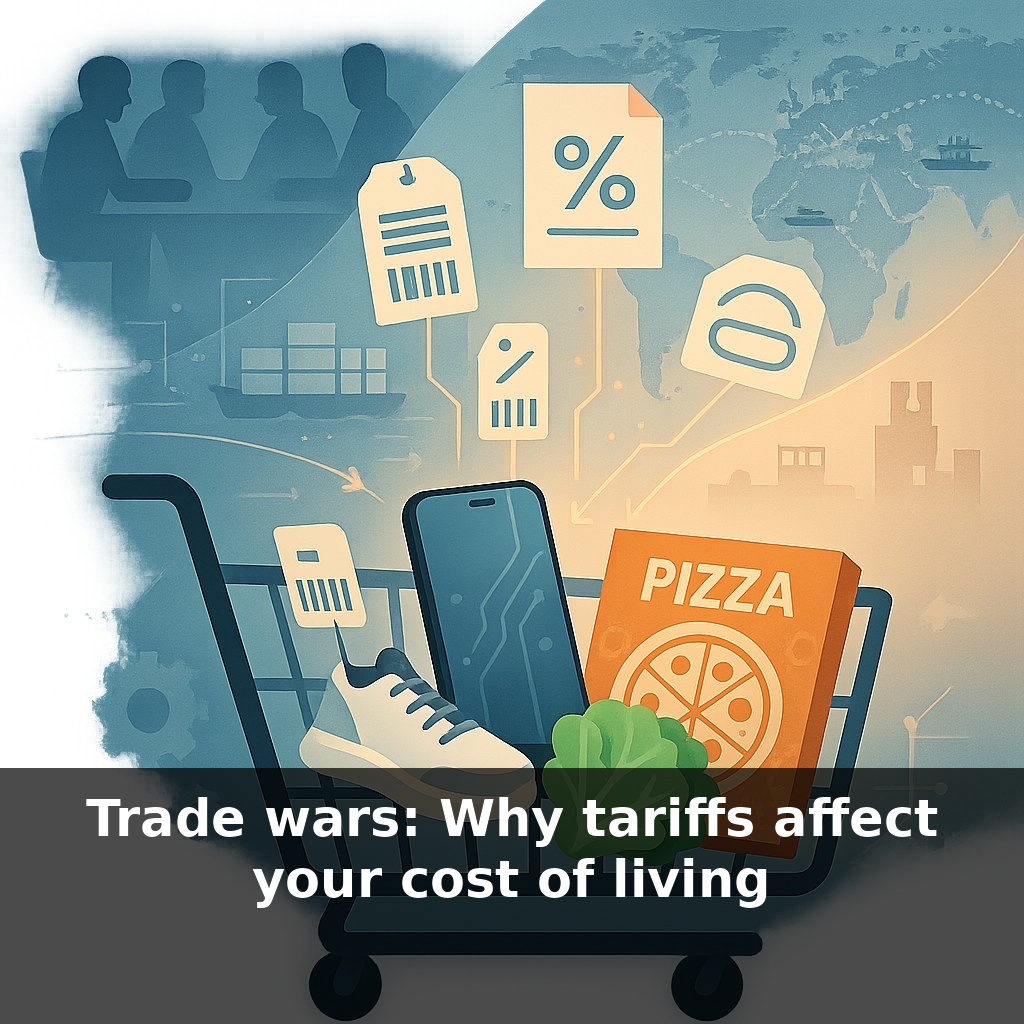
Your grocery bill is being shaped by meetings you’ll never see. A last‑minute tariff in Washington or Beijing can quietly add a few dollars to your phone, your sneakers, even your frozen pizza—long before you notice. Today, we’ll pull back that curtain on your cost of living.
You don’t see “tariff” printed on a price tag, but it’s buried in the story of how that product got to you. Start with the parts: the copper in your phone, the steel in your fridge, the fertilizer on the lettuce you buy. Many of those inputs cross borders multiple times before they reach you, picking up extra costs each step of the way when countries start taxing each other’s goods. A chip might be designed in California, produced in Taiwan, assembled in Mexico, and finished in Texas—each border crossing is a chance for a new trade barrier to bite. Even if the last company in the chain is local, it’s building on a global scaffolding of parts and materials. When that scaffolding gets shaken by a trade dispute, firms must either swallow the hit, cut corners, or raise prices. Often, they do a mix of all three—and the results quietly show up in your wallet.
When countries escalate tariffs, they’re not only nudging prices—they’re rewriting business plans. A sneaker brand might quietly swap a trusted Vietnamese supplier for a costlier one in Brazil. An electronics firm may delay launching a new tablet because a key chip just became 15% more expensive overnight. Some companies shrink product sizes rather than raise sticker prices, so your cereal box looks the same but holds less. Others rush to stockpile imports before new tariffs hit, briefly flooding warehouses, then passing storage costs on later. Step by step, these choices accumulate into a persistent squeeze on household budgets.
Here’s where the numbers start to tell the story.
When the average U.S. tariff rate doubled from 1.5% in 2017 to 3.1% by 2020, it didn’t sound dramatic. Two percentage points feels tiny. But applied across hundreds of billions of dollars in imports, that shift made this the most protectionist period since the 1940s—and the extra cost had to land somewhere. Studies of the 2018–19 U.S.–China trade rounds show that “somewhere” was mostly U.S. consumers and firms, who ended up paying around $51 billion more per year.
Notice who isn’t on that hook: foreign exporters. A common assumption is that “China pays the tariffs” or “Europe pays the tariffs.” In practice, the tax is charged at the U.S. border to U.S. importers. They may squeeze foreign suppliers a bit, but most of the time they either raise prices, accept lower profits, or both. Consumers face higher price tags; some businesses quietly earn less per unit and cut back on hiring, investment, or wages.
The washing machine episode makes this concrete. When the U.S. slapped tariffs on imported washers in 2018, average retail prices jumped about 12%, roughly $86 more per machine. Dryers—untaxed—went up too, because appliance makers realized shoppers saw them as a bundle and the market would bear a higher combined price. A policy aimed at one product reshaped a whole category.
Retaliation deepens the hit. China’s 25% tariff on U.S. soybeans shrank American exports to China by roughly 75% in 2018. Farmers needed about $28 billion in federal aid to stay afloat. That’s tax revenue or borrowing redirected to patch a wound created by the trade fight itself, rather than to schools, roads, or healthcare. Meanwhile, shipping routes, storage investments, and processing plants had to be rethought as soybean flows rerouted to other buyers.
Step back to the global level and the pattern sharpens. Since 2018, the WTO has logged more than 2,800 new trade‑restrictive measures, versus about 1,500 moves in the opposite direction. Each new restriction is like one extra tollbooth on a major highway: one or two barely register; thousands slow everything down. Over time, that drag shows up not only as higher prices, but also as fewer choices, slower innovation, and a harder climb for any household trying to keep up.
Think about a mid‑range laptop assembled in Malaysia. The screen glass comes from South Korea, the battery cells from Japan, the memory chips from Taiwan, and the final product heads to the U.S. One new fee on just one of those stages can push the model out of a student’s price range, nudging them toward an older, slower machine. Now scale that choice across millions of students and offices: fewer people upgrade, software makers adapt more slowly, and demand for support on older systems spikes.
Or take a restaurant that uses imported olive oil, canned tomatoes, and espresso. A small jump in the cost of each input might be too awkward to show on the menu line by line, so the owner drops the complimentary bread basket, trims portion sizes, and quietly raises the price of the lunch special. Diners feel “eating out is just more expensive now,” without tracing it back to customs paperwork.
Your challenge this week: pick three everyday items you buy—one food, one gadget, one household product—and google where their main components originate. If you see news of new import rules touching any of those countries, note how long it takes before you notice even a subtle change in price, quality, or availability. This is your personal early‑warning radar for policy shocks.
Now flip the experiment: the next time a headline announces “new tariffs” or “trade restrictions,” skip the political spin and ask one concrete question: “Which specific product categories are affected, and are they in anything I regularly buy or use at work?” Search for a quick list of HS (tariff) codes or example products in the announcement. Then watch your receipts on those categories over the next month. Even if you don’t see an immediate jump, look for indirect shifts: discounts disappearing, shipping times stretching, or brands rotating off the shelf.
Your rent, your Netflix bill, and your next phone upgrade are increasingly tied to choices made in trade ministries, not just in boardrooms. As firms reshuffle production to “safer” countries, they often trade cheap efficiency for political reliability. Think of it as buying travel insurance for the world economy: it cushions shocks but adds a surcharge to almost everything. Over time, that surcharge shapes which jobs appear in your city—and which quietly disappear.
Trade fights can also tilt power inside your country. Industries cushioned by barriers may lobby to keep them, even after tensions ease—like scaffolding that never comes down, adding permanent weight to the structure. Over years, that can shift which skills are rewarded, which cities grow, and even how secure your paycheck feels in the next downturn.
Before next week, ask yourself: 1) “Looking at my last month of purchases, which everyday items (like groceries, electronics, or clothing brands I actually buy) are most exposed to tariffs on imports from countries like China or Europe, and how would my budget change if those prices rose another 10–20%?” 2) “If I had to consciously ‘vote with my wallet,’ which products could I realistically switch from imported to local or tariff-free alternatives this week, and what trade-offs in price or quality would I actually be willing to accept?” 3) “When I hear politicians talk about ‘protecting domestic jobs’ with tariffs, how would my opinion shift if I translated that promise into a concrete number on my monthly expenses and imagined who, specifically, is paying that extra cost—me, a business I buy from, or workers in another country?”